
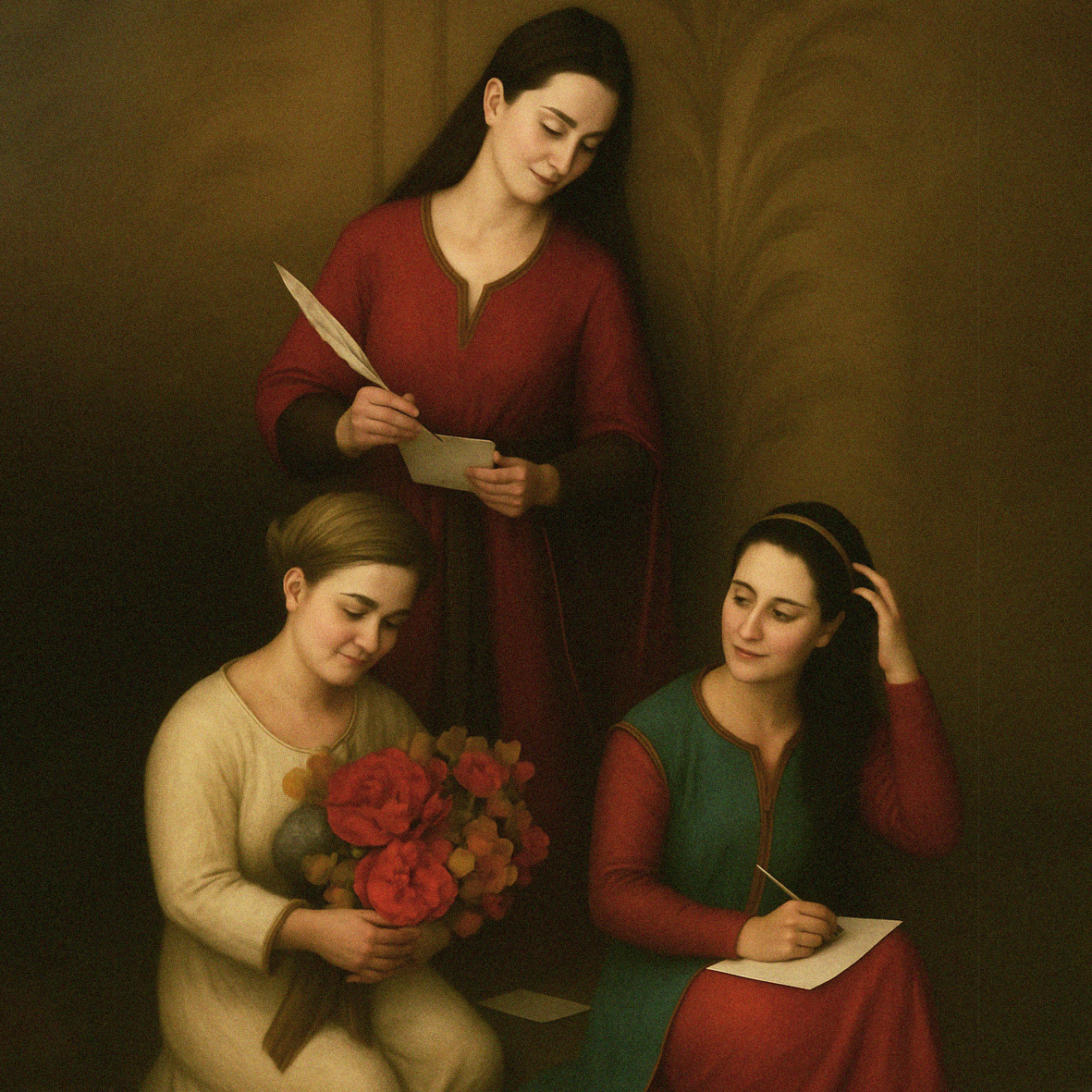
Women Poets of Kerman: Part One – From the 7th/13th to the 13th/19th Century AH/CE



Prologue
Traveling from Tehran to Kerman, as one approaches the province, the desert landscape becomes increasingly expansive, the villages more scattered, the sun more intense, and water—life’s essential resource—ever scarcer. The resilient inhabitants of this region have, through immense labor and hardship, extracted water from the depths of the earth by constructing kārīz and qanāt systems, interconnected underground channels that often stretch for several kilometers. Through these efforts, they have managed to cultivate agricultural fields in the heart of the desert, planting trees whose shade has long offered rest and respite to travelers. However, life in this arid region has been made more difficult by chronic drought and repeated invasions by passing tribes, who have at times deliberately or filled the qanāts, undermining the very infrastructure that sustain local communities. While Kerman has always held a prominent place among Iran’s major historical cities, a more detail discussion of its significance lies beyond the scope of this article.
Despite these hardships, there have always been individuals in this region, just as in other parts of Iran, who have cultivated a deep passion for poetry. Their works are recorded in regional tazkirahs (biographical anthologies or memoirs), and at times in general tazkirahs of Iranian poets. Given the cultural and historical context of Iran, it is not surprising that the majority of poets documented in such anthologies were men. Therefore, it becomes even more essential to recover ad preserve the poetic contributions of women such as Turkān Khātūn (also known as Lālah Khātūn), Bībī Hayātī, and Nahānī Kirmānī, the central figures of this article. This study aims to introduce these poets as part of the Iranian Women Poets Project of the Encyclopedia Iranica, thereby contributing to broader historical and cultural inquiries in the field of Iranian literary studies. Additionally, the article provides an analysis of their poetry with attention to language, structure, theme, and message, as well as intertextual elements, their influence from both contemporaneous and earlier poets, their impact on subsequent literary traditions, and the aesthetic dimensions of their work.
Part One
Lālah Khātūn (Pādshāh Khātūn)
Lālah Khātūn is perhaps the most compelling and earliest recorded figure of the AH 7th/13th century in Kerman, and possibly in Iran. In Tazkirah-ʾi shāʿirān-i Kirmān (Biographical anthology of the poets of Kerman), she is described as belonging to a royal lineage, a woman of power and grandeur who ruled Kerman for several years. She treated nobility and refined individuals with respect and governed her subjects with dignity. Her words reflect the excellence of her generosity and the perfection of her chastity, and her poems reveal her agreeable traits. Her Dīvān (Book of poems) contains 5000 couplets (sg. bayt). In his Nuql-i majlis (The confectionery of gathering), Shāhʹzādah Mahmūd Mīrzāʾī writes:
I do not know whether Lālah Khātūn is her pen name, or whether she used another pen name. She ruled Kerman justly for a time and treated poets and refined individuals with respect. She is the daughter of Qutb al-Dīn Shāh Muhammad Kirmānī, the third Qarākhitāʾī ruler of Kerman. She pursued the path of governance courageously and ruled the province of Kerman for a period. Adorned with the jewel of perfection, she also respected other refined individuals. Lālah Khātūn was endowed with both inner and outer beauty in great measure. In AH 690/1291, she assassinated her ruling brother and seized the throne. In AH 694/1295, another brother attempted to assassinate her and usurp the throne. Later, by the order of Kurūy Chīn (sic; more accurately Kūrdūjīn), the wife of her murdered brother, Jalāl al-Dīn Suyūr Ghatmish.1Husayn Bihzādī Andūhʹjirdī, Tazkirah-ʾi shāʿirān-i Kirmān (Sitārigān-i Kirmān) [Biographies of the poets of Kerman: Stars of Kerman)] (Tehran: Dashtistān, 1381/2002), 671. The name appears as “Kurūy Chīn,” and on this matter, Andūhʹjirdī refers to Nāmah-ʾi Haftvād [The letter of Haftvād], vol. 1, and Simt al-ʿalī liʾl-mawqif al-aʿlā [The lofty necklace for the exalted station] by Nāsir al-Dīn Munshī Kirmānī.
One of Lālah Khātūn’s most notable poems is a mufākhirah (self-praising poem) titled “Mastūrī va nīkū′kārī” (Chastity and benevolence). The poem’s speaker is a kulahʹdār (a hat-wearing figure of high status) woman who celebrates her exceptional abilities. This poem is significant because it depicts a woman occupying a role rarely held by women of her time. Its language is generally direct and explicit but includes metaphorical elements that show her awareness of poetic conventions. Without introduction, the speaker declares herself “benevolent” (nīkū′kār). Without any introduction, she asserts her claim of being “benevolent” (nīkū′kār) and this manner of expression, while embodying a feminine style, also carries a masculine-like emphasis drawn from the traditions of a male-dominated world. The tone is firm and emphatic, calling the audience to an unquestioning and absolute acceptance:
I am that woman whose every deed is benevolence
Beneath my maqnaʿah [woman’s headscarf], I wear many kulahs [sg. hat].2Bihzādī Andūhʹjirdī, Tazkirah-ʾi shāʿirān-i Kirmān, 671.
This bold self-identification in the opening couplets signals her self-confidence, grounded in her symbols of power and political role. The poem’s structure presents fundamental binary gender oppositions and reinforces gendered linguistic registers in Iranian cultural history. However, the speaker evokes a new concept of female rulership that combines both masculine and feminine attributes. In the opening couplet, three significant terms, zan (woman), maqnaʿah (a woman’s headscarf), and kulāh (a masculine hat), appear together in a paradoxical syntagmatic arrangement. These words function metonymically under the idiomatic expression kulāhʹdārī (literally, “wearing a hat”), which connotes kingship, grandeur, and power, thereby suggesting meanings that transcend their literal sense. In this couplet, although the poet identifies as a woman who adheres to religious and social and religious norms by wearing a head covering, she regards her kulāhʹdārī, or her sovereignty, as far more significant than the usual markers of femininity. She uses the emphatic adverbs “every” (hamah) and “many” (basī) to restrict the notions of benevolence and just rule exclusively to herself. This assertive style is a prime example of the rhetorical device of hasr (exclusive attribution), whereby an adjective is confined to a specific noun within a literary linguistic structure. Furthermore, the powerful and self-glorifying phrase “I am that woman” (man ān zanam) highlights the presence of powerful women in Iranian cultural and political history. This phrase later reappears, either consciously or unconsciously, with intertextual resonance in Furūgh Farrukhʹzād’s poem at the beginning of her collection “Īmān biyāvarīm bih āghāz-i fasl-i sard” (Let us believe in the beginning of the cold season), thus underscoring the significance of Lālah Khātūn’s poetry in shaping a literary and historical discourse on female power.3See the poem “In manam, zan-i tanhā, dar āstānah-ʾi fasl-i sard” (This is me, a lonely woman, in the threshold of a cold season) by Furūgh Farrukhʹzād, in the poetry collection Īmān biyāvarīm bih āghāz-i fasl-i sard [Let us believe in the beginning of the cold season] (Tehran: Murvārīd, 1352/1973), 423.
In the next couplet, the speaker amplifies this sense of self-praise and authority by invoking the laudatory adjective “popularity among people,” apparently exclusive to her:
To whomever I give a headscarf (maqnaʿah) from my head, they say:
“This is more than a headscarf, this is a crown worth a thousand dinars.”4Bihzādī Andūhʹjirdī, Tazkirah-ʾi shāʿirān-i Kirmān, 671.
Here, the aesthetic power of the verse lies in the contrast between maqnaʿah and tāj (crown). In Iranian cultural tradition, the crown is typically a male attribute, and the headscarf is associated with women. Nevertheless, the speaker implies that the value of her headscarf surpasses the ruling men’s crowns in value. Such bold assertion of feminine authority is exceedingly rare in the classical literary tradition of Iran. Additionally, in this couplet, the headscarf serves as an instrumental synecdoche, a cultural signifier loaded with ideological and political meaning. This constitutes a striking use of majāz‑i mursal, where something instrumentally associated becomes a potent symbol.5Majāz-i mursal is a figure of speech in which a word is used not in its literal sense, but in a related and non-similar meaning, where the relationship is not based on resemblance (unlike metaphor), but on association or contiguity.
The next couplet attains aesthetic elevation through literary expression and metaphor in the phrase musāfirān-i sabā (Travelers of the Sabā breeze), even while echoing a widely held cultural cliché concerning female chastity:
Behind the curtain of chastity is my abode
Through which the travelers of the sabā breeze can scarcely pass6Bihzādī Andūhʹjirdī, Tazkirah-ʾi shāʿirān-i Kirmān, 671.
In this couplet, the speaker constructs a unique position for herself—a place behind a curtain and beyond reach. This inaccessible location symbolizes the nature of the separation and distance between the lover and beloved in the traditional Persian ghazal. Although the couplet does not explicitly mention the presence of a male lover who is unable to access the “speaker behind the curtain of chastity,” such a meaning is implied through the poem’s underlying motifs and the cultural connotations embedded within it. Additionally, the metaphorical expression musāfirān-i sabā (travelers of the Sabā breeze) and their difficult passage through the “dwelling of the speaker,” which is a well-established convention in classical Persian lyric poetry, occupies a prominent place in the poem’s aesthetic structure. This is particularly true in its use of mythological elements of animism, which reflect a mythological worldview and contribute significantly to the poem’s literary beauty.
The subsequent couplet defies convention by challenging conventional roles while proposing new meanings appropriate to each gender’s rightful place:
Not every woman becomes a lady by wearing a headscarf
Not every person is fit to be a commander by wearing a hat7Bihzādī Andūhʹjirdī, Tazkirah-ʾi shāʿirān-i Kirmān, 671.
Although both “lady‑hood” and “commandership” are attributed to women here, the broader metonymic implications of “hat” and “head” for both sexes (as established earlier) indicate that authority may belong to anyone who merits it, irrespective of gender.
Nonetheless, as the poem continues, the speaker, aware perhaps of the cultural psychology around women’s roles, places pronounced emphasis on three traditional female virtues in Iranian-Islamic culture. The three qualities are modesty and benevolence, chastity and virtue, and household management. This raises a critical question: Is this emphasis intended to shield the poet from social censure, since women writing poetry was regarded as unusual or possibly improper in that era? Could it be a protective layer behind which the speaker conceals herself? These questions bear relevance for socio-psychological literary criticism, though they lie beyond the scope of this study.
Later in the poem, Lālah Khātūn addresses all women while reaffirming her own chastity and benevolence:
The cord of a woman’s captivity is any headscarf (maqnaʿah)
That is not woven from the threads of chastity and benevolence8Bihzādī Andūhʹjirdī, Tazkirah-ʾi shāʿirān-i Kirmān, 671.
In the next couple, the speaker foregrounds her religiosity:
Although I am a sovereign over the entire world,
Before God, my vocation is that of a servant.9Bihzādī Andūhʹjirdī, Tazkirah-ʾi shāʿirān-i Kirmān, 671.
This final verse frames the poem’s central conflict, between speaker and deity, within religious norms. While the poet claims sovereign or regal status to the world, using “entire” for hyperbole, she immediately humbles herself before God, presenting herself as His nurse or servant (parastār).
Upon closer examination of Lālah Khātūn’s poetry, it can be argued that what truly establishes her as a distinguished poet is her collection of quatrains (sg. rubāʿī). These quatrains, independent of her social and political standing, reflect the essence of her inner nature and her personal, psychological states. At times, she writes of a painful, internal loneliness that discloses her profound sorrow, despite her position as queen:
I am the daughter of Ulugh Sultan
The fruit of the gardens of the Turks’ hearts
I smile at the arrival of happiness
Yet I weep for this boundless solitude10Bihzādī Andūhʹjirdī, Tazkirah-ʾi shāʿirān-i Kirmān, 672.
This is one of her most poignant poems, depicting the profound inner solitude of a woman confined within her castle. She is a powerful and esteemed monarch who has not hesitated to engage in fierce struggles to attain sovereignty, even going so far as to murder her own brother to ascend the throne. Despite being well-liked and popular among the people, she regards herself as estranged and tormented by an unending loneliness.
Another noteworthy feature of Lālah Khātūn’s quatrain is the subtle presence of love, often conveyed through the simple use of the pronoun “you,” directed toward an unseen beloved. Although the imagery used to describe this beloved often draws on conventions of classical male literary traditions, at times it surpasses these conventions by suggesting a kind of physical and tangible intimacy. This is especially striking considering the constraints traditionally imposed on women’s poetry due to cultural taboos:
This sorrow that flowed from your sweet fountain
When my hand today reached your shoulder
I see pearls glistening in your ears
Could it be that my tears have reached your ears?11Bihzādī Andūhʹjirdī, Tazkirah-ʾi shāʿirān-i Kirmān, 672.
In this quatrain, the metaphor “sweet fountain” for the lover’s lips or mouth is atypical in female voice poetry. Equating tears with pearls that fall into the beloved’s ears in the throes of intimacy creates a decidedly erotic image. A similar effect emerges in another quatrain:
The apple, passed in secret from your hand,
Becomes for me the dream of life unending.
My heart, like a pomegranate, bursts with joy
When wine is offered gently from your palm.12Mahmūd Hidāyat, Gulʹzār-i jāvīdān [Eternal garden] (Tehran: Zībā, 1353/1974), 1:242.
In this quatrain, the use of the word apple (sīb), a well-known symbol in creation myths and Iranian folklore signifying physical love, is particularly noteworthy.13In wedding ceremonies across many regions of Iran, the groom either throws or gently places a red apple in the bride’s hand, an act followed by various rituals such as dancing and singing. For the motif of apple-throwing by lovers in Iranian folktales, see Sayyid Abū al-Qāsim Anjavī Shīrāzī, Qissahʹhā-yi Īrānī [Iranian tales] (Tehran: Amīr Kabīr, 1351/1972), 3:94. The poet refers to Iranian tales and mythological traditions by invoking the popular cultural custom of “throwing an apple” toward someone as a sign of desire, or the mutual exchange of apples between the lover and the beloved to express love and loyalty. Lālah Khātūn further emphasizes that this symbolic gift is delivered in secret, likely with the help of a messenger. This act not only introduces an element of mystery but also reflects the concealed nature of romantic relationships in traditional Iranian culture. In the next quatrain, a fully tangible and erotic image is evoked by using the metaphors laʿl (ruby, signifying the beloved’s lips), ghāliyah (perfume, signifying the scent of the beloved’s hair) and mushk (musk, signifying the scent and the color of the beloved’s hair):
Who has ever seen musk stain a ruby’s hue?
Or perfume cast its shadow over musk?
O my soul, that black mole upon your lip
Is where darkness and the water of life converge.14Hidāyat, Gulʹzār-i jāvīdān, 242.
In this quatrain, in addition to the use of classical and aesthetically pleasing metaphors, the poet employs an innovative and effective compound simile by likening the “black mole on the beloved’s lip” to the conjunction of two contrasting elements: darkness and the water of life. This imaginative synthesis can be regarded as one of the poet’s most successful uses of mythology within a poetic framework.15The allusion to “the water of life” and “darkness” refers to the mythological motif of the Water of Life found in various traditions. Known in Islamic and Persian lore as ʿayn al-hayāt (the spring of life), it is said to be a hidden fountain located in darkness or shadow. Anyone who drinks from it or bathes in its waters is believed to regain youth and attain eternal life. In Western tradition, this concept is known as “the fountain of youth.” See ʿAlī Akbar Dihkhudā, Lughatʹnāmah [Dictionary] (Tehran: University of Tehran Press, 1377/1998), under the entry “zulumāt” (darkness).
Nahānī Kirmānī
Nahānī Kirmānī was another woman poet from Kerman about whom limited historical information is available. Based on existing evidence, it can be inferred that she lived during the AH 12th/18th century, specifically in the Safavid period (AH 906/1501-113471722). In Tazkirah-ʾi shāʿirān-i Kirmān, we read the following about her:
The exact dates of Nahānī’s birth and death are not known. She was the sister of Khvājah Afzal Kirmānī, the treasurer of Sultān Husayn Mīrzā. She was remarkable in both character and eloquence, which is one of the most obvious characteristics of the people of Kirmān. According to the Tazkirat al-khavātīn (Biographical anthology of women) and the Mirʾāt al-khīyāl (Mirror of imagination), she was also known as a close companion and confidant to Haram Baygum, Shāh Sulaymān’s mother and her father was said to be among of the prominent commanders of Shāh Sulaymān’s army. When her beauty and spirited nature became widely known, many prominent and noble men sought her hand in marriage. In response, Nahānī wrote a chahārʹpārah16A poem consisting of several stanzas, each containing four hemistichs; typically, in each stanza, the second and the fourth lines rhyme and publicly displayed it in the bazaar square, declaring that whoever could respond to it with a better verse would become her husband. Interestingly, no one was able to offer a reply. This is the quatrain she composed:
I ask for gold from the bare-faced man,
For wings from the spider’s house, I demand.
I ask for sugar from the serpent’s mouth,
And a male lion from the female mosquito.17Bihzādī Andūhʹjirdī, Tazkirah-ʾi shāʿirān-i Kirmān, 836.
An analysis of this quatrain, with its assertive and combative tone, suggests that Nahānī was seeking a partner who could intellectually rival her. This boldness and independence of spirit are indicative of her distinct personality and temperament.
The most striking observation when studying her poetry is that she clearly had access to a robust literary and educational background. It is evident that she created for herself an independent intellectual space, enabled by her upbringing in an affluent and well-educated family. This space was both literal and metaphorical, aligning with the concept that Virginia Woolf, from a feminist perspective, identified as a fundamental requirement for any woman who aspires to become a writer. As Pāyandah explains, Woolf posed the essential question: under what conditions can women write fiction? Her answer was that any writer, regardless of gender, must have a room of their own—a physical and metaphorical refuge in which to think, reflect, and nurture the imagination. This “room,” in its literal sense, refers to a designated space within the home, separated from distractions, that enables focused creative work. Metaphorically, it represents an intellectual and psychological sanctuary essential for artistic creation. Woolf argued that patriarchal culture has long provided such rooms for men, while women have been denied them by virtue of the domestic roles traditionally assigned to them. These roles have structurally excluded women from the conditions necessary for literary production.18Husayn Pāyandah, Darsʹnāmah-ʾi naqd-i adabī [Textbook of literary criticism] (Tehran: SAMT, 1397/2018), 77.
Considering Woolf’s argument, it appears that Nahānī Kirmānī had access to such a “room,” which enabled her to articulate her thoughts and project an autonomous intellectual world, independent of the dominant masculine discourses of her time. The rubāʿī mentioned above is a powerful example of this independence. Here, Nahānī formulates a riddle, not only as a precondition for selecting a spouse, but also as a symbolic articulation of her values and expectations. The primary semantic symbols in her poem, “naked man,” “spider,” “snake,” and “male lion,” all convey images of strength, danger, and violence, traditionally associated with masculinity. The fact that she seeks these symbols, rather than conventional domestic security or material comfort, marks her as markedly distinct from societal expectations of women. Her language reveals no trace of sentimentality or stereotypical feminine emotion. Rather, it is armored with intellectual rigor and articulated in a tone of challenge and confrontation. This rhetorical style aligns closely with the tone and structure of patriarchal literature. The influence of this dominant masculine literary culture appears so deeply internalized in her poetic voice that it prevents the expression of emotion through a more traditionally feminine tone or style. The conclusion of her story, as documented in her biography, is equally telling. It is stated:
Seemingly, no one was able to respond to this riddle during Nahānī’s lifetime. After her death, a man named Saʿd Allāh, the minister of Shāh Jahān, the king of India, responded to her riddle with the following verses:
Knowledge is the naked man and education pure gold.
The body is the spider’s house and the soul the wings.
Bitter is the pain of knowledge and its meaning sweet as sugar.
Any mosquito that tastes this truth becomes a lion.19Bihzādī Andūhʹjirdī, Tazkirah-ʾi shāʿirān-i Kirmān, 836.
Also, in Tazkirah-ʾi rawzat al-salātīn va Javāhir al-ʿajāyib (Memoir of the garden of kings and the Jewels of wonders), Nahānī is also identified as the sister of Khvājah Afzal, a member of the Kerman nobility.20Sultān Muhammad Fakhrī Hiravī bin Muhammad Amīrī, Tazkirah-ʾi Rawzat al-salātīn va Javāhir al-ʿajāyib (maʿa Dīvān-i Fakhi Hiravī) [Memoir of the garden of kings and the Jewels of wonders (Along with poetry compendium of Fakhr Hiravī)], ed. by Sayyid Hisām al-Dīn Rāshidī (Hyderabad: Sindhī Adabī Būrd, 1968), 132. This work quotes one couplet by Nahānī that exhibits a notably emotional and poetic tone:
Although the sun may rise by eternal providence,
It will never reach my moon, no matter a thousand years’ existence.21Fakhrī Hiravī, Tazkirah-ʾi Rawzat al-salātīn va Javāhir al-ʿajāyib, 132.
A particular noteworthy feature of this couplet is the use of the literary device murāʿāt al-nazīr (using words from the same semantic field), as reflected in the two words mihr (the sun) and māh (the moon). Through a poetic and hyperbolic comparison, this device serves to elevate the moon above the sun.
In another poem, Nahānī addresses and chastises other poets for their conventional comparisons of the beloved’s beauty to cypress tree (sarv) and the moon. From her perspective, these metaphors fail to capture the true superiority of the beloved’s beauty, which transcends that of the cypress tree and the moon:
Oh, these blind and witless poets
Their eyes lack even a glimmer of light.
They praise the stature of the fair as cypress,
And liken radiant faces to the moon.
But the moon is a circle, flawed and faint,
And the cypress a rough, uncarved plank.22Bihzādī Andūhʹjirdī, Tazkirah-ʾi shāʿirān-i Kirmān, 673.
It is well established that such metaphors are commonly employed by male poets in Persian classical poetry to praise the beauty of their female beloveds. However, it appears that women poets were also compelled to adopt these conventional metaphors when expressing admiration for their beloveds. This necessity likely arose from social constraints and normative linguistic conventions, which restricted the direct expression of feminine desire and compelled female poets to veil their femininity through established poetic imagery.
Bījah Munajjamah Kirmānī
The Tazkirah-ʾi shāʿirān-i Kirmān records the following about Bījah Munajjamah Kirmānī:
Bījah Kirmānī composed poetry under the pen names Māh and Mah. Although her name appears in many biographical anthologies, only two couplets attributed to her have survived. These lines attest to her poetic talent. She is believed to have been the sister of Mawlānā ʿAlā al-Dīn Kirmānī and a contemporary of Sultān Husayn Bāyqarā and Mawlānā Jāmī. A remarkable story is told about her: she commissioned the construction of a grand mosque adjacent to Jāmī’s residence, with the hope that he would pray in it, However, Jāmī did not act according to her wishes. Amīr ʿAlīʹshīr writes about her: “Bījah’s grace has no end or limit. She was skilled in astronomical calculations and composed beautiful poetry. He cites the following opening verse (matlaʿ) of her poem as an example of her poetic ability:
If my tears did not, each moment, flow from your lane,
I would love in such a way that even the heavens would envy.23Fakhrī Hiravī, Tazkirah-ʾi Rawzat al-salātīn va Javāhir al-ʿajāyib, 121.
Bījah Munajjamah Kirmānī also composed the following verse upon the death of her husband:
The star of my fortune once lit the sky through you,
But look, my moon has fallen to earth in your absence.24Hidāyat, Gulʹzār-i jāvīdān, 230.
Hayātī Kirmānī (Bībī Jahān)
If one seeks to explore the pinnacles of women’s poetry prior to the dawn of the modern period, the oeuvre of Hayātī Kirmānī unquestionable represents one such summit. She was a remarkable and esteemed literary figure in her era. As historical accounts indicate:
Bībī Hayātī was born in the city of Bam at the end of the AH 12th/18th century or the beginning of the AH 13th/19th century. She was the sister of Rawnaq ʿAlī Shāh and was educated under his tutelage, attaining both formal learning and spiritual refinement. Through the support of her brother, she entered the majlis (spiritual assembly) of Nūr ʿAlī Shāh Isfahānī (the qutb or pole of the Niʿmat Allāhī mystical order). She became a member of the order and subsequently married Nūr ʿAlī Shāh. Their union resulted in an eloquent daughter, who later married Sayyid Abū al-Maʿālī Muhammad Saʿīd Husaynī (also known as Surkh ʿAlī Shāh Hamadānī). Bībī Hayātī embodied virtue and was well-versed in both the prophetic dispensation (sharīʿat) and mystical path (tarīqat), while also adept in domestic affairs. Encouraged by her husband, she began composing poetry and, as her Sāqīʹnāmah reveals, she was also knowledgeable in music. After her husband’s death, she married Mullā Muhammad Khurāsānī.25Bihzādī Andūhʹjirdī, Tazkirah-ʾi shāʿirān-i Kirmān, 316.
Before examining some of her poems, it is important to note that, like other women poets before or even contemporary to her, Hayātī Kirmānī was able to pursue education and poetic creation due to her affiliation with the affluent and influential class of mystics, figures who occupied a special place in the history of Iran. She was one of the most eminent women poets of the AH 13th/19th century, surpassing Rābiʿah (the earliest known woman poet in Persian literature) in both spiritual guidance and poetic craftsmanship. Her poetry collection comprises over ten thousand couplets. It was first edited and published in Kerman by Husayn Shakūrī, and later critically edited by Javād Nūrʹbakhsh and republished in Tehran in 1349/1950.26Bihzādī Andūhʹjirdī, Tazkirah-ʾi shāʿirān-i Kirmān, 316.
A particularly noteworthy aspect of Hayātī Kirmānī’s poetry is found in one of her ghazals, where she demonstrates a refined and artistic engagement with one of Hāfiz’s most celebrated and captivating ghazals, which begins with:
In the early morning, when intoxicated with the night’s wine,
The cup, I took, with the harp and the flute.
For the sake of wisdom, I placed road-provisions with wine,
Him (wisdom), to the city of intoxication, I sent traveling.
Me, the form of the wine-seller (the murshid) gave a look,
That safe, from time’s deceit, I became.
From the cupbearer of bow eyebrow, I heard:
“O target of the arrow of reproach!
Like the girdle, profit from that waist you gain not,
If within, only yourself you see.
Who gains good profit from union with the beloved,
Who, at love with herself ever plays?27Shams al-Dīn Muhammad Hāfiz, Dīvān [Book of poems], ed. by Qāsim Ghanī and Muhammad Qazvīnī (Tehran: Majlis, 1320/1942), 427. A translation of this ghazal appears in H. Wilberforce Clarke, The Dīvān-i-Hāfiz (Bethesda: Ibex Publishers, 2007), 804.
The following is Hayātī Kirmānī’s ghazal:
At dawn, as blood fell from my eyes,
I heard the night bird sing.
It sparked a fire deep in my soul,
And drew a fiery wail from my heart.
Place not an empty cup, cupbearer
The tulip’s cup is full of morning dew.
Burn not my heart any longer,
Beware the blaze of a heart aflame.28Bihzādī Andūhʹjirdī, Tazkirah-ʾi shāʿirān-i Kirmān, 316.
In this ghazal, we witness not only an intertextual relationship in form and, to some extent, in content, rhythm and tone, but more significantly, the poet’s discernment and interpretive insight into Hāfiz’s ghazal. Her imitation is both masterful and precise, demonstrating technical competence while preserving her creative autonomy and avoiding blind imitation.
In comparing these two ghazals, it becomes apparent that the speaker in Hāfiz’s poem uses a distinctive temporal marker, saharʹgāhān (dawn), a symbolically charged and timeless moment in the mystical night. According to the conventions of classical Persian poetry, this time may signify several specific states: the mystic’s nocturnal vigil, the lover’s restless longing, the moment of prayer and supplication, or other metaphysical states conditioned by the context. Furthermore, certain semantic markers in this ghazal carry ontological and philosophical weight, emphasizing the subjectivity and volition of the speaker. As the speaker asserts, during this dawn, following a symbolic nocturnal vigil, he engages in actions that defy normal logic: in a state of intoxication, he takes up a cup of wine along with two musical instruments. In doing so, he abandons reason, expels it from the metaphorical city of existence, and surrenders himself to the infinite realm of drunkenness and unconsciousness, aspiring to attain a renewed understanding of being. Although this choice may entail certain consequences, the coquetry and counsel of the beautiful companion and wine-bearer (the ever-present sāqī in Hāfiz’s poetry) efface all his concerns, liberating him from fear and the illusion of time and existence. This message conveyed by the beloved is crucial: to achieve joy, one must relinquish the controlling self and abandon selfhood. The cupbearer then poses a rhetorical question: who can delight in vasl (union) with the sovereign of beauty if he clings to the self (be it rationally or ego)? The implied answer is no one. Therefore, the speaker arrives at this understanding: liberation is the path to the highest form of love and happiness. In the mystical tradition, the rejection of reason and the embrace of love is equivalent to abandoning consciousness and choosing wine and ecstatic intoxication. These symbols are woven into the metaphoric and symbolic fabric of Hāfiz’s ghazal.
In the ghazal by Bībī Hayātī, analogous themes are presented, albeit with greater subtlety. In the first three couplets, the speaker weeps, her tears likened to the shedding of blood, during the symbolic time of saharʹgāhān. Amidst this lamentation, she hears the singing of the murgh-i shabʹāvīz (the night bird).29The murgh-i shabʹāvīz or murgh-i haqq is a type of owl that emerges from its nest to hunt and calls out as if uttering the word haqq (truth). See shiʿr/shuʿarā in Dihkhudā, Lughatʹnāmah, 208. This cry, resembling a howl, has a profound emotional impact and conveys a transformed understanding of existence and time. The culmination of this experience appears in the speaker’s declaration: “Place not an empty cup, cupbearer.” This insight, expressed in the third couplet of Hayātī’s ghazal, parallels the revelation attained by the speaker in the fourth couplet of Hāfiz’s ghazal,an understanding made possible with the help of the beloved or the cupbearer. In both texts, the message centers on the preference for wine and spiritual liberation over the attachments of the material world.
Bībī Hayātī’s use of intertextual references to earlier prominent poets—drawing on their vocabulary, recurring metaphors, and widely recognized symbols that reflect religious and mystical beliefs in Persian literature—demonstrates her deep familiarity with the poetic tradition preceding her. The deliberate incorporation of themes, atmospheres, and stylistic features of earlier skilled imitation of their poetic mannerisms, is also evident in another qasīdah composed by Hayātī in a similar style:
It was a sorrowful night, like the beloved’s hair,
A night of grief in my suffering body.
I was so restless, I lost all sense of self.
A single moan was all that filled my mind.
The light of my cottage was my burning sigh,
The cup of my wine—my tearful eyes.
I saw nothing but the image of the beloved’s face,
The companion of my heart, his sorrow deep within my soul.
Though silent, I opened my mouth
And began to unveil the mystery.
With sincerity, I raised a prayerful hand to him,
Saying, “O Lord, all supplications reach your threshold.”30Bihzādī Andūhʹjirdī, Tazkirah-ʾi shāʿirān-i Kirmān, 316.
The initial atmosphere of this qasīdah evokes the well-known qasīdah by Manūchihrī Dāmghānī, which begins with the following lines:
It was a night with its hair gathered in its skirt,
Clad in a thick dark scarf and a pitch-black crown.
A night like Bīzhan’s well, narrow and dark
And I, like Bīzhan, in that well.
The Pleiades shone in the sky upon the well like Manīzhah,
And my eyes gazed at them, as Bīzhan’s upon her.31Abū al-Najm Manūchihrī Dāmghānī, Dīvān [Book of poems], ed. by Saʿīd Shīrī (Tehran: Nigāh, 1396/2017), 130.
What renders this act of imitation particularly noteworthy is Hayātī’s graceful appropriation of the tone, atmosphere, and rhythm of an earlier poetic text, despite the divergence in thematic content. The intertextual reference to Manūchihrī Dāmghānī’s poem is made in the first couplet, where a familiar comparison between a woman’s hair and the night, along with the metaphor of dark scarf, appears in the form of a hidden simile. This elaborate metaphor is not original to Hayātī Kirmānī but rather belongs to Manūchihrī Dāmghānī and is traditionally attributed to him. Nevertheless, the significant point lies in Hayātī’s transformation of this famous qasīdah, which is characterized by its lyrical tone and sensuous, tangible imagery, into a poem imbued with mystical themes.
In examining several poems by Hayātī Kirmānī, one of the most striking elements is her impassioned soul and restless spirit, qualities that infuse her poetry with a distinctly poetic sensibility. The restlessness reflects not only a personal unease with life but also an ontological perspective, revealing a deeper existential awareness. This same spiritual agitation appears in her prose, evident in her skillful arrangement of words:
…O Lord, although this insignificant speck is but a raw thought in the sun’s test of affection, “Do not despair” is Your Word. And this mournful bird, though it finds some comfort in this meadow, ultimately dwells in a field of deprivation. “Call upon Me, I will respond to you” is its foundation, its order, born from the burning hearts of forsaken lovers, the yearning souls of afflicted seekers; from the sighs of passionate breasts and the tearful eyes shedding stirring blood that ignite the spirit.”32Bihzādī Andūhʹjirdī, Tazkirah-ʾi shāʿirān-i Kirmān, 317.
Hayātī Kirmānī’s biography in Tazkirah-ʾi shāʿirān-i Kirmān also states: “Her Dīvān [Book of poems] includes qitʿah [literally “piece” or “segment,” a short, monothematic poem], qasīdah [a longer form of poetry, often composed to praise or criticize someone or something, usually containing a central theme or purpose], ghazal [a lyrical poem, typically expressing themes of love, loss, and mysticism, consisting of rhymed couplets with a refrain], tarjīʿʹband [a poetic form consisting of stanzas with a repeated refrain at the end of each verse], musammat [a type of poem with a fixed pattern of rhyme, where each verse is structured according to a set meter and rhyme scheme], masnavī [a poem, usually in rhymed couplets, often telling a story or moral lesson] and rubāʿī [a quatrain, typically containing philosophical, mystical, or moral themes, with a specific rhyme scheme (AABA)]. Her following and imitation of great poets like Saʿdī, Khvājū, and Sāʾib is evident throughout.”33Bihzādī Andūhʹjirdī, Tazkirah-ʾi shāʿirān-i Kirmān, 319.
The thematic scope of her poetry encompasses mystical, religious, and philosophical reflections, often centered on the transience of life and occasionally marked by traces of love. The language and style used in the articulation of these themes remain faithful to both the social customs of her time and to the formal, linguistic, and stylistic conventions of the predominantly male literary tradition. Her work operates within these frameworks. In portraying the beloved, Hayātī does not depict a male figure, as her poetry adheres to established masculine literary conventions. Nevertheless, despite prevailing social restrictions, certain poems reveal glimpses of intimate, delicate moments:
Oh, your mouth surpasses the water of life,
And your sweet lips have lessened sugar’s worth.
Oh, your ear is like morning in the night of your hair
A sunlight that reveals itself in the dark.34Bihzādī Andūhʹjirdī, Tazkirah-ʾi shāʿirān-i Kirmān, 319.
In this quatrain, by using metaphor, symbol, and myth, as well as evocative images such as “the water of life,” “darkness”, “ear like morning,” and “night of your hair,” the poet explores new avenues for challenging established poetic norms that are grounded in a familiar yet lyrical sensibility.
In another poem, Hayātī Kirmānī reflects on the cruelty of time and the transience of human life, as well as the fleeting nature of beauty in the world:
No trace will remain of the flowers or the gardens,
Nor of the signs and songs of the nightingales.
The color of the flowers and the nightingales’ song belong to today.
Tomorrow, neither this nor that will remain.35Bihzādī Andūhʹjirdī, Tazkirah-ʾi shāʿirān-i Kirmān, 319.
The theme of time and its inevitable passage is a recurring motif in the works of poets predating Hayātī, including Khayyām, Rūdakī, Saʿdī and Hāfiz. Hayātī’s engagement with this subject is noteworthy, whether through her creation of topical intertextual connections or through more personal, ontological contemplations. Her counsel to embrace the present moment is also evident in another quatrain addressed to the beloved, expressing the longing for a final encounter:
If, at the moment of death, a breath touches my lips,
I long to see your face, if only for that final breath.
O friend, come to me in this last moment,
And help me, for a moment, for the sake of God.36Bihzādī Andūhʹjirdī, Tazkirah-ʾi shāʿirān-i Kirmān, 319.
In concluding this analysis of Hayātī’s poetry, it is relevant to highlight another form of intertextual dialogue with classical texts that occurs in her poems. One such example is a ghazal by Hayātī that may be viewed as an adaptation of a celebrated ghazal by Hāfiz. This adaptation adopts the stylistic and thematic framework of male poetic conventions, incorporating metaphor, atmosphere, imagery, narrative, structure, and emotional tone. A comprehensive examination of both ghazals is required for a more precise comparative analysis. In Hāfiz’s ghazal, the following lines appear:
(The Beloved), tress disheveled, sweat revealed, lip smiling, intoxicated,
Garment torn, song-singing, goblet in His hand,
Eye, challenge-seeking, lip lamenting
Came, at midnight, last night, to my pillow, (and there) sat.
To my ear, He brought His head, (and), in a low soft voice,
Said: “O my distraught Lover! sleep is yours” (sleep has overcome you).
That Lover to whom they give wine like this, night-watching
Is unfaithful to love, if he is not wine worshipper.37Hāfiz, Dīvān. A translation of this ghazal can be found in Wilberforce Clarke, The Dīvān-i-Hāfiz, 111.
In the ghazal of Hayātī Kirmānī, the following verses appear:
A tulip-faced, hot-tempered, wine-worshipper,
An elegant cypress, a coquette with drunken eyes.
His hair entangled, his eyes seeking trouble,
His smile blood-seeking, his lips wine-worshippers.
His heart beating, his blood boiling, biting his lips,
He came to sit on my bed at midnight.
Like a blossom, he coquettishly parted his lips and said:
“Oh, you who are drunk and mesmerized by the wine of my beauty,
How can one whose eyes are opened by love
Imagine thoughts of sleep and food?
Why should she take the wine of paradise from the angels,
When, like Hayātī, she has been drunk since the day of alast (“am I not…”)?38Bihzādī Andūhʹjirdī, Tazkirah-ʾi shāʿirān-i Kirmān, 320. The Day of Alastu birabbikum? or “Am I not your Lord?” refers to when all the children of our father Adam were made to acknowledge the oneness of their Lord and Creator (Qurʾan 7:172).
Although the two ghazals differ in metrical structure, they share significant similarities. Both include nearly identical lines: “Came at midnight, last night, to my pillow, (and there) sat” in Hāfiz’s ghazal and “He came to sit on my bed at midnight” in Hayātī’s version. Thematically, they are aligned in their depiction of the beloved’s state during the nocturnal visitation, his reproachful words to the lover, and the overall romantic and mystical atmosphere. What is particularly notable is Hayātī’s imaginative adaptation of the motifs and themes in Hāfiz’s ghazal. Rather than resorting to mere literary imitation, she elevates her poem to the level of intertextual dialogue, presenting a nuanced comparison between the emotional and spiritual dynamics of the lover and beloved in Hāfiz’s era and in her own.
It is also worthwhile to consider selected lines from a masnavī by Hayātī Kirmānī, in which the speaker addresses the beloved through the symbolic intermediary of the nasīm (breeze). This recurring motif, drawn from the conventions of romantic and mystical Persian poetry, is here infused with a strikingly personal and corporeal tone. What distinguishes Hayātī’s masnavī is her bold transgression of literary norms through explicit expression of desire and physical intimacy, articulated from a distinctly female perspective. The imagery in the following verses is exceptionally vivid and sensual:
Oh breeze, oh gentle element, if you can,
Pass by the garden that you know well.
Carry my message to that tall cypress
In that cherished and sweet spring garden:
That, oh, your memory is sealed upon my heart
And is the light of my solitude.
Sweet was the day in that secret garden
When I was a singing nightingale for your blossom.
The chamber door was closed to strangers,
I sat beside you like a shadow.
I tasted your sugar-sweet lips,
And drank the wine of life from them.
I was drunk on the cup of your presence,
A butterfly circling around a candle.39Bihzādī Andūhʹjirdī, Tazkirah-ʾi shāʿirān-i Kirmān, 320.