
The Rhetoric of Loneliness and Its Manifestations in Shahrʹbānū Baygum’s Safarʹnāmah-ʾi hajj



Introduction
This article examines the Safarʹnāmah-ʾi hajj, a unique pilgrimage travelogue composed in verse by Shahrʹbānū Baygum, wife of the Safavid court official Mīrzā Khalīl.1While the name Shahrʹbānū Baygum is not securely attested in any primary sources, some contemporary scholars have referred to the poet by this name, as discussed in the article. Despite extensive research, I have been unable to determine the basis on which scholars such as Rasūl Jaʿfariyān, the editor of her work, have attributed this name to her. In addition to “Shahrʹbānū Baygum, daughter of Muhtasib al-Mamālik,” she is variously identified in modern and historical sources as the “wife of Mīrzā Khalīl (zawjah-ʿi Mīrzā Khalīl),” “widow of Mīrzā Khalīl (bīvah-ʾi Mīrzā Khalīl),” “spouse of Mīrzā Khalīl (hamsar-i Mīrzā Khalīl),” and “the Isfahānī lady (Bānū-yi Isfahānī).” To avoid oscillating among these titles, I have opted, provisionally and with caution, to refer to her primarily as Shahrʹbānū Baygum, while fully acknowledging that this attribution lacks direct confirmation in the extant manuscript or other contemporaneous documentation. As the only surviving example of a pre-19th-century verse travelogue authored by a woman, the work stands out not only for its rarity but also for the emotional and rhetorical richness it brings to Persian travel writing.2In this article, the term rhetoric is used as the equivalent for the Persian word balāghat. Throughout the history of Western thought, the concept of rhetoric has had multiple connotations. However, today it is primarily understood as the use of linguistic or non-linguistic strategies to increase the impact of a message on an audience and to foreground a particular topic. These strategies may appear either consciously or unconsciously in a text or any other human artifact. It is important to note that in the Islamic intellectual tradition as well, the term balāghat has, at certain points, carried the same broad range of meanings. For example, figures such as Abū Sulaymān Mantiqī, Abū Hilāl ʿAskarī, and others have used phrases such as “rhetoric of interpretation” (balāghat al-taʾwīl), “rhetoric of sermon” (balāghat al-khitābah), “rhetoric of proverb” (balāghat al-masal), “rhetoric of improvisation” (balāghat al-badīhah), “rhetoric of reason” (balāghat al-ʿaql), and a kind of rhetoric or eloquence found in silence (minhā mā yakūn fī al-sukūt). See Abū Sulaymān al-Mantiqī al-Sijistānī, Siwān al-hikmah wa thalāth rasāʾil, ed. ʿAbd al-Rahmān Badawī (Tehran: Intishārāt-i Bunyād-i Farhang-i Īrān, 1974), 36–38; Abū Hilāl ʿAskarī, al-Sanāʿatayn: al-kitābah wa al-shiʿr, ed. ʿAlī Muhammad al-Bajāwī and Muhammad Abū al-Fazl Ibrāhīm (n.p.: Dār Ihyāʾ al-Kutub al-ʿArabiyya, 1952), 20. Through a comparative and literary analysis, the article argues that the distinctive character of the Safarʹnāmah-ʾi hajj does not arise merely from the gender of its author or its poetic form, but from the central role played by the theme of loneliness, which informs the entire rhetorical and narrative structure of the text. Positioned within both early verse travelogues and later prose narratives, the study demonstrates how Shahrʹbānū Baygum’s introspective and emotionally textured perspective offers an early and singular model of the subjective, experiential travelogue that only became more common in later centuries.
The article situates the Safarʹnāmah-ʾi hajj in the context of earlier Persian verse travelogues, highlighting its departure from established generic conventions, especially in its blending of didactic, mystical, and autobiographical elements. It then compares the travelogue to later prose narratives from the 19th century onward, in which the narrator’s inner life and personal experiences become central to the storytelling. Throughout, the study highlights specific rhetorical devices, including metaphor, simile, dialogue with inanimate sounds, and the erasure of human interlocutors, that reveal the deep psychological and literary significance of loneliness in shaping the author’s self-representation and narrative voice.
The Author, Her Context and The Travelogue
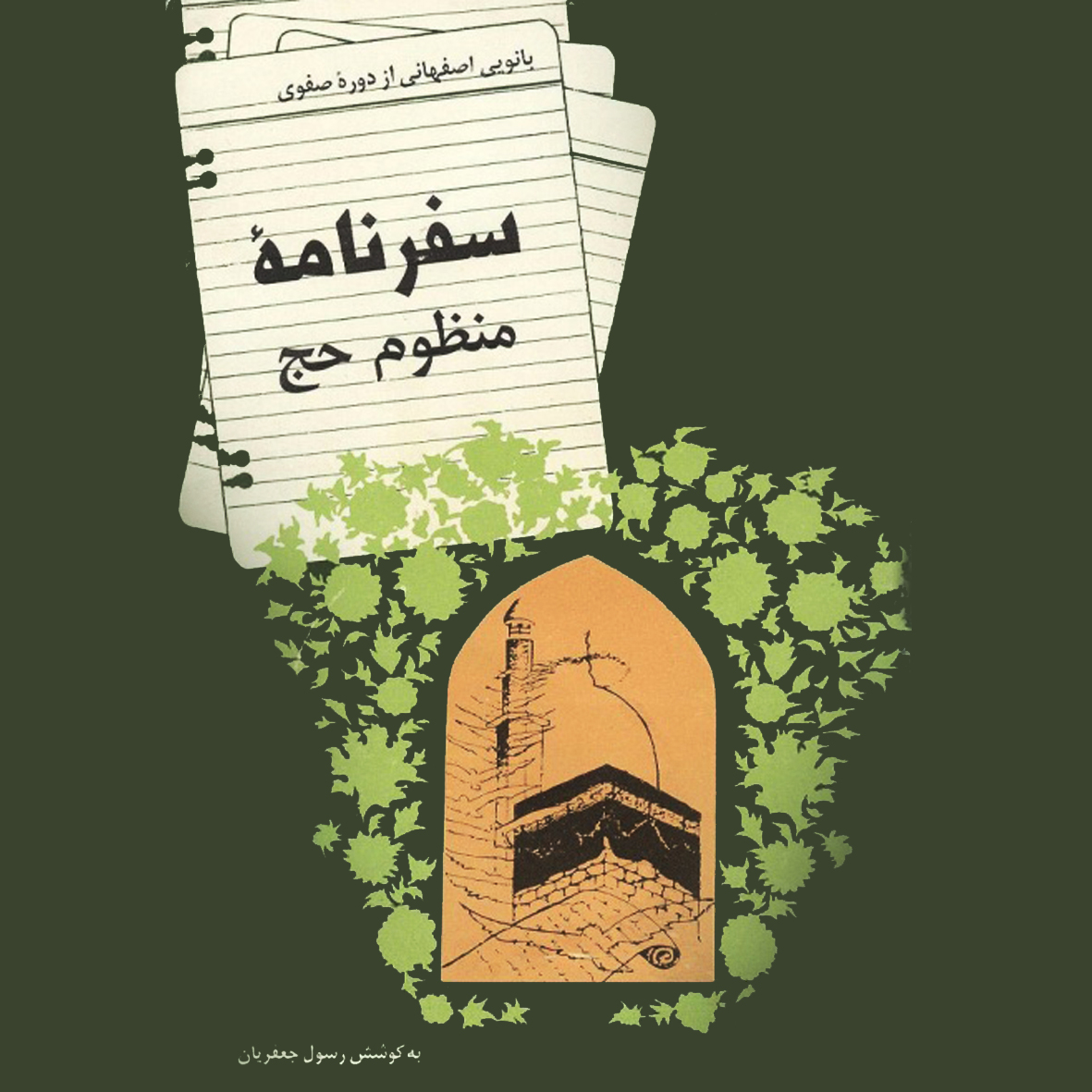
As noted, the Safarʹnāmah-ʾi hajj (The travelogue of pilgrimage) by Shahrʹbānū Baygum is the only verse travelogue composed by a woman to have survived from before the AH 13th/19th century, dating to the Safavid period (1501–1722). Unfortunately, the details of the author’s life remain largely unknown. As the editor of the Safarʹnāmah-ʾi hajj Rasūl Jaʿfariyān notes in the introduction to the work, all that is certain is that she was an educated lady who was married to Mīrzā Khalīl, the scrivener, one of the secretaries and courtiers of the final years of Safavid dynasty.3Shahrʹbanū Baygum, Safarʹnāmah-ʾi manzūm-i hajj (hazār va divīst bayt), Sarāyandah Bānū-yi Isfahānī [The verse travelogue of pilgrimage (a thousand and two hundred verses), composed by the Isfahānī lady], ed. Rasūl Jaʿfariyān (Tehran: Mashʿar, 1374/1995), 9. This travelogue has been published in two other editions: Shahrʹbānū Baygum, Safarʹnāmah-ʾi manzūm-i hajj, Sarāyandah Bānū-yi Isfahānī, hamrāh bā naqshahʹhā va tasāvīr [The verse travelogue of pilgrimage, composed by the Isfahānī lady, with maps and pictures], ed. Rasūl Jaʿfariyān (Tehran: Geographical Organization of Armed Forces, 1386/2007). This edition is used for references to the text in the present article. Hājiyah Hamdam Kafshʹgar, Safar-i sabz, khātirāt-i hajj-i yik zan, Sarāyandah yik Bānū-yi Isfahānī [Green journey, a woman’s pilgrimage memories; composed by the Isfahānī lady] (Isfahan: Pūyānʹmihr, 1386/2007). The third edition offers a prose rendition of the original verse travelogue. She is mentioned in different sources by a variety of names and titles, including “Shahrʹbānū Baygum, daughter of Muhtasib al-Mamālik,”4Abāzar Nasr Isfahānī, “Kitābʹshināsī-i safarʹnāmahʹhā va khātirāt-i hajj-i zanān” [A bibliography of women’s travelogues and pilgrimage memoirs], Āyinah-ʾi Pazhūhish [The mirror of research] 22, no. 3 (Murdād-Shahrīvar 1390/August-September 2011): 98. “wife of Mīrzā Khalīl,”5Āqāʹbuzurg Tihrānī, al-Zurriʿah ilā tasānīf al-shīʿah, vol.19 (Beirut: Dār al-azvāʾ, 1983). See also Ahmad Munzavī, Fihrist-i nuskhahʹhā-yi khattī-i Fārsī [A list of Persian manuscripts] (Tehran: Regional Cultural Institute, 1348/1969), 5:4033. “widow of Mīrzā Khalīl,”6Siobhan Lambert-Hurley, Daniel Majchrowicz and Sunil Sharma, Three Centuries of Travel Writing by Muslim Women (Bloomington: Indiana University Press, 2022), 49. “spouse of Mīrzā Khalīl,”7Muhammad Hasan Rajabī, Mashāhīr-i zanān-i Īrānī va pārsiʹgūy az āghāz tā Mashrūtah [Famous Iranian and Persian-speaking women, from the beginning to the Constitutional Era] (Tehran: Surūsh, 1374/1995). See also Banafshih Hijāzī, Zanān-i muʾaddab [Eloquent women] (Tehran: Qasīdahʹsarā, 1394/2015), 254. and “the Isfahānī lady.”8In both editions of the masnavī, the editor Rasūl Jaʿfariyān refers to the author as “a lady from Isfahān” or “the lady from Isfahān” (bānū-yi Isfahānī or bānū-yī Isfahānī). See Shahrʹbānū Baygum, Safarʹnāmah-ʾi manzūm-i hajj, Sarāyandah Bānū-yi Isfahānī, hamrāh bā naqshahʹhā va tasāvīr, and Safarʹnāmah-ʾi manzūm-i hajj (hazār va divīst bayt), Sarāyandah Bānū-yi Isfahānī. The scribe of the manuscript of the Safarʹnāmah-ʾi hajj also refers to her with honorifics such as “her exalted presence, the embodiment of innocence, chastity, and purity, the Bilqīs of the time, the Khadījah of the age, the esteemed and noble spouse of the late Mīrzā Khalīl, the scrivener.”9See manuscript no. 2591, titled Jung-i Mīrzā Muʿaynā Urdūʹbādī [The poetry collection of Mīrzā Muʿaynā Urdūʹbādī], held at the University of Tehran, fol. 764. Her family, for generations, held the position of muhtasib al-mamālik (the grand supervisor of bazaars and trade) under the Safavid dynasty.10Nasr Isfahānī, “Kitābʹshināsī-i safarʹnāmahʹhā va khātirāt-i hajj-i zanān,” 99. Little is known about her husband, Mīrzā Khalīl, except that he was the scrivener (the writer of courtly decrees) and one of the secretaries at the court of Shāh Sultān Husayn Safavī (r. AH 1105–1133/1693–1720 CE). There is no consensus regarding the birthplace of this Isfahānī lady. Some scholars identify her birthplace as Urdubad, while others suggest Dawlatabad in Qazvin.11Muzaffar Alam and Sanjay Subrahmanyam, Indo-Persian travels in the Age of Discoveries, 1400-1800 (Cambridge University Press, 2007), 24. See also Shahrʹbānū Baygum, Safarʹnāmah-ʾi manzūm-i hajj, hamrāh bā naqshahʹhā va tasāvīr, 4 (of the introduction). The Safarʹnāmah-ʾi hajj itself suggests that she had relatives in both cities. Nevertheless, Shahrʹbānū Baygum began her journey to Mecca from Isfahan, and since she mentions in the Safarʹnāmah-ʾi hajj her long separation from her relatives in Urdubad, it can be inferred that she resided in Isfahan for a considerable period.
The exact date of composition of this 1200-couplet poetic travelogue cannot be determined with certainty.12The number of couplets in this travelogue exceeds 1200 in some published editions. The only known manuscript is held in the Central Library of the University of Tehran, but it is unclear why some references, such as al-Zurriʿah (19: 207) and Fihrist-i nuskhahʹhā-yi khattī-i Fārsī (6:4033), list it as having 1300 couplets. Western scholars generally date it to the late 17th century CE, corresponding to the final decades of Safavid rule.13Alam and Subrahmanyam, Indo-Persian travels in the age of discoveries 1400-1800, 24; See also Lambert-Hurley et. al., Three centuries of travel writing by Muslim women, 49. Rasūl Jaʿfariyān estimates its composition to have occurred sometime between AH 1100/1688 and 1132/1720.14Shahrʹbānū Baygum, Safarʹnāmah-ʾi manzūm-i hajj, hamrāh bā naqshahʹhā va tasāvīr, 2 (of the introduction). However, in another article, drawing on a date mentioned in the Jung (Collection of poems) of Mīrzā Muʿaynā Urdūʹbādī, he suggests that the Safarʹnāmah-ʾi hajj was composed before AH 1122/1710.15Rasūl Jaʿfariyān, “Urdūʹbād va ahammiyat-i farhangī-i ān dar dawrah-ʾi akhīr-i Safavī” [Urduʹbad and its cultural significance in the late Safavid period], Payām-i Bahāristān 3, no. 11 (Spring 1390/2011): 19. The Safarʹnāmah-ʾi hajj itself indicates that the journey (up to the point of reaching Mecca) lasted seven months. The author entered the (Ottoman) Byzantium territory from the northwest of Iran and traveled from there to Mecca and the Levant, before returning to Aleppo. The Safarʹnāmah-ʾi hajj provides details of the return route only as far as Aleppo and the city of Urfa. Thus, we have no information about how Shahrʹbānū Baygum returned to Isfahan, where she lived.
Style, Language, and Literary Value
From the scattered references to certain verses by Nizāmī Ganjavī in the text, it can be inferred that the author modeled her work on the narrative poems (in the form of rhymed couplets or masnavī) of this renowned Persian poet of the AH 6th/12th century, or at least on his Khusraw va Shīrīn (Khusraw and Shirin).16Kathryn Babayan, seemingly due to Shahrʹbānū Baygum’s sympathy with “Majnūn,” suggests that this travelogue is influenced by Nizāmī’s Laylī va Majnūn (Laylī and Majnūn) and even mistakenly claims that the writer directly quotes a couplet from it while describing the Kaʿbah. However, it is not possible to directly quote a couplet from Laylī va Majnūn in the travelogue, as the two works do not share the same meter. The couplet that Shahrʹbānū Baygum includes in her travelogue from Nizāmī is from Khusraw va Shīrīn. See Kathryn Babayan, The City as Anthology: Eroticism and Urbanity in Early Modern Isfahān (Stanford University Press, 2021), 185. However, in terms of language and the use of literary devices, her work stands at a considerable distance from that model. As has been noted by some scholars, the language used in this verse travelogue is fluent and free of obscurity. Rasūl Jaʿfariyān, commenting on the linguistic characteristics of the Safarʹnāmah-ʾi hajj, observes: “Her poems are composed with absolute simplicity and fluency, without the slightest difficulty in versification… only occasionally, due to the necessity of mentioning city names, some verses suffer a minor disruption in fluency, an issue that is easily forgivable.”17Shahrʹbānū Baygum, Safarʹnāmah-ʾi manzūm-i hajj (hizār va divīst bayt), Sarāyandah Bānū-yi Isfahānī, 14. Also, Shahrʹbānū Baygum, Safarʹnāmah-ʾi manzūm-i hajj, hamrāh bā naqshahʹhā va tasāvīr, 5 (of the introduction).
It should be noted, however, that contrary to the editor’s view, the verses of the Safarʹnāmah-ʾi hajj, despite their fluency and simplicity, exhibit notable linguistic and literary shortcomings that are not limited to the verses in which city names appear. Numerous verses can be identified that contain flaws in meter and rhyme, even where no place names are mentioned. For example, the rhyme deficiencies in the following couplets are immediately apparent:
مرا دیدند چون آن ماهرویان
ستایش مینمودندم چو شاهان
When those moon-faced beauties saw me
They praised me like kings
نمودم چار روزی کامرانی
به فیروزی در آنجا عیشرانی
I indulged in pleasure there for a few days
Reveling in joy in that place of delight
رسیدم چون به سوی آن دهستان
زدم خرگه به دامان کهستان
When I arrived at that village
I pitched my tent at the foot of the mountains
In addition, several couplets contain extra syllables that disturb the meter, and there many verses in the Safarʹnāmah-ʾi hajj that show signs of poor or weak composition (zaʿf-i taʾlīf). Nevertheless, it is precisely because the author was not a “professional” poet that she composed the Safarʹnāmah-ʾi hajj in a style free from the obscurity and complexity prevalent at the time—a style favored by the proponents of the new style, which is generally called the “Indian style” (sabk-i hindī). As a result, the work remains accessible and comprehensible to a broad Persian-speaking readership.
Rethinking Uniqueness: Gender, Form, and Misconceptions
Scholars examining travel writing in the Islamic world have highlighted the unique position of “Mīrzā Khalīl’s wife’s travelogue” among Persian travel narratives, both in verse and prose. Some attribute this distinctiveness solely to the author’s gender or because the fact that it was written in verse.18Alam and Subrahmanyam, Indo-Persian travels in the age of discoveries 1400–1800, 25. Others consider the “feminine” perspective in the Safarʹnāmah-ʾi hajj unique, noting its emphasis on “details, personal emotions, and viewpoints… absent from male-authored texts from that period.”19Nafīsah Murshid′zādah, “Rivāyatī az safarʹnāmah-ʾi manzūm-i hajj az zawjah-ʾi Mīrzā Khalīl-i raqqamʹnivīs, zanī az ahd-i Safavī: Bilā-tashbīh gūyā nawʹjavānī” [A reading of the verse travelogue of pilgrimage by the wife of Mīrzā Khalīl the scrivener, a woman from the Safavid era: “It resembles an adolescent”], Khiradʹnāmah-ʾi hamʹshahrī 61 (Ābān 1379/November 2000): 92. While the Safarʹnāmah-ʾi hajj indeed holds a prominent place among Persian travel narratives, especially those predating the AH 13th/19th century,20The AH 13th/19th century, nearing the end of the Qajar period, can be considered, following Bert Fragner, as a time when Iranian government and society gradually distanced themselves from medieval conditions. Consequently, memoir writing and travel writing underwent changes. Modern travelogues can be discussed only after this period, culminating in the year 1285/1906, the year of the Constitutional Revolution. For more details, see Bert G. Fragner, Khātirātʹnivīsī-i Irānīān [Iranians’ memoir writing], trans. Majīd Jalīlʹvand Rizāʾī (Tehran: Intishārāt-i ʿIlmī va Farhangī, 1377/1998), 1–17. it is not due to the reasons often cited. The fact that it is written in verse does not constitute a unique advantage, as several pilgrimage travelogues from the same period or even earlier are composed in verse. In addition, expressing emotions about specific cities and regions traversed is not exclusive to a “feminine” perspective. Even early Persian travelogues, such as the Safarʹnāmah attributed to Nāsir Khusraw, or those nearly contemporaneous with “Mīrzā Khalīl’s wife’s” travelogue, openly express feelings upon encountering new geographical and cultural environments. Furthermore, certain similes in the text, such as the comparison of the Kaʿbah to an “adolescent” wearing “a black velvet qabā (traditional long coat for men)” and a “golden belt” have been deemed “feminine.”21Murshid′zādah, “Rivāyatī az safarʹnāmah-ʾi manzūm-i hajj,” 99. While these similes may contrast with the male poets’ depictions of the Kaʿbah, where it is generally imagined as “a veiled lady,” they should not be exclusively interpreted as indicative of a feminine perspective. Such similes need to be understood within a broader rhetorical context, alongside other literary techniques in the text, to grasp their specific function. The Safarʹnāmah-ʾi hajj’s unique position is primarily linked to two other factors, which will be explored further, highlighting that its distinctiveness is not fundamentally based on the author’s gender.
Challenging Genre: The Travelogue and Its Mixed Form
To understand the uniqueness of the Safarʹnāmah-ʾi hajj, it should be studied within two different frameworks. First, it should be examined in the context of verse travelogues that were composed before and/or at the same time as this one. As Lambert-Hurley has pointed out, while the genre of travelogue does not have fixed rules and travel writers often make use of various other genres (such as epistolary writing, autobiography, etc.) to narrate their travel experiences, in the Persian language, the sub-genre of “verse travelogue” has a relatively well-established history and a set of accepted principles, which are generally adhered to by other travel writers.22Lambert-Hurley, et al., Three centuries of travel writing by Muslim women, 12. Most of the verse travelogues written before the second half of the AH 13th/19th century are either entirely focused on the pilgrimage to Mecca or include the pilgrimage as part of the author’s experience.23There are exceptions as well, such as Bihishtī Hiravī’s Nūr al-mashriqayn (AH 11th/18th century), which, while not a pilgrimage travelogue, nevertheless contains religious themes. See ʿAbd Allāh Bihishtī Hiravī, Nūr al-Mashriqayn, Safarʹnāmah-ʾi manzūm az ʿahd-i Safavī [The light of the two Easts, a verse travelogue from Safavid period], ed. Najīb Māyil Hiravī (Mashhad: Foundation for Islamic Research of Āstān-i Quds-i Razavī, 1377/1998). Similarly, the poetic travelogue by Nizārī Qūhistānī (AH 7th/13th century) was not written with religious intentions. For details on this travelogue, see Hakīm Nizārī Qūhistānī, Dīvān, ed. Mazāhir Musaffā (Tehran: ʿIlmī, 1371/1992), 1:232–38. It should also be noted that some of these verse travelogues are written in Persian, despite their authors originating from other of the Islamic world, such as Mughal India and the Ottoman Empire. These travelogues can be divided into three categories: first, didactic travelogues, which mainly describe the rituals and practices of pilgrimage, such as Ahmad Miskīn’s Hajjʹnāmah;24Ahmad Miskīn, “Hajjʹnāmah, guzīdah” [Hajjʹnāmah, selected parts], in Shahrʹbanū Baygum, Safarʹnāmah-ʾi manzūm-i hajj (hazār va divīst bayt), Sarāyandah Bānū-yi Isfahānī. second, mystical travelogues, which, in addition to describing the rituals and practices, frame the pilgrimage experience within a mystical worldview, manifested both in the description of the holy places and in the interpretation of the pilgrimage rituals, offering a deeper spiritual meaning, such as Vāhib Hamadānī’s Iʿjāz-i Makkī (The Meccan miracle),25Vāhib Hamadānī, Iʿjāz-i Makkī [The Meccan miracle], in Chahārdah safarʹnāmah-ʾi hajj-i Qājārī-i dīgar [Fourteen other Qājāri pilgrimage travelogues], ed. Rasūl Jaʿfariyān (Tehran: ʿIlm, 1392/2013). Vāhib Hamadānī’s travelogue belongs to the Safavid period. and Muhyī al-Dīn Lārī’s Futūh al-haramayn (Description of the two holy cities);26Muhyī al-Dīn Lārī, Futūh al-haramayn [Description of the two holy cities], ed. ʿAlī Muhaddis (Tehran: ʿIttilāʿāt, 1366/1987). and third, travelogues that primarily describe the cities and report events during the journey, such as Muhammad Nabī Qūrchī Isfahānī’s travelogue27Muhammad Nabī Qūrchī Isfahānī, “Safarʹnāmah-ʾi manzūm-i hajj” [The verse travelogue of pilgrimage], Maqālāt va risālāt-i tārīkhī [Historical articles and treatises] 2 (Spring 1393/2014): 317–58. and Husayn Abīʹvardī’s Chārʹtakht (Four seats).28Īraj Afshār, “Du asar az Husayn Abīʹvardī” [Two works by Husayn Abīʹvardī], Farhang-i Īrān′zamīn [Iran’s culture] 15 (1347/1968), 5–10. See also Husayn Abīʹvardī, “Masnavī-i chārʹtakht” in Shahrʹbanū Baygum, Safarʹnāmah-ʾi manzūm-i hajj (hazār va divīst bayt), Sarāyandah Bānū-yi Isfahānī. This latter type of travelogue is closer to autobiographies. The verse travelogues available before the composition of Shahrʹbānū Baygum’s Safarʹnāmah-ʾi hajj generally fall into one of these three categories.
Shahrʹbānū Baygum’s Safarʹnāmah-ʾi hajj is a blend of the three types of travelogues and does not comfortably fit into any of the categories. In the Safarʹnāmah-ʾi hajj, both the author’s personal state of mind and the description of the rituals and practices of pilgrimage are significant. The author provides a chronological account of the pilgrimage rituals, although she does not go so far as to turn the travelogue into an instructional treatise on how to perform the pilgrimage rituals. Additionally, the Safarʹnāmah-ʾi hajj conveys a sense of mystical experience upon entering Mecca. While the writer, unlike other mystical travel writers before the AH 13th/19th century, does not attempt to present a spiritual meaning of the pilgrimage rituals and practices, she does not merely “report” her entry into Mecca and the performance of the pilgrimage rituals and practices. Instead, she seeks to depict the romantic union between herself and the Beloved, an attempt that lends the text a mystical atmosphere, whether consciously or unconsciously.
It is worth noting that the Safarʹnāmah-ʾi hajj opens directly with the writer’s personal account, rather than with praise of God, admiration for the Prophet Muhammad and the Imams. As Lambert-Hurley suggests, verse travelogues prior to the AH 13th/19th century followed specific principles and conventions,29Lambert-Hurley, et al., Three centuries of travel writing by Muslim women, 6. and beginning with an epilogue praising God and honoring religious figures was undoubtedly one of these conventions. Therefore, the first distinguishing feature of Shahrʹbānū Baygum’s Safarʹnāmah-ʾi hajj, compared to other verse travelogues of the same or earlier periods, is that it distances itself somewhat from the accepted conventions of verse travelogues and cannot be specifically categorized didactic or mystical. Furthermore, the Safarʹnāmah-ʾi hajj exhibits other notable differences from those composed before the AH 13th/19th century, such as its style of reporting travel events, its description of cities, and the narration of personal experiences. These differences will be discussed further below.
Proto-Modern Traits: Subjectivity and Narrative Voice
To explain the second distinguishing feature of the Safarʹnāmah-ʾi hajj, it should be situated within the broader context of travel writing in the Persian language. In other words, one must consider not only verse travelogues but also prose travelogues, both prior to and following the AH 13th/19th century. As Fragner observes:
Most Persian travelogues written in the AH 13th/19th century and after differ in several respects from earlier Islamic travel accounts. In modern travelogues, personal memories, experiences and observations are no longer used merely as tools to confirm and support the credibility of the report. In the new-style travel writing, such as Mīrzā Sālih’s [Shirāzī] travelogue, the author’s personal life story, alongside the accounts of events, constitutes the main theme and subject of the book… Most writers give equal importance to recounting personal memories and conveying their ideas and perspectives, as well as to informing the reader about recent news and occurrences.30Fragner, Khātirātʹnivīsī-i Īrānīān [Iranians’ memoir writing], 27–28.
Shahrʹbānū Baygum’s Safarʹnāmah-ʾi hajj is perhaps the only known example from before the AH 13th/19th century in which the writer’s personal experiences carry as much weight as the report of the journey itself. This characteristic aligns it with modern travelogues composed from the late AH 13th/19th century onward. Additionally, these personal experiences are not merely narrated; they also serve as an organizing and unifying function—an attribute that can be found only in select number of post 13th/19th century travelogues.31For example, in Mīrzā Sālih Shīrāzī’s Hayratʹnāmah [Book of amazement], the experience of “amazement” upon encountering the manifestations of Western civilization is not merely one among other personal experiences; rather, it serves as a lens through which many of the events in the travel narrative should be interpreted. While not all modern travelogues share this characteristic, it is more frequently encountered in them. On the other hand, it could be argued that pre-modern mystical travelogues should also be understood through the prism of mystical experience, and thus, the unifying element of the mystical experience is present in these works as well. However, it is important to note that mystical experiences in these texts are often conveyed through conventional mystical tropes, making it less likely to find vestiges of personal, subjective experiences in them. In other respects, however, a comparison between Shahrʹbānū Baygum’s travelogue and later pilgrimage travelogues written by women, such as those by ʿIsmat al-Saltanah, ʿAlaviyah Kirmānī, and others from the Qajar period, does not reveal significant differences.
Loneliness as the Core Experience
An analysis of Shahrʹbānū Baygum’s Safarʹnāmah-ʾi hajj reveals that her aim in writing this work was not merely to record and report the events of the journey. The most significant lived experience conveyed in this travelogue—arguably one that strongly shapes the author’s particular perspective—is the experience of “loneliness” and the inner turmoil resulting from it. Loneliness, in its broadest sense—encompassing physical, emotional, and spiritual isolation, lack of companionship, absence of shared language, alienation, and disorientation—is prominently reflected in the text. Undoubtedly, these feelings must have been intensified by the death of her husband and must have had a considerable impact on the narrative style she adopts. This experience is so central that it informs the way Shahrʹbānū Baygum engages with the events of her journey. In fact, the Safarʹnāmah-ʾi hajj opens with the description of this experience, which also serves as the underlying motivation for undertaking the pilgrimage:
When the devious wheel of fate,
Tore my heart with the loss of my intimate companion.
I was bereft of a comforting sleep in bed,
I had no remedy but to set out in journey.
I found no sleep by night, no peace by day,
So, I donned the ihrām to circle the Kaʿbah.32Shahrʹbānū Baygum, Safarʹnāmah-ʾi manzūm-i hajj, hamrāh bā naqshahʹhā va tasāvīr, 1.
Among pilgrimage travelogues written in Persian from early periods up to the present, there appears to be no other example in which the author undertakes the pilgrimage solely due to a sense of loneliness and the unease arising from it. Other authors typically cite their motivations such as fulfilling a religious obligation, pursuing spiritual or mystical aspirations, or traveling for the sake of exploration and experience. The only partially comparable example is Muhyī al-Dīn Lārī’s Futūh al-haramayn. However, even in Muhyī al-Dīn Lārī’s case, “loneliness” as the impetus for pilgrimage differs significantly from how it is experienced and presented in Shahrʹbānū Baygum’s text:
Last year, in this ruined world,
A wave anxiety stirred within my heart.
The bird of my heart set its course for the sanctuary,
Beating its wings, it soared into flight…
From the cruelty of the ancient spheres’ ways,
I became a captive in the desert of separation.
Whoever is parted from the abode of the Beloved
Is, in all places, a strange and a prisoner.
For the love of God, O minstrel of love,
Play a tune from the land of Hijāz.
Out of longing’s sorrow and aching grief,
From the pain, the torment, and the ache of separation,
I walked without knowing where I stepped,
Every breath I drew was in the sanctuary’s remembrance…33Muhyī al-Dīn Lārī, Futūh al-haramayn, 35–36.
Muhyī al-Dīn Lārī’s experience of loneliness is a mystical one, characterized by separation from the “abode of the Beloved,” i.e., God, and bears no connection to personal loss or separation from family members and relatives. His feelings of anxiety, alienation, and captivity should be understood within the framework of mystical experience, shaped more by the conventions of mystical teachings than by concrete, lived experience. By contrast, for Shahrʹbānū Baygum, loneliness and the restlessness that follows from it, at least in the beginning of her journey, are entirely personal, tangible, and devoid of mystical overtones.
Shahrʹbānū Baygum’s experience of loneliness is further emphasized and intensified by her explicit statement that none of her relatives were willing to accompany her on the journey:
No one of my kin became my companion
Like Majnūn, I set out alone into the desert
What use is the help of others to anyone?
For the friendless, God alone suffices.34Shahrʹbānū Baygum, Safarʹnāmah-ʾi manzūm-i hajj, hamrāh bā naqshahʹhā va tasāvīr, 1.
Although we know she was not entirely alone on this journey and, considering the social class to which she belonged, she likely traveled with a few of her servants,35For more explanations, see Lambert-Hurley, et al., Three centuries of travel writing by Muslim women, 166. From the AH 13th/19th century onward, most travelogues introduce the companions of the writers either in the opening pages or as the journey unfolds. It is of little significance whether the writers and their companions are of the same social standing or whether the companions are slaves or servants. In either case, mentioning the names and titles of fellow travelers is one of the most frequent themes of modern travelogues. The use of the first-person narrative perspective, despite the presence of fellow travelers, is, as Lambert-Hurley suggests, a form of poetic license. In the case of the travelogue by Shahrʹbānū Baygum, the application of this poetic license, along with the deliberate omission of her companions’ names, can be interpreted as a reflection of the writer’s personal experience of loneliness, which, in turn, is the fundamental impetus for embarking on the pilgrimage in the first place. These companions are entirely absent from the narrative until the appearance of a caravan of Iranian pilgrims. Shahrʹbānū Baygum refers to the caravan’s leader (amīr al-hājj) as ʿAjam Āqāsī (literally, Persian lord).36Shahrʹbānū Baygum, Safarʹnāmah-ʾi manzūm-i hajj, hamrāh bā naqshahʹhā va tasāvīr, 31. Until the narrative reaches the city of Nakhchivan, the journey is recounted in the first-person singular, as if the author had started it completely alone, without any company whatsoever. The effect of the experience of loneliness (in its broadest sense) and the emotional toll of separation from her husband is not limited to these direct references. The descriptions of landscapes, places, and the events of the journey also appear to be shaped by this experience and by a longing to escape it. To grasp the extent to which this experience informs the narration of the journey and, more generally, the rhetorical fabric of the text, one must attend closely to its details: the characters, the dialogues, the imagery, and the self-representation offered by the author at both the beginning and the end of the travelogue.
Solitary Voices: The Jaras and the Absence of Dialogue
From the outset of the travelogue until the arrival of the Iranian pilgrimage caravan, most dialogues are attributed to the sound of the caravan bell (jaras). There are very few instances where the writer engages in conversation with any of the individuals she encounters. Even upon reaching Urdubad or Dawlatabad in Qazvin—cities where she has relatives—dialogues between her and her relatives are scarce. Instead, the text offers some general descriptions of her relatives without delving into specific conversations. This pattern suggests that the writer places greater significance on the utterances of the jaras concerning stops and movements than on the dialogues with her relatives in various cities. According to a literary tradition, it is the sound of the jaras that dictates the frequency and duration of stops and the timing of departure during the journey. However, Shahrʹbānū Baygum’s frequent references to the jaras (over fifty times) and the inclusion of dialogues between the jaras and the narrator imply that the jaras serves as a substitute for human conversation. Even when she reaches Urdubad and describes a relative who was closer to her than a sister and had cared for her during an illness, she provides minimal information about their interactions. Instead, at the time of departure, she again attributes the dialogue to the jaras:
That dear kin was better than a sister,
Kinder than all other relatives…
When my allotted time there came to an end,
The jaras called out, its voice loud:
“The moment has come to gather your things
This is no time to linger in comfort indoors…”
I departed that valley in the late afternoon
Along the road, the jaras began its refrain:
“Why do you grieve for the friends you have left?
Turn your face now toward the House of God.
Do not despair at parting from the beloved
Urge the camel on, there are miles still ahead…37Shahrʹbānū Baygum, Safarʹnāmah-ʾi manzūm-i hajj, hamrāh bā naqshahʹhā va tasāvīr, 30–28.
Interestingly, even after joining the Iranian caravan in Nakhchivan, Shahrʹbānū Baygum’s sense of loneliness does not diminish significantly. The jaras continues to feature prominently in the travelogue. Shahrʹbānū Baygum frequently attributes her feelings and emotions throughout the events of the journey to the jaras:
So many black stones I saw along that road,
It was as if my wretched life were cut short.
The jaras cried out in protest at the stones:
“My ringing is deafened; my camel goes lame.”38Shahrʹbānū Baygum, Safarʹnāmah-ʾi manzūm-i hajj, hamrāh bā naqshahʹhā va tasāvīr, 42.
Only upon reaching Medina and Mecca, and during the return journey, does the role of the jaras diminish, and the writer begins an internal dialogue with her own “heart.”39Shahrʹbānū Baygum, Safarʹnāmah-ʾi manzūm-i hajj, hamrāh bā naqshahʹhā va tasāvīr, 70. Throughout the journey, her conversations with natural elements such as the breeze and the sky are more frequent than her dialogues with relatives and companions.
Rhetoric of Isolation: Imagery and Metaphor
The second manifestation of the experience of loneliness in the Safarʹnāmah-ʾi hajj is evident in the specific rhetorical strategies that the writer uses for describing herself, the phenomena and landscapes encountered during the journey. She frequently portrays herself as a gazelle or a Majnūn, wandering the deserts. As is well-known, one of the most significant implications of these metaphors is the conveyance of the experience of loneliness to the reader. The metaphor of the gazelle has been traditionally used to evoke the experience of loneliness in Persian literature. From the famous couplet (bayt) of Abū Hafs Sughdī, “How the mountain gazelle runs in the plain / It doesn’t have a beloved, how does it run?,” considered one of the first lines of Persian poetry, to the masnavī “O wild gazelle” by Hāfiz, where in the hemistich (misrāʿ) “Two lonely, wandering and friendless ones,” a parallel is drawn between the gazelle and the poet, the gazelle metaphor has been used to convey the experience of solitude.40See Shams Qays Rāzī, al-Muʿjam fī maʿāyīr ashʿār al-ʿajam, ed. Muhammad Qazvīnī, rev. ed. Mudarris Razavī (Tehran: University of Tehran, 1338/1959), 194. Shams al-Dīn Muhammad Hāfiz, Dīvān-i Hāfiz, ed. Muhammad Qazvīnī and Qāsim Ghanī (10th repr., ed. Tehran: Zavvār, 1390/2011), 354. A comparative analysis of the metaphors of the “gazelle” and “Majnūn” in this text and in two other mystical travelogues, Futūh al-haramayn and Iʿjāz-i Makkī, offers illuminating insights. In the latter two works, these metaphors are not used to evoke themes of loneliness, wandering, or separation, as they are in the present travelogue. Rather, they serve to convey the intensity of mystical “love.” For example, in the Futūh al-haramayn, Muhyī al-Dīn writes: “Is there Laylī’s carriage in between / That has turned so many people into its Majnūns? / The plain is full of Majnūns and Laylī is in the center / Everyone is infatuated and bedazzled by her.” See Muhyī al-Dīn, Futūh al-haramayn, 78). Similarly, in the Iʿjāz-i Makkī, Hamadānī writes: “What plain is this, a land of Laylī full of gazelles / Where the number of Majnūns exceeds the desert sand / Behind each rock is a madman / In each bush, a disheveled man.” See Hamadānī, Iʿjāz-i Makkī, 134. The connection between the metaphor of “Majnūn” and its implication of homelessness and loneliness in the desert is self-evident.
In addition to these, the writer uses other metaphors to convey the experience of loneliness and isolation. For example, after departing from Savah, they reach a region adorned with rows of plane trees on both sides of the road:
Plane trees rose close on either side,
All equal in height, stretched two leagues wide.
Like gentle lovers walking side by side
Each tightly clasped in the other’s stride.41Shahrʹbānū Baygum, Safarʹnāmah-ʾi manzūm-i hajj, hamrāh bā naqshahʹhā va tasāvīr, 8.
This simile implicitly reflects Shahrʹbānū Baygum’s anxiety stemming from loneliness and her hidden desire for companionship. Elsewhere, she describes the mountain weather, lake, and stream flowing from the mountain:
A stream flowed gently from the mountain’s hem,
As clear as the whiteness of the beloved’s neck.
What a mountain! It lifts sorrow from the heart,
What a mountain! Its peak touches the sky.
Its air as mild as in the beloved’s abode,
Its slopes green and fresh as the beloved’s face.
Come, listen to the song of its lake,
Its head adorned with delicate folds of rage.
It wound its way down the mountain’s side,
Like the creases on the forehead of the beloved.42Shahrʹbānū Baygum, Safarʹnāmah-ʾi manzūm-i hajj, hamrāh bā naqshahʹhā va tasāvīr, 2–4.
The references to “the beloved’s abode,” “the whiteness of the neck,” and “the creases on the forehead” in various phenomena and landscapes encountered during the journey are certainly not coincidental. The most important example of this rhetorical strategy is found in the description of the Kaʿbah:
How can I describe the House of God?
It is far above anything I can say.
If I were to compare it, I would say it’s like a youth,
As tall as a strong cypress tree.
He wears a black velvet robe (qabā),
And has a golden belt around his waist.43Shahrʹbānū Baygum, Safarʹnāmah-ʾi manzūm-i hajj, hamrāh bā naqshahʹhā va tasāvīr, 89.
As previously mentioned, when considered in isolation, this simile might seem “feminine.” However, when placed alongside the other metaphors and similes discussed earlier, it appears to reinforce and emphasize the experience of loneliness.
Seeking Substitutes: God, Kin, and Unfulfilled Union
The third rhetorical strategy that Shahrʹbānū Baygum uses in the Safarʹnāmah-ʾi hajj to emphasize her sense of loneliness involves constructing alternative relationships that could replace her lost connection with her husband. A notable instance of this occurs during her farewell to a relative in Urdubad. The writer falls ill in Urdubad and is cared for by a relative who is “kinder than a sister” for several days. This experience profoundly affects her, and even after reaching Fayzabad (one league away from Urdubad), she reflects on the woman with the following verses:
But from the pain of parting from that dear kin,
I wandered lost, distracted, in that famed garden.
What joy is there in strolling through such a garden
When none I love are there to share its grace?
No flower did I see, nor did I pick it there,
For I only wept from separation and despair.44Shahrʹbānū Baygum, Safarʹnāmah-ʾi manzūm-i hajj, hamrāh bā naqshahʹhā va tasāvīr, 30.
Considering that the primary motivation of the journey was to alleviate the pain of “separation from the companion,” it is not difficult to see that Shahrʹbānū Baygum equates the separation from her husband with the farewells to others encountered during the journey. In addition, the hemistich (misrāʿ) “For the friendless, God alone suffices” suggests that even the pilgrimage to Mecca and the visit to the House of God can be viewed as the writer’s attempt to find an alternative to her lost relationship with her husband—a relationship intended to be established with the eternal Beloved. The metaphors Shahrʹbānū Baygum uses to describe her relationship with God are mystical and romantic and they align with those used for her lost husband or others she had to part with during the journey.45The connection between Shahrʹbānū Baygum’s relationship with God and her lost relationship with her husband is clearly reflected in the verses surrounding her time in Mecca. Upon entering the city, she writes: “The night of separation from the beloved has come to an end / My eyes are bright with the sight of the beloved.” Yet, upon leaving Mecca, she laments: “I have lost the skirt of the beloved / My poor heart is sick with separation / It is still hungry for reunion / I have become the hunter of separation.” The pain of being deprived from “Khalīl” (a name that not only refers to her husband but also carries the meaning of “friend” in Persian) remains with her throughout the travelogue. For a more detailed discussion, see Babayan, The City as Anthology: Eroticism and Urbanity in Early Modern Isfahan, 185. Even the metaphors used upon leaving Mecca mirror those used at the beginning of the journey:
At last, when the pilgrims set out on their way,
They seized my camel’s reins, though I wished to stay.
They pulled me off and led me from that land,
And like the mad, I turned toward the desert sand…46Shahrʹbānū Baygum, Safarʹnāmah-ʾi manzūm-i hajj, hamrāh bā naqshahʹhā va tasāvīr, 105.
However, this mystical-romantic relationship, like the one with her husband and others she encountered during the journey, remains unfulfilled. Shahrʹbānū Baygum’s perception of herself upon leaving Mecca and Medina does not significantly differ from her self-perception at the beginning of the journey:
Returning home tore me apart,
And struck the root of my life with an axe.47Shahrʹbānū Baygum, Safarʹnāmah-ʾi manzūm-i hajj, hamrāh bā naqshahʹhā va tasāvīr, 107.
Conclusion
In the Safarʹnāmah-ʾi hajj, the experience of loneliness is not merely one among other experiences but serves as an experience that encompasses the narrative style, imagery, interactions with others, and even the mystical experiences. This experience and its unique mode of articulation, which finds parallels in some modern travelogues of the AH 13th/19th century and beyond, present an unprecedented conflict between the relatively established conventions of Persian poetic travel writing—such as a specific manner of beginning the poem, describing the rituals of pilgrimage to Mecca, using a predominantly impersonal tone, transforming narration into a form of reportage, emphasizing the objectivity of phenomena, and so on—and the expression of personal experiences, as observed in modern travelogues. In fact, the rhetoric of loneliness and its specific strategies in the Safarʹnāmah-ʾi hajj are such that only considering them can the text be regarded as a cohesive whole. Without this rhetoric, the report of events, the description of phenomena, and the author’s perspective on her environment would appear as scattered fragments of a travel report not particularly unique, with numerous similar examples in Persian literature. The specific rhetorical strategies that Shahrʹbānū Baygum uses to articulate the experience of loneliness, thereby imparting a new direction to the elements of the text, elevate this travelogue beyond the traditional framework of its time and place it alongside many travelogues of later periods. In these travelogues, as Fragner states, the travel writer’s unique perspective and interpretation of events are as significant as the events themselves. Through this experience, a remarkable coherence is established among the parts and elements of the text.