
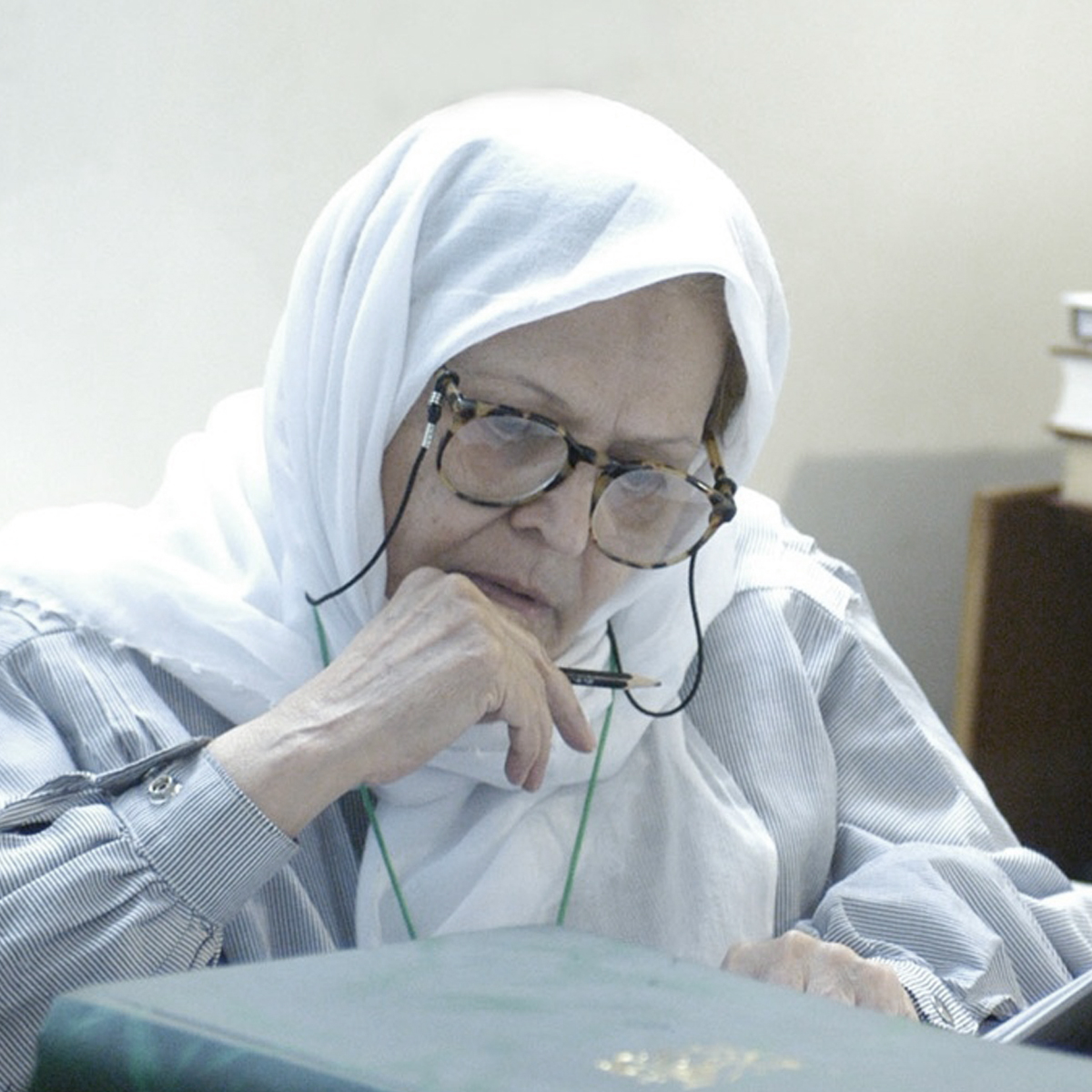
A Private Journey Under the Red Shadow of an Umbrella: A Reading of Tāhirah Saffārʹzādah’s Poems from the Perspective of Dominance Approach



Introduction
Tāhirah Saffārʹzādah’s pen name (takhallus), Mardumak (“the pupil of the eye”), may be regarded as emblematic of her poetic persona. In one phase of her career, she wrote with a rebellious and independent spirit open to the possibilities of language and new worlds, while in another, despite preserving a justice-seeking stance, she was drawn into the constricted world of ideology and became the modern representative of the existing power structure. If one considers the relationship of light to the pupil of the eye as analogous to the relation of power to the poet’s capacity for receptivity, one can deduce that in moving closer to power, her poetic world contracted and her linguistic capacities became more limited.1In an interview published in the special issue “Hingām” of ꜥAsr-i mardum (People’s age) newspaper, Saffārʹzādah discussed her pen name (takhallus), Mardumak, derived from mardum (“people”) and the diminutive suffix –ak, stating: “Mardumak, or “the pupil of the eye,” whose opening and closing regulate the amount of light and act as the agent of sight; it introduces the poet as a part of the opening and closing of the “people,” inseparable from the society.” , Khurdād 26, 1384/June 16, 2005, 3–4. Her literary oeuvre exhibits distinct differences, particularly in poetic form, between periods before and after the Islamic Revolution in Iran (1357/1978). Although the dominant themes of her poetry, a combination of religious beliefs and a concern for social justice in the context of religion, remain a constant thread throughout her poetic career, this justice-oriented voice fell silent in response to many sociopolitical events following the revolution, thereby casting doubt on the integrity of the poet.
Nādir Nādirʹpūr views Saffārʹzādah’s journey to the United States in 1345/1967 as marking the boundary between two distinct poetic phases.2Nādir Nādirʹpūr, Tifl-i sad sālah-ʾi bih nām-i shiʿr-i naw: Guftigū-yi Sadr al-Dīn Ilāhī bā Nādir Nādirʹpūr [A hundred-year-old child called modern poetry: Sadr al-Dīn Ilāhī’s interview with Nādir Nādirʹpūr] (Tehran: Bungāh-i Tarjumah va Nashr-i Kitāb-i Pārsah [Pārsah Foundation for the Translation and Publication of Books], 1397/2018), 332. However, most critics divide her career into three periods: before her journey to the United States, after her return to the United States, and after the Islamic Revolution. In the first period, she appears as an innovative and inquisitive poet seeking a poetic form unique to her own voice. Initially, like Furūgh Farrukhzād (1313–1345/1934–1967) and many of her contemporaries, Saffārʹzādah was formally categorized among the conservatives and began her career within the chārʹpārah-style tradition of interconnected quatrains, a current combining Romantic tendencies with emotional intensity, gathering passion and audacity within the shadow of profound melancholy. Her second poetic period begins with the discovery of a distinct personal language, influenced by modernists such as T. S. Eliot. This stage, formulated through her theory of “resonance” or “echo” (tanīn), introduced to Iran’s literary community as a poet audacious in form. The boldness of her experiments was such that even many modernist readers initially found her poetry difficult to interpret. Consequently, her work and personality provoked a number of strong critical reactions.3See Muhammad Shams Langʹrūdī, Tārīkh-i tahlīlī-i shiʿr-i naw [An analytical history of modern poetry] (Tehran: Markaz, 1384/2005), 4:216–22. During the final phase, Saffārʹzādah’s poetry underwent a pronounced regression in form. In many instances, what she expressed overshadowed how she expressed it, to the extent that the resulting works at times became scarcely distinguishable from political manifestos and ideological proclamation.
Rahʹguzar (Passerby): The Beginning
Tāhirah Saffārʹzādah was born on Ābān 27, 1315/November 18, 1936, in Sirjan in the province of Kerman, Iran. Having lost her father and mother within a short period at the age of five and being raised by her grandmother, Bībī Murassaʿ, who was skilled in medicine and poetry, Saffārʹzādah developed a resilient personality marked by religious inclinations. Her poetic talent was first discovered and encouraged by Muhammad Bāstānī Pārīzī (1304–1393/1925–2014), her teacher at Bahmanʹyār High School in Kerman. At the age of thirteen, Saffārʹzādah composed a poem titled “Bīʹnavā va zimistān” (The destitute and the winter) for her school’s wall newspaper. This achievement motivated her to choose literature as her major in the second period of high school. After graduation, she selected English Language and Literature at Shiraz University in 1329/1950 from among three possible fields: law, Persian literature and English literature.4 Siyyid ꜥAlī Muhammad Rafīʿī, Bīdārgarī dar ʿilm va hunar: Shinākhtʹnāmah-ʾi Tāhirah Saffārʹzādah [Awakening in science and art: Understanding Tāhirah Saffārʹzādah] (Tehran: Hunar-i Bīdārī, 1386/2007), 1:15–16. Tāhirah Saffārʹzādah, “Shiʿr-i pīshʹtāz” [Pioneering poetry], in Bīdārgarī dar ʿilm va hunar, 279–80, originally published as Tāhirah Saffārʹzādah, “Khudā va shiꜥr,” ꜥAsr-i mardum, Khurdād 26, 1384, 3–4.
Some sources make no mention of her first marriage.5Sārah ʿAskarī, “Saffārʹzādah, Tāhirah,” Farhangʹnāmah-ʾi zanān-i Īrān va jahān [Encyclopedia of women of Iran and the world] (Tehran: Irtibāt-i Nawīn, 1394/2015), 873. In the documentary Safar-i Tāhirah (Tāhirah’s journey), her brother Jalāl Saffārʹzādah reveals that her first husband, Muhammad Rizā Jabbārʹpūr, was a physician from Shiraz from whom Saffārʹzādah divorced following the birth of their only child, ʿAlī Rizā, due to her husband’s addiction. He explains that it was during her studies at Shiraz University that ʿAbd al-Vahhāb Nūrānī Visāl (d. 1373/1984), a professor of Persian language and literature, who would later marry her in 1358/1979, expressed his affection for Saffārʹzādah.6Safar-i Tāhirah [Tāhirah’s journey], directed by ʿAlī ʿAzīmī and Amīn Mukhtārī (Tehran: Muꜥāvinat-i Riyāsat-i Jumhūrī dar Umūr-i Zanān va Khānivādah, 1399/2020). However, she rejected his proposal by composing the following poem:
O man, you are never free like me.
Go toward those people
Whose bodies are burdened with jewels,
Whose faces are tinted by hypocrisies,
Whose lips are sealed against the clamor of humankind.
Go blindly, take the hand of a wife,
To tread once more in the worn steps of your ancestors.7Tāhirah Saffārʹzādah, Rahʹguzar-i mahtāb [The passerby of the moonlight] (2nd repr. ed., Shiraz: Navīd Shīrāz, 1365/1986), 20.
It appears that one of the reasons for rejecting this proposal was Nūrānī Visāl’s belonging to a wealthy family. Farzaneh Milani observes that in this poem, Saffārʹzādah sharply denounces the entrenched social structures placing men as the dominant element at the center of traditional social contracts.8Farzaneh Milani, Veils and Words: The Emerging Voices of Iranian Women Writers (Syracuse: Syracuse University Press, 1992), 159–60.
After the divorce, Saffārʹzādah moved to Tehran. Alongside her work in journalism, she was employed by the National Oil Company as a translator of technical texts. Her first journey abroad took her to England on a three-month scholarship to study journalism. However, this trip was cut short by the death of her only child, who was five years old at the time. Some sources do not mention this episode of her life, perhaps because the poet who, in “Kūdak-i qarn” (The child of the century), castigates mothers who neglect raising their children in favor of pleasure seeking or personal ambitions, was regarded by post-Revolution cultural authorities as closer to the idealized image of womanhood.9See Rafīʿī, Bīdārʹgarī dar ʿilm va hunar, 17; ʿAskarī, “Saffārʹzādah, Tāhirah”, 873; Muhammad-Rizā ꜥAbd al-Malikiyān, “Rāh-i dushvār, rāh-i rawshan” [Difficult road, bright road], in Bīdārʹgarī dar ʿilm va hunar, 187. Nevertheless, the death of her child had a profound effect on Saffārʹzādah’s life. She refers to this loss in her long poem “Safar-i avval” (First journey), which centers on the cremation ceremony in India. In three interwoven temporal layers, Saffārʹzādah contemplates the concept of death through associative imagery:
In the narrow alleys of Benares, if you see a thirteen-year-old
Chasing the chariot of the Maharaja and the lady, throwing stones
He is my son.
When he was five, he was a thousand and five years old
A thousand years of unending sunlight
Later, I greeted a little girl
Whose eyes bore the same color as his.10Tāhirah Saffārʹzādah, Tanīn dar diltā [Echo in the delta] (2nd repr. ed., Shiraz: Navīd Shīrāz, 1365/1986), 23.
Following her return to Iran, Saffārʹzādah resumed her position at the National Oil Company. However, she was dismissed a short time later due to delivering an anti-discrimination speech at the North Camp among the children of the company’s workers. Consequently, she obtained a letter of introduction from Faraydūn Rahʹnamā (d. 1354/1976),11Faraydūn Rahʹnamā was a proponent of avant-garde poetry in Iran and an influential figure in introducing modern world poetry, especially French, to Iranian readers during the 1330s/1950s and 1340s/1960s. who served as the director (1345–1349/1966–1970) of the Research Department at National Iranian Television, enabling her to attend a screenwriting course at one of the institutes affiliated with BBC Television in London. While in London, at an international poetry festival, an American poet recommended that she apply to the Iowa Writers’ Workshop at the University of Iowa.12Rafīʿī, Bīdārgarī dar ʿilm va hunar, 17; Saffārʹzādah, “Shiʿr-i pīshʹtāz”, 281.
Prior to undertaking these journeys, Saffārʹzādah published her first collection of poems under the title Rahʹguzar-i mahtāb (The passerby of the moonlight) in 1341/1962. From her text “A Word at the Beginning,” which serves as a preface to the collection, it is apparent that although she had accepted the format of chārʹpārah and at times Nīmāʾī verse, she was troubled by the constraints she felt were imposed upon her thought:
The poet’s need:
A burning desert
Her feeling:
A roaring flood
And the usual limitations:
An inefficient dam
…
This collection
Is a sign
Of my attempts
And the remainder
Of poems
That have taken life in my mind
And have died in my hands13Saffārʹzādah, Rahʹguzar-i mahtāb, 12.
Apart from its content, the arrangement and segmentation of the lines in the above example reveal the poet’s pronounced urge to experiment with new forms. The seemingly irregular line breaks may have been influenced by Ahmad Rizā Ahmadī’s book Tarh (Sketch, 1341/1962) and the early emergence of New Wave poetry.14Tarh was published in Āzar 1341/December 1962 and Rahʹguzar-i mahtāb in Bahman 1341/February 1963. As noted earlier, most of the poems in Rahʹguzar-i mahtāb bear the influence of the chārʹpārah-style of the late 1330s/1950s. Nevertheless, the collection also contains poems which, according to Shams Langʹrūdī, may be compared to Nīmā Yūshīj’s shiꜥr-i naw (New Poetry). One of these, which attained considerable fame at the time, is “Kūdak-i qarn” (The child of the century). Langʹrūdī critiques it as weak, romantic, and sociologically themed.15Shams Langʹrūdī, Tārīkh-i tahlīlī-i shiʿr-i naw, 3:84–85. “Kūdak-i qarn” conveys the poet’s evident indignation toward the women of a modernizing society who, as Saffārʹzādah relates, are abandoning the stereotypes of the traditional mother:
Your mother is here
In the colorful house of the pleasure-seekers
In the warm and fragrant air of a prison
The qāmat (frame) of that beautiful mother is dancing around the frame of a stranger And her hands are around his neck
Their feet on the dancing floor, moving with a rapid tune
That room is filled with drunken cries and laughter!16 Saffārʹzādah, Rahʹguzar-i mahtāb, 30.
Interestingly, the poet uses the word qāmat (frame) instead of “body” (badan, tan, andām), a choice that indicates the operation of taboos in her consciousness. Some scholars of language and gender argue that women, influenced by the dominance of men over the intellectual sphere, subconsciously reveal certain signs of this influence in their speech and writing.17Deborah Cameron, Feminism and Linguistic Theory (2nd ed., London: Macmillan, 1992). One sign is the heightened observance of taboos. In fact, most women attempt to avoid provoking audience reactions by remaining within social boundaries and by expressing themselves in a less overt or provocative manner. Another technique often used by women to mitigate the intensity their language, which is also observable in this collection, is the indirect articulation of the self and the indirect disclosure of their desires:18For an example of the classification of the characteristics of feminine language, see Robin Tolmach Lakoff, Talking power: The politics of language (New York: Basic Book), 204.
Look back and slowly open behind you
Your closed eyes
Accompanying you is the shadow of a woman who rises
From the bygone roofs
That woman who lived with you
That woman who slept with you
Through the long nights19Saffārʹzādah, Rahʹguzar-i mahtāb, 27.
In this collection, Saffārʹzādah repeatedly relinquishes her emotional attachments, as though in a continuous process of renunciation:
The sea of my heart
Regretting the lost turbulence of hope
The hope of his love
Assumes the color of silence and before death
Suddenly surrenders the struggle of living20Saffārʹzādah, Rahʹguzar-i mahtāb, 25.
Saffārʹzādah writes of affection and the yearning of love, but unlike Furūgh Farrukhzād, despite her own desire to establish a romantic relationship and to transcend restrictive boundaries, she abstains from experiential engagement. She resists direct experience:
O stranger!
I bid farewell to the embryo of your memory
Before our meetings
Grow a child of love21Saffārʹzādah, Rahʹguzar-i mahtāb, 26.
This restraint may stem from the pervasive weight of moral stereotypes that envelop her poetry. In other words, the poet’s reluctance to cross moral and ideological red lines, combined with her scrupulous observance of social taboos, prevents her from experiencing the sense of spiritual and emotional liberation achieved by some of her contemporaries. Having endured profound losses through the deaths of her mother, father, and child, as well as her separation from her husband, Saffārʹzādah stands as a genuine disciple of the dark Romanticism that emerged in the late 1330s/1950s. However, her sorrow differs from that of poets such as Furūgh Farrukhzād or Nusrat Rahmānī (1308–1379/1929–2000), whose grief was inseparable from rebellion. For example, in the poem “Bāzʹgasht” (Return), Saffārʹzādah addresses God and speaks of sin, recalling Farrukhzād’s ʿUsyān (Rebellion, 1336/1957). Yet, unlike Farrukhzād, Saffārʹzādah’s tone is that of a devoted servant rather than a rebellious soul:
I came back toward You, O Creator of love
I came back to seek refuge in You from myself
Take from me the strength that is rebellious
Bestow upon me the ring of faith and the collar of religion22Saffārʹzādah, Rahʹguzar-i mahtāb, 32.
If one seeks traces of religion as a stylistic feature that would later become more prominent in Saffārʹzādah’s poetry, this collection offers few explicit examples beyond the present poem and a handful of other isolated hints. In other words, what is observable here of religion is limited to the residual the effects of religious upbringing in the life of a woman, revealed through self-refrain, pride, and a tinge of regret. In the poem “Bihisht-i gurīz” (The paradise of escape), the poet is in the act of leaving behind a life or a love, much like Farrukhzād in her poem “Gurīz” (Escape) from the collection Asīr (Captured, 1331/1952). The difference lies in the poets’ attitudes toward expressing emotion while crying, which not only reflects their divergent worldviews but also reveals Saffārʹzādah’s adherence to the taboo of ābirū (honor) and, likely, her self-censorship. Saffārʹzādah writes:
The curtain was not drawn from my thoughts
Behind that curtain many imaginings died
If a warm tear dropped upon my lips
The cold hand of honor wiped it away23Saffārʹzādah, Rahʹguzar-i mahtāb, 72.
Farrukhzād, by contrast, writes:
I went to wash away the mark of your regretful kiss
With the tears of my eyes from my lips
I went to remain incomplete in this song
I went to regain honor for myself by silence24Furūgh Farrukhʹzād, Majmūʿih-ʾi ashʿār (Collection of poems) (West Germany: Navīd, 1368/1989), 42.
In Farrukhzād’s case, the poet intends to remain silent about what occurred in order to reclaim the honor that she believes she has lost. In Saffārʹzādah’s case, she does not even allow a tear to fall and thus refrains from revealing anything about what happened.25The influence of Furūgh Farrukhʹzād’s first two collections on Saffārʹzādah’s debut volume extends beyond these examples and merits a comprehensive scholarly study.
Milani interprets the poems in this collection as resembling rebellious cries from a woman who experiences profound limitations both in emotion and in lived experiences.26Milani, Veils and Words, 159–60. Confronted with these constraints, the poet confines herself to the passive act of withdrawal. Muhammad Huqūqī regards this withdrawal as a sign of contentment and mystical submission in the face of the sorrow of separation.27Muhammad Huqūqī, “Guftigū bā Tāhirah Saffārʹzādah” [Interview with Tāhirah Saffārʹzādah], Firdawsī 1030, in Harikat va dīrūz[Movement and yesterday] (Shiraz: Navīd Shiraz, 1365/1986), 159.
Tanīn (Echo): The Climax
Tāhirah Saffārʹzādah’s journey to the United States and her several years of residence there marked a turning point in her professional life. Living in a society dissimilar to Iran, free from the customs and norms that historically governed a traditional Iranian nation in transition toward modernization, proved an invaluable opportunity for the maturation and expression of Saffārʹzādah’s independent and rebellious spirit. It allowed her to think and write with greater intellectual and creative liberty.
The International Writing Program (IWP) at the University of Iowa (1967) was a course designed for writers and poets, combining theoretical and practical criticism.28Other Iranian writers who have participated in this program include Rizā Barāhanī (1353/1974), Hūshang Gulʹshīrī (1357/1978), Ismāʿīl Khuʾī (1368/1989), ꜥIzzat Gūshahʹgīr (1369/1990), Shahrʹnūsh Pārsīʹpūr (1371/1992), Mīmī (Maryam) Khalvatī (1385/2006), Maryam ʿAlā Amjadī (1387/2008), Farangīs Sīyāhʹpūr (1389/2010), Yaʿqūb YādʹʿAlī (1391/2012), and Mahsā MuhibʹʿAlī (1392/2013). Saffārʹzādah joined the first cohort of this program alongside several prominent poets,29In sum, the program numbered seventeen participants, including Fernando Afable (Philippines), Zbigniew Bienkowski (Poland), Hans Christoph Buch (Germany), Elizabeth Azcona Cranwell (Argentina), Dai Shing Yee (Hong Kong), Shankha Ghosh (India), Eugene Nicole (France), Wilfrido D. Nolledo (Philippines), U. Sam Oeur (Cambodia), Tamura Ryuichi (Japan), Wilton Sankawulo (Liberia), Hatsuyoshi Tauchi (Japan), Wang Ching-lin (Taiwan), May Wong (Singapore), Daniachew Worku (Ethiopia) and Ya Hsien (Ethiopia). including Tamura Ryuichi (d. 1998)30Tamura Ryuichi was a member of the modern poets’ circle at Meiji University. After the war, he founded the literary magazine Arechi (The waste land), which emerged as one of the most significant phenomena in modern postwar Japanese poetry. from Japan, Shankha Ghosh (d. 2021) from India,31Shankha Ghosh combined poetry and prose. His verse often carries satirical undertones in its portrayal of social injustices in Indian society. Elizabeth Azcona Cranwell (d. 2004) from Argentina, and U. Sam Oeur from Cambodia.32U. Sam Oeur wrote extensively about the Cambodian genocide. He acknowledged the influence of Walt Whitman and T. S. Eliot on his poetry and believed that the suffering of modern humanity could not be expressed through traditional forms. The works of participants of this group shared several distinguishing features: the influence of modern American poetry, particularly the poetry of T. S. Eliot (d. 1965); preoccupation with themes of injustice, poverty, and war; and opposition to imperialism.33See Saffārʹzādah, “Marāhil-i dushvār-i shāʿirī” [Difficult stages of being a poet], an interview with Tāhirah Saffārʹzādah, in Mardān-i munhanī [Curved men] (Shiraz: Navīd Shīrāz, 1366/1987), 84. According to Alishan, Saffārʹzādah was influenced by Eliot more than any other poet. Nevertheless, she also exhibits traces of influence from writers such as Zbigniew Herbert (d. 1998), Archibald MacLeish (d. 1982) and Vladimir Mayakovsky (d. 1930).34Leonardo P. Alishan, “Tahereh Saffarzadeh: From the Wasteland to the Imam,” Iranian Studies 15, nos. 1–4 (1982), 186. Alishan discusses in detail the parallels between T.S. Eliot’s “The Love Song of J. Alfred Prufrock” and the poem “The Voice” from Saffārʹzādah’s The Red Umbrella.
In Ghosh’s account of the Iowa program in his book, we learn that Saffārʹzādah was remembered by her peers as an assertive, attractive, reserved, and temperamental woman. It is also stated that she warned Ghosh not to become overly close to other members of the group, emphasizing their shared experience of colonial oppression as a bond of solidarity.
35Shankha Ghosh, An Album Gone to Sleep, trans. Srotaswini Bhowmik (Kolkata: Dey’s Publishing, 2014), 45–46. Apparently, Saffārʹzādah remained in Iowa after completing this course and eventually received her Master’s degree in Fine Arts from the university.
36Based on her academic background, Saffārʹzādah apparently completed several cinematic works, including a few student film projects. See Saffārʹzādah, “Marāhil-i dushvār-i shāʿirī”, 110. For her final project in the program, Saffārʹzādah composed a collection of poems titled The Red Umbrella (1969),37The title of Saffārʹzādah’s master’s thesis at the University of Iowa is recorded as The Red Umbrella and After (1970). which was published by Windhover Press at the University of Iowa. This collection contains fifteen poems. Muhammad Huqūqī (d. 1388/2009), in the collaboration of Saffārʹzādah herself, translated seven of these poems into Persian and published them with an introduction in the collection Sad va bāzuvān(The dam and the arms) (1350/1971).38Except for three poems titled “Don’t Stop Me, Sir,” “The Voice”, and “A New Line,” the remaining poems were published in Persian, either fully or in part, in Daftar-i duvvum (The second book) and Tanīn dar diltā. The poems in The Red Umbrella, written originally in English, reveal a distinct poetic personality characterized by “an unprecedented expression of love, femininity and eroticism” and by the bold expression of personal emotions.39Fatemeh Shams, A Revolution in Rhyme (Oxford: Oxford University Press, 2021), 60. According to Alishan, The Red Umbrella and its translation mark the final phase of Saffārʹzādah’s work in which traces of earthly love remain, a motif that Milani interprets as explicit references to sensuality and romantic love.40Leonardo P. Alishan, “Tahereh Saffarzadeh,” 188. Milani, Veils and Words, 162. Milani also argues that The Red Umbrella represents not only a change in poetic form but also a transformation in the poet’s relationship with herself.41Milani, Veils and Words, 162. Saffārʹzādah herself regarded this collection as the beginning of a new stage in her poetic evolution and as the point at which concrete experiences into her verse. She believed that in these poems, she spoke with greater freedom and adopted a softer “addressing tone.”42Tāhirah Saffārʹzādah, Harikat va dīrūz [Movement and yesterday] (Shiraz: Navīd Shīrāz, 1365/1986), 140. In this set of poems, she not only articulates her personal experiences and desires without constrain but also deliberately disregards the dominant moral and cultural expectations of her society:43Milani, Veils and Words, 162.
Yet the miracle is happening under our skin
Under your blue shirt
Which I always love to unbutton44Tāhirah Saffārʹzādah, The Red Umbrella (Iowa: Windhover Press, 1969), 22.
It seems that the weight of social restriction no longer presses upon her. The woman who once, for the sake of preserving her ābirū (honor), hastily wiped away tears shed for her beloved from her lips now, beneath the red umbrella, takes the initiate in love:
Invite me to a sandwich of love
Serve me in your hands
Wrap my body
In the warm paper
Of your breath
At the table of this cold winter night.45Saffārʹzādah, The Red Umbrella, 20.
As Milani argues, the explicit eroticism of these poems may be attributed to several factors: Saffārʹzādah’s physical distance from home, her interactions with companions from diverse cultural backgrounds, and her experience of creative freedom in a foreign language, which did not activate the deeply internalized taboos of her native tongue.46Milani, Veils and Words, 162. Both Milani and Alishan maintain that the poet’s ability to disregard such taboos in this collection derives from the fact that she composed the poems in a language other than her mother tongue. In her poem “Nostalgia,” the poet explicitly articulates her departure from the symbolic and affective boundaries of her native language within her romantic experiences:
It is hard to attract strangers
Without Aphrodite’s belt.
We might forget our mother tongue
The last time I was murdered by a man in my bed
We ran into linguistic problems.47Saffārʹzādah, The Red Umbrella, 10.
This poem appears in Harikat va dīrūz (1357/1978) and Majmūʿah-ʾi ashʿār (Collection of poems) (1391/2012). In both cases, however, the phrase “in my bed” is censored, thereby erasing its erotic connotation in Persian. In Harikat va dīrūz, the line reads, “The last time I was murdered by a stranger,” and in Majmūʿah-ʾi ashʿār, “The last time a stranger murdered me.”48Saffārʹzādah, Harikat va dīrūz, 42. Tāhirah Saffārʹzādah, Majmūʿah-ʾi ashʿār [Collection of poems] (Tehran: Pārs Kitāb, 1391/2012), 182.
Interestingly, due to the political constraints of the time, the poem “Diltangī” (Longing) was also censored in Sad va bāzuvān.49Alishan, “Tahereh Saffarzadeh”, 189. Alishan believes that it is likely that this poem is among those in The Red Umbrella that were originally written in Persian. In an extended version of this poem, Tāhirah Saffārʹzādah is identified as both the poet and the translator. See Tāhirah Saffārʹzādah, “Love Poem,” The Iowa Review 7, no. 2/3 (Spring–Summer, 1976): 37–39. Such modifications recur in the Persian reproductions of several other poems from this collection. It should be noted that the poems in Sad va bāzuvān were translated largely without censorship or omission and with only with some aesthetic adjustments. However, in Majmūʿah-ʾi ashʿār, compiled and published after the Islamic Revolution, and in Harikat va dīrūz, a collection of her poems from the same period, we observe the omission and the censorship of erotic sections. For example, the poem “Love Poem” appears in Sad va bāzuvān and translated in full under the title ʿĀshiqānah (Romantic):
We travel towards the enjoyment of salty waters
In a boat with no compass, we travel from nowhere
To somewhere from somewhere to nowhere
Cruising in the song of our bodies
My breasts trust every word that your hands
—hands with suppleness of the gentle heart—whisper50Saffārʹzādah, The Red Umbrella, 12.
In Harikat va dīrūz, however, this poem is omitted entirely, and in Majmūʿah-ʾi ashʿār, it is censored to read:
I trust every word that your hands
—hands with suppleness of the gentle heart—whisper51Saffārʹzādah, Majmūʿah-ʾi ashʿār, 187.
At times, the erotic tone in Persian is softened by altering particular words. For example, in the Persian translation of the poem “From Chicago” in Sad va bāzuvān, the imagery includes balconies adorned with “family flags, red bras, lemon underwear,” using the sexually-charged Persian word pistān (“breast”). Yet, in Majmūʿah-ʾi ashʿār, the word is replaced with the more neutral word sīnah (“chest”), thereby diminishing the erotic charge.52Saffārʹzādah, Sad va bāzuvān, 35; Saffārʹzādah, Majmūʿah-ʾi ashʿār, 188; Saffārʹzādah, The Red Umbrella, 13. Three poems featured in Sad va bāzuvān are completely omitted from Majmūʿah-ʾi ashʿār.53“Sāʿatam bih man khiyānat mīʹkunad” [My watch is cheating on me], “Maʹrā bih sāndavīch-i ʿishq daʿvat kun” [Invite me to a sandwich of love] and “Istiʿfā” [Resignation]. Among these, Maʹrā bih sāndavīch-i ʿishq daʿvat kun (Invite me to a sandwich of love) stands out as one of Saffārʹzādah’s most daring works. Muhammad Rizā ʿAbd al-Malikiyān, one of Saffārʹzādah’s like-minded poets in the post-Revolution period, offers a critical comment that sheds light on the poet’s turn toward self-censorship and textual revisions. He writes with reference to Sad va bāzuvānand Daftar-i duvvum:54The poems written during the years 1341/1962 to 1347/1968 were published as an appendix in Tanīn dar diltā (1349/1970).
[These two collections] represent an effort to achieve an independent poetic language. The anti-imperialist thought is expressed more clearly and profoundly, particularly in Sad va bāzuvān. Moreover, within the content of these volumes, one can detect the influence of intellectualism and, at times, aspects of feminine boldness common to the poetry of that period. Consequently, we observe a noticeable attenuation in Saffārʹzādah’s relationship with the heavens.55ʿAbd al-Malikiyān, “Rāh-i dushvār, rāh-i rawshan,” 191.
ʿAbd al-Malikiyān later argues that the last poem in Daftar-i duvvum, titled “Fath kāmil nīst” (The conquest is not complete), holds the promise that Saffārʹzādah has not been entirely swept away in the vortex of intellectualist allure. Two aspects of this observation invite attention: first, the notion of recklessness; second, the prevalence of this recklessness in the poetry of women during that period. It is plausible that what ʿAbd al-Malikiyān means by feminine daring in the poetry of the late 1340s/1960s was shaped by Furūgh Farrukhzād’s poems and her tragic life in the middle of that decade. The second point lies in the semantic dimension of the term “daring” (bī’parvā). In its literal sense, “daring” denotes someone unafraid of anything. From ʿAbd al-Malikiyān’s perspective, it was considered improper for a woman to fear nothing. The “frightening thing,” predominantly ignored by women poets of the era was shame or the sexual taboos imposed on their social lives.
Nevertheless, the central issue is not that the poet, in one phase of her life, engaged in experiences different from those of her middle and later years; this is, after all, a common occurrence. The question is why the poet interprets these changes in the following way: “I do not deny and hide any corner of my poetic life. Even if there are indecent experiences in them, they still reveal my attempts as a truth-seeking human being.”56Saffārʹzādah, “Marāhil-i dushvār-i shāʿirī,” 107–8. This dual stance can be understood not only as a change in her perspective on sexuality but also as a product of her experience of freedom from linguistic taboos in English language.
From this discussion one may deduce that domination operates more effectively in the mother tongue. In order to disrupt the mechanisms of such domination, Iranian women poets incorporate foreign words into their poems. Some scholars attribute women’s use of foreign vocabulary in their work as an effort to undermine the authority or domination of the official language which is predominantly masculine in character. For example, ꜥAbbās Muhammadī Asl argues that women, “by using more foreign words, exhibit both their dissent against the masculine national language and their pursuit of prestige from the international foreign language.”57ʿAbbās Muhammadī Asl, Jinsīyat va zabānʹshināsī-i ijtimāʿī [Gender and social linguistics] (Tehran: Gulʹāzīn, 1389/2010), 81–82. The insertion of non-Persian vocabulary to counter the dominance of the mother tongue underscores the intimate connection between language and the societal, or more precisely, customary, restrictions imposed on women. Notably, the use of non-Persian words is significantly more frequent in Saffārʹzādah’s works than in the those of her contemporaries, and she can be regarded as one of the earliest poets to use foreign words extensively in poetry.58Milani, Veils and Words, 158.
Upon returning from the United States, Saffārʹzādah’s approach shifted in two ways. Her religious inclinations became deliberately integrated with social-political criticism, adopting a justice-oriented and global perspective. Fatemeh Shams contends that no other poet has achieved such a transnational approach to Islam.59Shams, A Revolution in Rhyme, 61. Milani places Saffārʹzādah among those who regard Islam as a powerful ideology and a catalyst for change.60Milani, Veils and Words, 158. In the political atmosphere of the late 1340s/1960s, a number of avant-garde artists and writers were drawn to Islam as a favored political alternative. This group included figures such as Mīr Husayn Mūsavī, Zahrā (Zhālah) Rahʹnavard, and Murtazā (Kāmrān) Āvīnī (d. 1372/1993). Many of them, maintaining revolutionary-Islamic ideals in art and cinema, entered politics after the Islamic Revolution, attained governmental positions, and played active roles in shaping the state’s orientation toward art and literature. For example, in a teacher retraining program called “Kānūn-i farhangī-i nihzat-i islāmī” (The Cultural Institute of the Islamic Movement), Saffārʹzādah, along with her like-minded writers and poets, instructed students in theater, fiction writing, poetry, and cinema.61Saffārʹzādah, “Marāhil-i dushvār-i shāʿirī,” 126. Shams, A Revolution in Rhyme, 89. This institute subsequently evolved into “Hawzah-ʾi andīshah va hunar-i islāmī” (The Islamic Institute of Thought and Art) and later into “Hawzah-ʾi hunarī-i sāzmān-i tablīghāt-i islāmī” (The Artistic Institute of the Islamic Republic).62Shams, A Revolution in Rhyme, 66.
Considering the cultural and political record of this group, it can be argued that their shared characteristic was a tendency toward excess. Alishan maintains that Persian contemporary poetry after Nīmā Yūshīj’s “Barf” (Snow)—a poem whose distinct symbolic tone was a tribute to leftist inclinations—anticipated a Marxist revolution. However, Saffārʹzādah and this group of avant-garde, pioneering and overtly daring artists had arrived at a different conclusion: that freedom would come beneath the banner of Islam.63Alishan, “Tahereh Saffarzadeh,” 197. It is in this atmosphere that significant Islamic symbols gradually emerged in Saffārʹzādah’s poetry. In other words, we observe the poet assembling a new set of moral codes for herself. Turning toward Islam, to borrow one critic’s description, resulted in the transformation, reviving and reformulation of her worldview, in which both Eastern and Western symbols were drawn upon.64Milani, Veils and Words, 158, 167. The more Saffārʹzādah’s poetry distances from her individual and emotional domain, the more the presence of sexuality fades, while traces of religiosity intensify. One of the earliest poems to capture this moral and spiritual shift is “Fath kāmil nīst,” included in Daftar-i duvvum:
And I am coming toward a grand prayer (namāz)
My ablution (vuzū) is from the air of the street
And the dark routes of smoke
And the prayer direction (qiblah) of incidents along with time
Turn toward my response
And my nail polish
Is not a sign of distance
For proclaiming the greatness of God takbīr (the magnificence of God)65Saffārʹzādah, Harikat va dīrūz, 36.
In this poem, words such as azān (call to prayer), muʾmin (the faithful), vuzū (ablution), namāz (prayer), qiblah (prayer direction), duʿā (supplication) and muʿjizah (miracle) signal the poet’s heightened spiritual gravitation. From this point onward, these terms become defining stylistic markers of her writing. Equally important is the verse’s reference to nail polish, believed in Islamic jurisprudence to invalidate ablution, which Saffārʹzādah reclaims as a symbol of reconciliation between religious practice and modern womanhood. By asserting that nail polish does not hinder prayer, she articulates an attempt to harmonize contemporary female identity with faith, proposing a renewed reading of Islam for a younger generation. This synthesis becomes central to Saffārʹzādah’s later poetic identity. From Daftar-i duvvumonward, Saffārʹzādah embarks on a path that, in conjunction with her religious convictions, transforms her into a “poet-prophet figure,” one whose voice and demeanor emulate the didactic tone of revelation. She dedicates her verse to the propagation for religion and, with the authority of faith—later intertwined with political power—adopts a firm, declarative, and uncompromising linguistic style that departs from the hesitancy and flexibility associated with feminine expression.
That said, although Daftar-i duvvum marks the beginning of Saffārʹzādah’s consciously Islamic and socially committed poetry, she still does not entirely refrain from manifesting her femininity outside prescriptive norms of modesty:
Is the atmosphere of all this loneliness not enough
That I become naked some completely no mirror can tell
And become such a cry
That no window can hear?66Saffārʹzādah, Tanīn dar diltā, 89.
During this period, Saffārʹzādah’s poetry also reveals a defiant response to the masculine-dominated structure that confined women to the margins of literary and social life.67 Milani, Veils and Words, 164. For instance, in the poem “Zādʹgāh” (Birthplace), from Daftar-i duvvum, she challenges the patriarchal devaluation of the birth of a girl compared to that of a boy:
I have not seen my birthplace
The place where my mother
Set down the heavy burden of her womb
Beneath a roof.
She is still alive,
The first ticking of my little heart
In the heater hole,
And the cracks of the old bricks,
And the trace of a shameful glance
Is visible upon the walls of the room
My mother’s look
Toward my father
And my grandfather.
A stifled voice said,
“It’s a girl!”
The midwife trembled,
Unsure whether to take the coin for cutting the cord,
And certain of the death
Of the sweets for circumcision feast.68Saffārʹzādah, Harikat va dīrūz, 23–24.
In the same poem, Saffārʹzādah states that, since she was not raised at the table of “male humans’” (ādam’hā-yi nar) dominance, she does not contemplate seizing power at the cost of killing others, and that her bright hands have no desire to clench into fists and strike. Her use of the expression “male humans” (ādam’hā-yi nar) rather than the word “men” (mardān) not only emphasizes her anger toward gender inequality but also demonstrates her skill in manipulating language. This choice can also be regarded a subtle indicator of her ideological extremism, a tendency hinted at through her reference to the complete seizure of power. Milani classifies the poems from this period as part of the poet’s feminist corpus.69Milani, Veils and Words, 163.
Tanīn dar diltā (1349/1970) was the literary product of Saffārʹzādah brought back from her extended stay in the United States. She regarded this collection as carrying her message about the essence of poetry and presented it as a manifesto for a distinctive poetic approach, later known as the “theory of tanīn” (“echo”). According to Huqūqī (1350/1971), the following excerpt from her long poem “Safar-i avval” (The first journey) serves as Saffārʹzādah’s declaration introducing this theory:70Huqūqī, “Guftigū bā Tāhirah Saffārʹzādah”, 118–19.
Read a poem, Shārāt, read a poem,
A poem without the anxiety of rhythm,
A poem as clear as a metaphor,
An intellectual whisper.
Ears are travelers of tunes.
Echo is the movement my words
Commence in the reader’s mind71Saffārʹzādah, Tanīn dar diltā, 18.
In an interview conducted by Muhammad ʿAlī Isfahānī (1354/1975), Saffārʹzādah explains the concept of tanīn:
The literal meaning of tanīn is the sound of a bell. The metaphorical meaning I apply refers to the broad reflection of meaning, or the multidimensionality of meaning, which, like the sound of a bell, spreads outward, strikes, and rouses the mind into movement and wakefulness. Tanīn emerges through the continuity and precise progression of perceptions from one stage to the next within a poem. When the poem is regarded as a whole and its entirety considered, even a colloquial line participates in this movement and semantic dimension.72Tāhirah Saffārʹzādah, interview by Muhammad ʿAlī Isfahānī, in Harikat va dīrūz, 164. Alishan has noted the connection between the theory of tanīn and Eliot’s ideas in Alishan, “Tahereh Saffarzadeh,” 187–88.
Saffārʹzādah offered a similar explanation in her introduction to Haft safar (Seven journeys) (1384/2005):
When a person reflections upon a concept, other subjects—either concrete or elusive—pass through the mind. If the poet can, by means of deliberate design, establish connections among these “flights of mind” and bring the associations closer together, then through this effort the reader engages with authentic and vital perceptions. The echo of the speaker’s thought in the listener’s mind can produce a healthy and fascinating movement.73Tāhirah Saffārʹzādah, “Tanīn-i andīshah dar Haft safar” [The echo of thought in Seven journeys], in Bīdārʹgarī dar ʿilm va hunar, 227.
This collection also includes six concrete poems by Saffārʹzādah. She is considered among the first poets to introduce the conceptual arrangement of words into Persian poetry. Safar-i Zamzam (The journey of Zamzam) continues the trend by expanding religious concepts in her poetry. According to Alishan, in Safar-i Zamzam, Saffārʹzādah gradually regains her faith and begins to emerge from the “wasteland.”74Alishan, “Tahereh Saffarzadeh,” 195. Alishan points out the influence of Eliot’s The Waste Land on two poems by Saffārʹzādah, “Safar-i avval” and “Safar-i Zamzam.”
Sad va bāzuvān (1350/1971), published after Tanīn dar diltā, has been described by Shams Langʹrūdī as “distinct, very modern, exceptional, unexpected, and daring, but prose-like and weak in expression.”75Shams Langʹrūdī, Tārīkh-i tahlīlī-i shiʿr-i naw, 4:217. The poem “Kūtūlahʹhā” (Dwarfs), a free adaptation of the children’s tale of Snow White and the Seven Dwarfs, is Saffārʹzādah’s most distinctly feminist poem. In it, she portrays the patriarchal and spiritually stunted society of Iran, a society that forces women to conform to restrictive social norms and punishes them if they fail to do so:
The dwarfs say she was weaned too early
The dwarfs say she was seen in a café
Where she should not have been.
The dwarfs say blue looks good on her.
The dwarfs say short hair does not…76Tāhirah Saffārʹzādah, Sad va bāzuvān, 54. The last three poems in this collection are prose-like without punctuation marks.
Muhammad Huqūqī, who had earlier written an article in defense of Tanīn dar diltā in Āyandigān (1349/1970), wrote the introduction to this new collection as well. However, his support did little to quell the backlash from critics and certain poets, who harshly criticized Saffārʹzādah’s poetry.77Muhammad Huqūqī, “Tanīn-i shiʿr-i dīgarī”, Āyandigān, Bahman 22, 1349/ February 11, 1971. Among them, Muhammad ʿAlī Sipānʹlū (d. 1394/2015), Mahmūd Mushrif Āzād Tihrānī (d. 1384/2005), Javād Mujābī, and Ismāʿīl Nūrī ʿAlā strongly disagreed with Huqūqī’s claim that Sad va bāzuvān represented a significant new development in Persian poetry. For example, in his essay “A Poetess Who Writes in a Foreign Language,” Sipānʹlū claimed:
Ms. Saffārʹzādah’s language has no connection with our Persian language. Sad va bāzuvān is the translation of poems originally written in English, but even where the ones the poet wrote directly in Persian show no difference from their English translations.78Muhammad ʿAlī Sipānʹlū, “Shāʿirah-ʾī kih bih zabān-i khārijī chīz mīʹnavīsad” [A poetess who writes things in a foreign language], Firdawsī 1061, quoted in Shams Langʹrūdī, Tārīkh-i tahlīlī-i shiʿr-i naw, 4:218.
The statement suggests that Sipānʹlū excluded Saffārʹzādah from the domain of the Persian language, effectively expelling her from it. Similarly, Ismāʿīl Nūrī ʿAlā compared Saffārʹzādah with Ahmad Rizā Ahmadī, writing:
The problem that our intellectuals have with Ahmadī—and not Ahmadī’s poetry—is simply that his name is not Furūgh or Tāhirah, or Laylī and he did not spend a few years in Europe.79Ismāʿīl Nūrī ʿAlā, “Insān, khudāyān-i muꜥāsir: Pāsukhī bih Muhammad Huqūqī dar difāꜥ az Ahmad Rizā Ahmadī va radd-i shiꜥr-i Tāhirah Saffārʹzādah,” Firdawsī 1064, quoted in Shams Langʹrūdī, Tārīkh-i tahlīlī-i shiʿr-i naw, 4:219.
Here Nūrī ʿAlā implicitly attributes Huqūqī’s defense of Saffārʹzādah to her gender. In this climate, poet and sociologist Muhammad Rizā Fashāhī wrote an open letter to Saffārʹzādah, arguing that the hostility directed at her stemmed from her lack of strong public relations skills.80Muhammad Rizā Fashāhī, “Nāmah-ʾi sarʹgushādah bih Tāhirah Saffārʹzādah, dar difāꜥ az majmūah-ʾi Sad va bāzuvān,” Firdawsī 1065, quoted in Shams Langʹrūdī, Tārīkh-i tahlīlī-i shiʿr-i naw, 4:220. He noted that these same critics refrained from criticizing Ahmad Shāmlū, reinforcing the suspicion of gender bias in their attitudes. Taken together, the critiques of Tanīn dar diltā reveal that these critics regarded Saffārʹzādah as a “woman poet” who wrote “things” that did not quality as poetry nor properly belonged to the Persian language. They implied that her poems would not have received any recognition had she not been a woman.81Rizā Barāhanī explicitly calls her poems “poem-like” and remarks: “It is neither traditional nor modern; what it is not is poetry.” See Rizā Barāhanī, “Darʹbārah-ʾi shiꜥr-i Tāhirah Saffārʹzādah,” Firdawsī 1068, quoted in Shams Lang’rūdī, Tārīkh-i tahlīlī-i shiʿr-i naw, 4:219. The sexism in such judgments is palpable. It seems that Saffārʹzādah’s identity as a woman, her refusal to revere the historical authority of Persian, and her issuance of a poetic manifesto under the title of tanīn were sufficient to provoke such adverse reactions.
In the introduction to Haft safar, Saffārʹzādah recounts that after she introduced the concept of tanīn in Safar-i avvaland Safar-i Zamzam, a group of academic critics, fearful of the growing popularity of explicitly political poetry, took the Tanīn dar diltā to government authorities and denounced it as destructive to the Persian language, under the pretext of protecting cultural identity.82Tāhirah Saffārʹzādah, “Tanīn-i andīshah dar Haft safar,” 228. Examining these reactions reveals the degree of linguistic liberation Saffārʹzādah must have experience when she consciously departed from the constraints of standard Persian.
One plausible reason for Saffārʹzādah’s subsequent turn to more radical religiously themed poetry was her exclusion from the literary community of her time. As Haqqʹshinās argues, in her later collection Safar-i panjum (The fifth journey) (1356/1977), Saffārʹzādah drew upon the spiritual sphere to explore new poetic innovations, leaving behind what little connection she still had with the contemporary literary scene.83ʿAlī Muhammad Haqqʹshinās, “Rāhī kih bā Safar-i panjum dar shiʿr-i imrūz-i āghāz mīʹshavad” [The path that opens in today’s poetry with The fifth journey], in Bīdārʹgarī dar ʿilm va hunar, 93. According to Haqqʹshinās, in Saffārʹzādah’s new poetic world, no trace of sensual imagery or reference to sexual organs remains; on the contrary, it is filled with religious allusions, invocations, and symbols.” Whereas Tanīn dar diltā displays the poet’s mastery of form, Safar-i panjum demonstrates her complete integration of form and content. According to publication statistics, the book went through three printings within two months and sold 30,000 copies, making Safar-i panjum not only Saffārʹzādah’s most widely read work but also has the highest-selling poetry book of its time.84Milani, Veils and Words, 159.
Haqqʹshinās argues that Safar-i panjum possesses the stylistic qualities of divine scriptures, an attribute he deems favorable for a poet transitioning away from intensely personal verse and, in her thought, replacing ummat (the Muslim community) with millat (the nation). In essence, Saffārʹzādah’s justice-driven sensibilities, shaped initially by her journey to the United States, were first directed toward anti-imperialism, presenting an image of a poet who rises in protest against oppression and injustice anywhere in the world. Subsequently, after returning to Iran, and by her own account in response to the closed and repressive political atmosphere, she was drawn toward religion as her window to freedom: “It is the cruel situation of the time that motivates the justice-seeking humans toward rebellion or the amplification of the manifestations of their faith and beliefs.”85Tāhirah Saffārʹzādah, interview by Muhammad ʿAlī Isfahānī, 172.
The poem “Safar-i ʿāshiqānah” (Romantic journey), from Safar-i panjum, is charged with social protests, employing religious motifs as the poet’s proposed alternative for a committed life. Saffārʹzādah read this poem during the eighth night of Shabʹhā-yi shiʿr-i Goethe (Goethe poetry nights) in 1356/1978, alongside other religious poets such as Mūsavī Garmārūdī. The audience received it warmly. The opening lines testify that, despite the intensified presence of religious themes in Safar-i panjum, Saffārʹzādah remains a woman who can begin a poem by speaking of her hair:
The sweeper of the morning saw me
Bringing my disheveled and wet hair
From the staircase of the river
The dawn was not visible.86Saffārʹzādah, Harikat va dīrūz, 93.
Midway through the poem, Saffārʹzādah bids good night to “the observing soul of her mother,” “a woman whose clothes had happy colors,” and turns to address the “ladies” (bānūvān) of the city:
O ladies of the city,
Your throats have never been fertilized with love.
Otherwise, you would mix your blusher with your tears.87Saffārʹzādah, Harikat va dīrūz, 96, 98.
The distinction Saffārʹzādah makes between her mother as a woman and the other women of the city whom she calls “ladies” is significant. Robin Lakoff has observed that patriarchal societies often use the term “lady” as a means of labeling and diminishing women. In practice, when individuals’ social status is deemed low by societal standards, they may be addressed with ostensibly respectful titles such as “lady” (bānū). Conversely, when a woman appears in a role outside her dominant sexual identity, society uses “lady” (bānū) to brand and mark her as an object of scrutiny.88Robin Tolmach Lakoff, Language and Woman’s Place: Text and Commentaries, ed. Mary Bucholtz (London: Routledge, 2004), 52–55. For example, the society uses the word bānū to address women engaged in low-income or physically demanding jobs, such as domestic workers, yet it rarely applies the term very rarely applies the term to professionals like lawyers or physicians. In terms of reduction, expressions such as “athlete bānū” and “head of the family bānū” are telling examples. In light of Saffārʹzādah’s chastisement of the “ladies of the city” in this poem, and her conceptual distinction between “woman” and “lady,” it appears she deploys the word bānū deliberately for derogatory effect. This signals a subtle return of the poetic persona evident “Kūdak-i qarn,” who habitually divided women into “good” and “bad” categories, considering “bad” women to be pretentious and lacking insight.
Bayʿat (Oath of Allegiance): The Fall
The beginning of Saffārʹzādah’s poetic career differs sharply from its end. Her Islamic-oriented committed poetry demonstrates the usual characteristics of verse influenced by ideology—that is, its submission to the realm of sloganeering. Across her poetic oeuvre, one observes a steep decline in aesthetic quality. Her revolutionary fervor and her devotion to the political movement that came to dominate the cultural sphere, like those of other committed poets, ultimately stripped her poetry of its beauty. In Bayʿat bā bīdārī (Allegiance with wakefulness, 1358/1979) and Dīdār-i subh (Meeting with the morning, 1366/1987), Saffārʹzādah bears almost no resemblance to the poet who once reflected deeply on form and was regarded as one of the earliest practitioners of word arrangement as a poetic technique. She appears so indifferent to the craft of poetry that her poems can scarcely be considered literary texts:
A truth-seeking and free human resembles the sky,
Which, with all its longings,
In step with the earth,
Deems its journey permissible
And in the total darkness,
Moves onward, indifferent to the season.89Tāhirah Saffārʹzādah, Dīdār-i subh [Meeting with the morning] (Shiraz: Navīd Shīrāz, 1366/1987), 20.
In Dīdār-i subh, beyond excessive sloganeering, we encounter a poet who appears not to even contemplate what she writes:
Cooling of warmth,
With a circular shape,
Or rectangular,
Which takes the form
Of frozen fragrance and ice,
Is drawn upon my chest.90Saffārʹzādah, Dīdār-i subh, 74.
It is unclear how the “cooling of warmth” is drawn upon the chest. Likewise, in the following poem, the reference to the “tired organs of the eyes” remains perplexing:
The kind caressing air
Separates
The tired organs of my eyes
From the curtain of the book.91Saffārʹzādah, Dīdār-i subh, 88.
Such examples abound in Dīdār-i subh. Unless we consider the fate of Saffārʹzādah’s subsequent collection Mardān-i munhanī (Curved men, 1366/1987), this drastic deterioration of her poetry remains puzzling and unjustified. Mardān-i munhanī is a collection of poems written between 1349/1970 to 1356/1977, which were excluded from Tanīn dar diltāand Safar-i panjum. In the preface to Mardān-i munhanī, Saffārʹzādah states that these poems were either prohibited from publication or deemed incompatible with the other poems. If this collection is placed correctly within the chronology of her oeuvre, the sharp decline observed in Bayʿat bā bīdārī and Dīdār-i subh would become less surprising. One might argue that Mardān-i munhanī marks the beginning of her increasing laxity in poetic craftsmanship. However, it is not only the artistic quality of her poetry that undergoes change; the principal theme of her earlier works—resisting oppression and defending the oppressed—also begins to lose relevance and lags behind the social and political realities of her time.
In a lengthy 1359/1980 interview printed at the end of Mardān-i munhanī, Saffārʹzādah makes certain claims that appear inconsistent with her described experiences. Although during her political activities against the previous regime she had never spent even a single day in prison, she declares:
In addition to these kinds of cultural harassments, of which I have given a brief account, my place of residence, telephone, workplace, and all my daily movements were under strict surveillance. They even had a key and, in my absence, would enter and leave my house…. How can all this harassment be compared to spending only a few days in prison?92Tāhirah Saffārʹzādah, “Marāhil-i dushvār-i shāʿirī,” 96.
Saffārʹzādah’s remarks gain added resonance when compared with the story of Ghulām Husayn Sāʿidī (d. 1364/1985) and his repeated arrests and instance of psychological and physical torture. At the time of this interview, numerous poets and writers were incarcerated; exactly one year later, Saʿīd Sultānʹpūr (d. 1360/1981) was executed after enduring severe torture. In the political climate of the 1360s/1980s—when a large number of poets and writers had incurred the wrath of the ruling system, many, including Qudsī Qāzīʹnūr and Shahrʹnūsh Pārsīʹpūr, were imprisoned, poetry collections were subject to censorship, and the publication of works by poets such as Furūgh Farrukhzād faced obstacles—Saffārʹzādah continued to publish her works both within and outside the university. At a time when secular university professors were being dismissed, Saffārʹzādah, who, after returning from the United States in 1349/1970, had been employed at the National University prior to the revolution and then dismissed in 1355/1976, was reappointed in 1359/1980, first as dean and then as vice-dean of the Faculty of Humanities.93Shams, A Revolution in Rhyme, 66. She even entered the parliamentary elections during this period, though she was not elected.94Milani, Veils and Words, 159. Alishan, “Tahereh Saffarzadeh,” 203. The government promoted her poetry as modern Islamic verse in opposition to secular modernists. Cultural institutions, in particular, sought to spotlight her poetry as an alternative to the influential image of Furūgh Farrukhzād. This, however, dealt a serious blow to her literary stature, for although the government sought, through the “Inqilāb-i farhangī” (Cultural Revolution) and the establishment of dependent bodies such as Hawzah-ʾi Hunarī, to bring art and literature under its control, poetry, unlike cinema and music, was never fully subsumed under government authority. As a result, poets such as Saffārʹzādah, isolated from contemporary developments and persisting in repeating their anti-oppression and anti-dictatorship poetry in pursuit of an ideal society, could no longer meet the expectations of an audience that was finding its voice in the work of figures such as Ahmad Shāmlū, Hūshang Ibtihāj and Mahdī Akhavān Sālis.
From the perspective of feminine language, Saffārʹzādah’s third poetic period may be described as desexualized. Milani argues that in Bayʿat bā bīdārī, the feminine voice present in her earlier poetry is repressed; the angry voice of a woman speaking against imposed sexual restrictions is no longer audible. The hands once outstretched embrace a beloved are now raised to clasp the hands of martyrs.95Milani, Veils and Words, 171—72. Religion, which in her earlier poems was an intimate and personal concern, gradually becomes a weapon of struggle. As religion assumes a more public and generalized presence in her poems, her individuality and sexuality become correspondingly less discernible. In her poetry of this period, there is no trace of empathetic tone, of linguistic markers of doubt, of vocabulary drawn from women’s lived experience, of indirect speech, of unfinished utterance, or of the disclosure of sexuality. In her last three collections, Saffārʹzādah poses questions only twice, and not for the purpose of inviting audience participation in the poem’s process. This reflects an absence of perceived need for either audience acceptance or rejection. It is well understood that one reason for the prevalence of hesitant and gentle expression in women’s writing is the fear of audience reaction and societal judgement. Saffārʹzādah disregarded such concerns; even when informed that contemporary critics opposed her stances, she declared: “I defended what I considered to be my rights like a man.”96Saffārʹzādah, “Marāhil-i dushvār-i shāʿirī,” 64. These features illustrate that in the third phase, shaped by the power derived from her social and academic standing, her proximity to the ruling government, and her role as custodian of modern poetry after the revolution, she adopted a decisive and admonitory mode of expression: a language designed to guide, to reproach, and to warn. Her language during this period substantiates the proposition that power determines the manner of performing the speech act,97Lakoff, Talking Power, 30. rather than gender.
Tāhirah Saffārʹzādah died on 4 Ābān 1387/October 25, 2008, of complications following a brain surgery in Irānʹmihr Hospital in Tehran. She was buried in Imāmʹzādah Sālih.
Cite this article

This article offers a critical reading of Tāhirah Saffārʹzādah’s poetic trajectory through the lens of dominance theory, with particular attention to her English-language collection The Red Umbrella (1969). Tracing her movement from early style in her verse compositions to the experimental poetics and, later, to ideologically inflected Islamic committed poetry, the study examines the interplay between linguistic innovation, erotic self-expression, and the pressures of patriarchal and political power. By foregrounding moments of censorship, self-silencing, and the poet’s shifting negotiations with taboo, the article illuminates how Saffārʹzādah’s poetic voice oscillates between rebellion and submission, autonomy and ideological containment. Situated within broader debates on language, gender, and authority in modern Iranian poetry, this reading underscores the tensions that shaped her evolution from an audacious formal innovator to a poet increasingly circumscribed by power.