

Form, Music, and Femininity: The Concerto Model as an Interpretive Framework for Fīrūzah Mīzānī’s Poetry



Fīrūzah Mīzānī: Life and Work
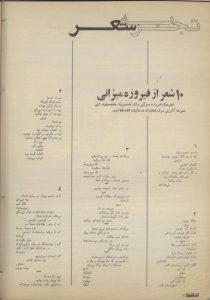
Fīrūzah Mīzānī, born on Āzar 21, 1329/December 12, 1950, in Tehran, is a contemporary Iranian poet, journalist, writer, and translator. Mīzānī holds a degree in Management from the University of Tehran, Iran, and a degree in Comparative Literature from the University of Utah, United States. Her first poems were published in 1354/1975 in the magazine Tamāshā and the literary monthly Rūdakī. She is regarded as one of the prominent poets who played a significant role in Iran’s literary movements during the 1350s/1970s and 1360s/1980s. She is also considered a key figure of the so-called Pure Wave (Mawj-i nāb) movement, a literary circle that included poets such as Hūshang Chālangī, Āryā Āryāʹpūr, Hurmuz ʿAlīʹpūr, Sayyid ʿAlī Sālihī, Sīrūs Rādʹmanish, and Yār Muhammad Asadʹpūr.1Shams Langarūdī, Tārīkh-i tahlīlī-i shiʿr-i naw [An analytical history of modern poetry] (2nd repr. ed., Tehran: Nashr-i Markaz, 1377/1998), 432. This poetic movement, mainly active between 1355–1357/1976–1978, emphasized clarity of imagery, the elimination of linguistic ornamentation, and the cultivation of pure imagination. Its poets, emphasizing a rejection of political and social commitment, believed that “the poet is not only averse to composing socially engaged poetry, but in every line of their verse speaks of the bitterest days of their life, without tying this bitterness to any root or cause.”2Yār Muhammad Asadpūr, Bar Sīnah sang’hā, bar sang’hā, nām’hā [On the chest stones, on the stones, on names] (Tehran: n.p., 1376/1997), 2–3. This trait, alongside a tendency toward regionalism and an inattention to content, is among the other features found in Pure Wave poetry.3ʿAlī Yārī and Manūchihr Jawkār, “Barrasī-i shiʿr-i mawj-i nāb-i fārsī, az sarāghāz tā sarānjām” [An examination of Persian Pure Wave poetry, from origin to end], Faslnāmah-ʾi Kāvushnāmah 14, no. 26. This idea was first articulated by Sīrūs Rādʹmanish, who observed that Pure Wave poems tend to follow a three-part structure analogous to that of a concerto: an initial fast section, a central development in which the motifs introduced earlier are elaborated and diversified, and a concluding section that returns to a slower tempo and brings the poem to resolution. What Rādʹmanish singled out as most distinctive, however, was the second, developmental section, which he compared to a musical idée fixe, a recurring motif, familiar from works such as Berlioz’s Symphonie Fantastique, that reappears throughout a piece in varied form. In the poem, this recurring idea may surface at both the beginning and the end, carrying shared musical and semantic significance, sometimes in tension with the poem’s overall structure and sometimes in harmony with it.4Sīrūs Rādʹmanish, “Gap u guftī bā Sīrūs Rādʹmanish: Ān kas kih zabān-i andīshmandī dārad hamīshah shāʿir mī’mānad [A conversation with Sīrūs Rādʹmanish: Whoever has the language of a thinker always remains a poet],” saeidmoradi.blogfa, accessed December 1, 2025, https://saeidmoradi.blogfa.com/post/20. The movement has, of course, faced criticism from other poets and critics, including the view that “although they shared a common cultural moment, they were unable to bring about change in poetic language commensurate with the idealized world of their poetry, and each went their own way.”5Sūrayyā Dāvūdī Ḥamūlah, “Mawj-i nāb: abzār-i tafakkur-i shiʿr-i nāb” [Pure Wave: The instrument of thought in pure poetry], Majallah-ʾi Āzmā, no. 69 (Bahman 1388/January–February 2010): 17.
The poet Manūchihr Ātashī, who coined the term “pure” (nāb) to describe the poetry of this group, remarks on Fīrūzah Mīzānī:
Fīrūzah Mīzānī’s poetry opens onto pure vistas, marked by warmth and intensity. Although she departs from conventional ʿarūz, her voice asserts itself with confidence. Mīzānī writes with full awareness—both of what she has written and of what she seeks to convey—revealing a masterful exploration of uncharted poetic territories.6Langarūdī, Tārīkh-i tahlīlī-i shiʿr-i naw, 441.
Fīrūzah Mīzānī has published the following poetry collections, listed here in chronological order: Tarāvat-i āvārah dar digardīsī (Wandering vitality in transformation) in 1357/1979, Shikl-i dīrūzī’am mumkin nīst (The shape of my yesterday is impossible) in 1372/1993, Ilāhiyah in1373/1994, Hasūdī bih sang (Jealousy toward the stone) in 1374/1995), and Shiʿr bih daqīqah-ʾi aknūn (Poetry in the present moment), published across three volumes: Vol. 1 (1368/1989), Vol. 2 (1370/1991), and Vol. 3 (1376/1997). Spanning from 1357/1979 to 1376/1997, these works reflect nearly two decades of sustained literary activity, from her earliest collection through her continued output in the 1370s/1990s.
This article aims to analyze selected poems from Fīrūzah Mīzānī’s Tarāvat-i āvārah dar digardīsī through the lens of concerto structure. It does not claim that all the poems in the collection adhere to this form; rather, it examines the usefulness of this structural framework in analyzing the poems and considers the extent to which they follow it. In addition to the structural analysis, the article will examine and interpret the feminine aspects that emerge within this framework.
A distinguishing feature of Mīzānī’s poetry is her subtle fusion of form and imagination. Her poems often build on minimalist imagery and a suspended, contemplative atmosphere, drawing readers into reflections on fundamental human emotions through a distinctive inner rhythm. Mīzānī’s poetry moves from concrete, tangible, everyday experiences toward the inner, mental, and imaginative realms of thought, feeling, and poetic reflection. Her presence in modern literature has been noted for the constructive role it played among female poets in the poetic developments of late 20th-century Iran. Mīzānī’s work exemplifies the Pure Wave style of poetry, in which the poet, employing minimalist imagery and eschewing complex and conventional structures, crafts a world of pure, introspective emotion, as illustrated in the following example of her poetry::
“I remember a love,
and in its wake, I have become hollow.
A rope suspends me from nothingness,
swaying through the wandering streets of the wind.
I return home,
lie down,
and the ceiling presses downward.
My thoughts, like rising bubbles,
turn transparent.
Beneath the soft glow of the lamp,
I whisper, “I have closed myself within the cocoon,”
yet, it all feels so empty.
For in the deepest chambers of solitude,
where I stand alone,
It is only your soft word
that turns me into a butterfly,
so that, at last,
I may
be released.”7Fīrūzah Mīzānī, Tarāvat-i āvārah dar digardīsī [Wandering vitality in transformation] (Tehran: n.p., 1357/1979), 16–17.
In this poem, the poet uses simple yet profound language. The poem directly expresses an experience in which the poet is engaged with herself and the world around her, using images that all stem from nature and personal human emotions. Like other works in the Pure poetry movement, this poem avoids any linguistic complexity. Simple images, such as “a rope suspends me from nothingness, swaying through the wandering streets of the wind” and “my thoughts, like rising bubbles, turn transparent,” show that the poet consciously attempts to avoid unnecessary complexity in language, allowing the emotional weight of the poem to rest on the images themselves rather than on elaborate phrasing.
This clear and straightforward language conveys meaning on a deeper, more intimate level to the reader. The poem’s imagery is at once personal and gendered. The emotional and mental layers behind it communicate a genuine human experience, but one that Mīzānī renders through a distinctly feminine register. Images such as “I have closed myself within the cocoon” and “it is only your soft word that turns me into a butterfly” enact a movement from confinement to release, and the poet frames that release specifically through the body and voice of a woman, moving from isolation and the constraints of her world toward freedom and renewal. This sense of release is close to what the Pure Wave poets themselves described as “pure” poetry which point to freedom from both social and personal constraints, as the poet seeks truth within herself and her world. Mīzānī’s contribution to that ideal is to locate it specifically within female experience as her poetry simultaneously seeks inner truth and the individual experience of femininity, and through this process, forges a profound connection with both humanity and the external world.
Form of Concerto in Fīrūzah Mīzānī’s Poetry
Fīrūzah Mīzānī’s poetry presents a blend of structural and linguistic innovation, reflecting both her mastery of traditional forms and her engagement with the modernist currents that had shaped Iranian poetry in the decades preceding her own emergence as a poet in the mid-1970s. Central to her early works is the concerto-like form, a unique feature of her poetic style. This form is not only structurally innovative but also conceptually significant within the context of modern Persian poetry. Mīzānī’s poetry, particularly during the period influenced by the Pure movement, follows a structure akin to that of a concerto. This quality is especially evident in her poems, which are crafted using minimalist imagery and simple language. One of the defining features of these poems is their division into three parts, which, though not always immediately apparent, are distinguished thematically and technically in various ways. This division is best identified through shifts in tone, pace, and imagery, and through elements such as a fast, image-driven opening; a slower, more emotionally and semantically layered middle section; and a closing return to the poem’s initial images, now transformed.
In her poetry, the first section introduces the primary themes and sensory images. Similar to the exposition movement in a concerto, this section introduces the fundamental concepts. Her poems typically begin with images drawn from nature, emotions, and mental experiences, conveyed in simple, direct sentences that immediately engage the reader’s mind. The second section, known as the development or thematic expansion, delves deeper into the initial concepts. Here, images and ideas are explored more profoundly, with the poet’s emotional and intellectual experiences depicted in a more complex and nuanced manner. This section, much like the second movement in a concerto, is often more emotional and intricate, sometimes accompanied by contrasts and semantic complexities. Finally, the third section of the poem, much like the final movement of a concerto, returns to the original themes, but with alterations and emphases that reflect the poet’s evolution. This section brings the poem to a close, typically ending in a way that feels complete and harmonious, often with a sense of calm or resolution.
This structure is not merely a formal echo of classical music; it also suits the aesthetic priorities of Pure Wave poetry itself, which sought clarity of imagery and a cultivation of pure imagination over ornamentation or overt commentary. The gradual movement from simple exposition through emotional complexity to a resolved return gives Mīzānī’s poems a shape capable of carrying inner transformation without recourse to the discursive or narrative devices the movement otherwise rejected. The close readings that follow examine how this structure operates across individual poems, and to what extent the presence or absence of a fully realized second movement corresponds to differences in the poems’ length and emotional scope.
An Analysis of Four Poems Based on the Concerto Structure
This section analyzes four poems from the collection Tarāvat-i āvārah dar digardīsī that follow the concerto-like structure. This will be followed by a brief statistical summary of how many poems in the collection use this structure.
Example 1:
“There is a pond – I think:
Each and every leaf
That falls,
Each and every stem
That grows
Under the warm rain of the sun.
There is a meadow – my pond is there.
I, like God, in timeless motion,
Am ever flowing, alone,
In a crystal, amidst a landscape
Shaped by the fleeting, deceptive forces of life,
And the crowd,
Into which it immerses itself.
I am lost in the debris of scattered flowers,
Unless the murmur of your tresses
Lays its hand, evoking a trance-like surrender within me.
A pond – there are soft hands,
By the power of the God of spring,
Planting a green seed
In the corners of desires.
I, in this pond,
Grow until I flower.
A pond – there are soft hands,
Tresses that the wind disperse—
Place their hands within the pond,
Gently,
it becomes
A support,
A bud,
Then.”8Mīzānī, Tarāvat-i āvārah dar digardīsī, 9–11.
In this poem, a concerto-like structure is clearly and coherently evident. The poem opens with simple, elemental images of nature such as pond, rain, meadow, and sun, and with phrases such as “each and every leaf that falls” and “each and every stem that grows.” This opening section, functioning like the exposition movement in a concerto, introduces the main concepts and initial imagery and provides a sensory, non-abstract space. The images, portraying natural processes of movement and growth, correspond to the thematic and motif development typically found in the first movement of classical music. Notably, the image of the pond is emphasized, reappearing and being reinterpreted in the subsequent movements.
In the second part, which expands in a more emotional, abstract, and complex manner, the poet moves from the initial image of the pond toward the inner world and human emotions. Phrases such as “I, like God, in timeless motion, am ever flowing,” “I am lost in the debris of scattered flowers,” the self-dissolving into the deceptive forces of life and the crowd, and “the murmur of your tresses” directly evoke inner and human transformations. This section, analogous to the development movement in a concerto, elaborates on the initial concepts and introduces greater complexity. Here, the poet’s inner and embodied emotions are powerfully emphasized and images such as “the murmur of tresses” and “trance-like surrender” render this inner world through the poet’s own body and voice, marking the poem’s turn toward what the poet elsewhere frames as a specifically feminine mode of self-address, her direct address to an intimate “you” who acts upon her (“your tresses,” “lays its hand”) positions her simultaneously as subject and as one acted upon, a relation the poem later resolves through images of growth and support. These images create an emotional and psychological space, common in much of Fīrūzah Mīzānī’s poetry.
Finally, the poem reaches its conclusion, where images such as “there are soft hands” and “becomes a bud” are presented to the reader in a simple and serene manner. This section, like the final movement in a concerto, represents a return to the initial themes, albeit with greater transformation and development. The poem’s closing two stanzas, both opening with the refrain “A pond – there are soft hands,” are read together here as a single recapitulation: the repeated refrain functions like the idée fixe discussed above, the same image recurring with variation to anchor the poem’s return. In this section, the poet returns to the pond image established at the poem’s opening and, through images such as the “bud” and “support,” depicts the process of growth and transformation the speaker herself undergoes, from passive observer to active source of nurture. At the end of the poem, it is evident that the initial image of the pond has been transformed into a soft and nurturing hand, and the return of the “pond” is accompanied by emotional, sensory, and conceptual changes. This transformation from observation to embodied nurture is made possible by the concerto structure. In this arrangement, the pond’s return in a changed form allows the poem to enact its transformation, closing the arc that the second movement’s turn inward had only begun.
Example 2:
“The Bright Song of Four Doors to the Winds”
“How dark
At nightfall
I do not see you
Call out a star in the colorless dust,
Slumbering freshness rolls:
– From the crystal of my closed eyelids
Light goes into the wind
– Until the leaves say a prayer upon the true steadfastness of the beds
– And the dreams that wander within the garden
Hang the vision upon a bud
The dream
– Thus we hear nothing
Except the sound of the sun floating
Amid the pond
Under the village roof
The wind breaks into four parts
A villager recites a quatrain.”9Mīzānī, Tarāvat-i āvārah dar digardīsī, 12–13.
The poem “Āvāz-i rawshan-i chahār darbārah-ʾi bād’hā” (The bright song of four doors to the winds) offers a useful limit case for the concerto framework. Though short enough that its concerto-like structure does not fully register in the statistical analysis presented later in this article, its compressed movements still trace the same underlying arc of confusion and concealment moving toward clarity and emergence. The poem thus illustrates the structure in miniature, even where its brevity prevents that structure from reaching the fuller elaboration seen in longer poems such as the first example. Its interconnected imagery, flowing sentences, and gradual shift from inner to outer scenes align the poem with a concerto-like structure. This analysis traces that process through three stages.
In the first movement, the poem’s “exposition” opens with a dark and ambiguous atmosphere, serving as a preliminary state that sets the stage for the subsequent movements: “How dark / At nightfall / I do not see you.” These words evoke a sense of perceptual void and a limitation in both vision and understanding. Night, darkness, and the absence of sight are the three elements that mark the starting point of this concerto. Subsequently, the poet sounds an inherent voice, calling for emergence or manifestation: “Call out a star in the colorless dust.” This metaphor expresses the poet’s desire for light in darkness and, like the opening theme of a concerto, introduces the poem’s central idea: the wish to emerge from concealment. The phrase “slumbering freshness rolls” that follows shows life gradually moving from stillness to motion. This gentle transition serves as an introduction to the second movement, where the elements of nature and the poet’s mind expand together.
In the second movement (Development), the initial theme of darkness and light is expanded with greater complexity. Four consecutive stanzas, each beginning with a dash like the measures of a musical piece, reflect and complement one another:
“– From the crystal of my closed eyelids
Light goes into the wind
– Until the leaves say a prayer upon the true steadfastness of the beds
– And the dreams that wander within the garden
Hang the vision upon a bud
The dream
– Thus we hear nothing
Except the sound of the sun floating
Amid the pond.”
These stanzas, with their parallel structure and echoing the musical themes of a concerto’s second movement, heighten the poem’s emotional depth and, through repeated semantic and syntactic patterns, enhance its rhythm and cadence. In this movement, natural elements such as “light,” “leaf,” “dream,” “bud,” and “sun” convey themes of awakening, transition, and emergence. The poet’s imagination mirrors an inner awakening; the leaves perform a devotional act; dreams drift through the garden, and visions settle gently upon the buds. These phenomena collectively indicate a progression from stillness to awareness. Ultimately, the “sun, ordinarily perceived visually, is apprehended through its “sound,” functioning as the metaphorical climax of this section.
The third movement (Recapitulation) summarizes and revisits the initial ideas in a transformed manner. However, rather than a mere repetition, it enacts a full transformation: the poem shifts from the metaphorical level to concrete imagery: “Under the village roof / The wind breaks into four parts / A villager recites a quatrain.” These lines have two very important structural points. First, the wind breaking into four is coordinated with the poem’s rhythm at the sonic level, and at the semantic level, it illustrates the joining of natural phenomena with artistic and poetic expression. Second, the explicit reference to the quatrain (chahār’pārah) refers both to a type of classical Persian poem (a four-line stanza with distinct rhymes) and, in this context, also conveys the connection between poetic language and everyday life and people. If the earlier sections of the poem were subjective and metaphorical, this final section establishes a link between that inner experience and the concrete language of society. The poem progresses from initial darkness to light, and ultimately to a language comprehensible to others. This constitutes the final transformation, which defines the third movement of the concerto.
From a different perspective, the poem “Āvāz-i rawshan-i chahār darbārah-ʾi bād’hā”, while clearly structured around the development of meaning and imagery, also conveys subtle affective nuances that, through feminine delicacy, lyrical imagination, and gentle emotion, actively engage the reader. In the opening lines of the poem, the poet experiences hesitation, loss, and darkness. The moment she declares, “I do not see you,” does not express anger or protest but arises from a longing for connection, perception, and illumination. The choice of words gives the poem a soft, reflective tone that resonates with feminine sensibility.
In the middle of the poem, particularly in the second movement, the expansion of metaphors such as light, dream, bud, and sun unfolds within a gentle and fertile context. Dream and vision are not static states but serve as foundations for the growth of meaning and emotion. The imagery of “buds” and the “prayer” creates a delicate, mystical space where nature and femininity are intricately intertwined. At the conclusion, with the image of a villager reading a poem, the poet connects her feminine voice to the collective culture. This is a language that is simultaneously memory-oriented, lyrical, and committed to light.
Example 3:
“In the tropical journey
The stature of centuries-old frost melts away, slowly
Two hands,
Two gentle hands clutch at your hair
Beyond sleep—
Remain silent.
The hottest tropic
Teaches:
There are countless moments
You must forget sleep,
On the warmest night—
Snow falls.
Under its scales,
The eyes of lightning will open.
Two suns become the guardians
of your night-fortresses—
“Then,”
You
Will grow,
You will reach maturity,
And
Two warm hands will give your ashes to the river.
The wonder is the snow in a tropical journey—
The sun in absolute night,
A piece of earth among the hard, rocky cliffs.
What a vastness in the quiet stillness.
Who knows?
It goes to sleep.
Why?
Tired,
It journeys toward the tropics,
To become eternal.”10Mīzānī, Tarāvat-i āvārah dar digardīsī, 28–30.
The poem “Dar safar-i ustuvāʾī” (In the tropical journey) has a coherent structure based on the three-movement concerto model. The gradual progression of the poem begins with static imagery, reaches a point of metaphorical and semantic tension in the middle, and ends with a transformed return, culminating in a cosmic unity. The combination of contrasting elements—such as cold and warmth, sleep and wakefulness, and matter and spirit—allows the poem to unfold slowly and steadily. Change occurs step by step, like a journey, and becomes clearly distinguishable across the three consecutive movements.
In the first movement (Exposition), images such as “The stature of centuries-old frost melts away, slowly” introduce the poem’s opening space through a contrast between an unchanging, cold past and a warm, dynamic present. This contrast helps set the stage for the themes and emotions that follow in the poem. It presents an image of historical frost slowly melting into fluidity under a warm and gentle force. The following lines, “Two gentle hands clutch at your hair / beyond sleep,” symbolize the initiating moment of change, where physical contact becomes a metaphor for awakening or transformation. The command “Remain silent” emphasizes a deep, contemplative silence, creating a state in which the mind and language are held in suspension, poised for transformation. This movement establishes a context in which the poem’s fundamental elements—sleep, stillness, freezing, warmth, contact, and the desire for awakening—are implicitly introduced.
The second movement (Development) intensifies contradictory images and metaphorical combinations. The line “On the warmest night/snow falls” exemplifies the merging of two opposing semantic poles, while, “The eyes of lightning will open” portrays mental awakening and clarity emerging within darkness and lethargy. The line “Two suns become the guardians/of your night-fortresses” uses the duality of the suns to vividly depict a protective, guarding role. In this movement, the contrasts between sleep and wakefulness, the cold of night and inner warmth, and the presence of light build upon themes from the first movement, adding complexity and dynamism to the poem.
In the third movement (Recapitulation), the poem returns to the second-person address (“you”), marking a stage of transformation and maturity: “You / will grow / you will reach maturity.” This process of growth results from moving through previous states and signifies the recognition of a new position for the subject. “Two warm hands will give your ashes to the river” signifies surrender, a return to the cycle of nature, and the acceptance of the body’s mortality in the face of the continuity of existence. At the end of the poem, composite images such as “Snow in a tropical journey,” “The sun in absolute night,” and “A piece of earth among the hard, rocky cliffs” form a metaphorical unity that represents the final synthesis of opposites. In this movement, the overall structure of the poem reaches its climax, while maintaining its internal movement or dynamism.
From the perspective of emotional dimensions and feminine symbols, the poem explores themes such as physical contact, inner transformation, the desire for awakening, and a return to the natural cycle. Terms like “soft hands,” “hair,” “two warm hands,” and “a piece of earth” serve as symbols of the body, softness, nourishment, and creation. The progression from initial contact to maturity, followed by surrender and integration with nature, mirrors a feminine pattern of birth, nurturing, and mortality. In this poem, the feminine force functions not only as the catalyst for change but also as the unifying element that reconciles opposites and fosters the reconstruction of unity. These roles, expressed through a gradual and rhythmic structural pattern, enhance the semantic coherence of the text.
Example 4:
“In the frame of my childhood,
There is a simple image of a girl,
Who lovingly
Presses flowers to her chest
And wonders
What will become of them.
If I had not grown,
It would have been an excuse:
Spring would come,
And the flowers would not wither.
I ascended early
To an awkward height above the plain,
And realized
The sun beyond
Is merely a reflection
Of what I now know.
I hold the image of my childhood
In my hands,
Yet,
No one believes it—
That it is me,
That it is still me,
And that so easily it passes.
Her thoughts among the flowers
Are tightly bound.”11Mīzānī, Tarāvat-i āvārah dar digardīsī, 18–20.
In the first movement (Exposition), the poem begins with a return to the image of childhood. “In the frame of my childhood / There is a simple image of a girl / Who lovingly / Presses flowers to her chest / And wonders / What will become of them.” These lines create a clear, nostalgic, and contemplative space that, by emphasizing the image of the child and the flowers, blends simple emotions with philosophical reflection. The image of a girl, full of love and thought in childhood, sets the opening mood of the poem, while the word “wonders” introduces an introspective viewpoint. This movement introduces the poem’s central themes: memory, childhood, nature, and the questioning of the future.
In the second movement (Development), the poem enters a stage of rupture and transformation. The poet begins with “If I had not grown” and “I ascended early” and reaches “to an awkward height above the plain.” The idea of “growth” is ironic because, instead of bringing advancement, it leads to awkwardness. On the other hand, the line “[I] realized / The sun beyond / Is merely a reflection / Of what I now know” conveys a newfound experience of the world, born from this unintended growth. The world is no longer as it was; its meaning and light are now understood as reflections of the poet’s newly acquired awareness. This section of the poem illustrates the development and expansion of the childhood experience, and through a blend of mental and abstract imagery, it reveals the poet’s inner complexity.
In the third movement (Recapitulation), the poet returns to the initial image: “I hold the image of my childhood/In my hands”, but this time with a sharp awareness and a transformed experience. This return to the past is not merely a recollection of memory, but a renewed encounter with the old self, now rejected by society (the Other): “No one believes it / That it is me.” Nevertheless, through the dual emphasis on “It is me / It is still me”, the poet demonstrates that, despite external changes, her core identity remains unchanged. The final lines, “Her thoughts among the flowers / Are tightly bound,” further underscore the mind’s connection to nature and how the inner self remains stable, even when the external world is in flux. This movement marks the stage of return and complete transformation, moving through the initial image and evolving into a more complex one, yet remaining faithful to the original.
In this poem, feminine motifs are subtly and symbolically woven into the fabric of the poetic language. The image of a girl who “lovingly presses flowers to her chest” symbolizes a nurturing and gentle connection between the feminine and nature. This act reflects the nurturing of the child, rooted in the inner experience of femininity. The terms “Spring” and “flowers,” as symbols of generative and feminine forces, contrast with the withering and awkward ascent, reflecting the unintended loss of delicacy along the path of growth.
The poem’s entire mental structure is built on reflection and introspection, a trait often found in the work of contemporary women poets such as Granāz Mūsavī, Ruzā Jamālī, Nāzanīn Nizām Shāhīdī, and other pioneering female poets of the 1370s/1990s and 1380s/2000s. The return to the childhood image, the dialogue with the past, and resistance to collective denial are vital elements of women’s poetry in the modern discourse. The final lines, “Her thoughts among the flowers / Are tightly bound,” further reflect the continuation of feminine and emotional concerns within the poem—a continuity of emotional origins that persists even after growth and maturity.
An Analysis of Tarāvat-i Āvārah dar Digardīsī
Among the thirty-four poems in this collection, all exhibiting characteristics of Pure Wave poetry, fourteen display concerto-like features, while twenty do not. It is possible that the concerto-like structure in Pure Wave poetry can only be fully realized in longer poems, making it difficult to identify this form in shorter works.12Some poetic movements, such as Hajm, are exceptions to this rule. In the concerto-like structure, the second movement (Development) plays a crucial role, one that might be absent in short poems. Additionally, the pacing of poetic elements across the different movements, which is a defining characteristic of the concerto, is not achievable in short poems. Therefore, the length of the poems in this collection is an important factor to consider.
For this purpose, poems were classified into three length categories. A short poem is defined as one consisting of a single stanza with no internal section breaks. A medium-length poem consists of two stanzas or sections. A long poem consists of at least three stanzas or sections, with a minimum of two line breaks between them. According to this definition, of the thirty-four poems in the collection, fourteen are short, four are of medium length, and sixteen are long. This raises the question of whether a poem’s length is related to its concerto-like structure or if this form is independent of length. To explore this, we applied the Chi-square (χ²) statistical test. The table below, along with the subsequent analysis, addresses this question.
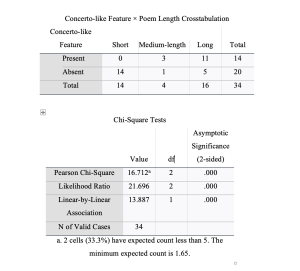
In the Chi-Square Tests table, the significance level (Asymptotic Significance (2-sided)) is less than 0.05, leading to the rejection of the null hypothesis, which posited independence between the two variables. This result indicates a statistically significant relationship between poem length and the presence of concerto structure. It should be noted that two of the six cells in the crosstabulation (33.3%) have an expected count below 5, meaning the chi-square approximation should be interpreted with some caution given the sample size and its distribution across categories; a Fisher’s exact test may offer a more conservative confirmation of this result in future work. The crosstabulation table further shows that poems with the concerto structure are predominantly long or medium-length, while shorter poems tend to lack this structure. Therefore, it can be concluded that the concerto structure is a stylistic feature specific to Fīrūzah Mīzānī’s longer and medium-length poems, rather than a characteristic of all her works.
Another important point is that the pace of progression in Mīzānī’s poems is closely linked to the concerto structure feature. As shown in Tables 1 to 4, the second movement of these poems tends to feature words that evoke a sense of speed, whether or not this reflects a deliberate choice on the poet’s part. For instance, words such as “grow,” “the wind,” and similar expressions create a sense of motion that aligns with the second movement. This sense of speed is created less by literal fast motion than by an accumulation of transformation across the movement: words such as “grow” mark a process unfolding and intensifying over the course of the poem, while words such as “the wind” introduce literal motion, and together they build a cumulative momentum toward the poem’s closing return. Instead of employing a rapid narrative that condenses imagery and prioritizes conciseness, as in Hajm poetry (also known as Espacementalisme), a modernist Iranian poetic movement characterized by “spatial thinking” and a poetics drawing on Husserlian phenomenology, which favors dense, compressed images that convey movement and dimension in a single stroke rather than through gradual unfolding, Mīzānī uses words with semantic depth that evoke the concept of speed through accumulation and development rather than compression.13Alireza Rayat, “Tahlīl-i guftimān-i shiʿr-i hajm va shiʿr-i inqilāb-i Islāmī” [A discourse analysis of espacementalisme and poetry of Islamic revolution,] Shiʿr pazhuhi (Bustān-i adab) [Journal of poetry studies] 11, no. 4 (2020): 95–112.
Conclusion
This article has examined the concerto model as an interpretive framework for Fīrūzah Mīzānī’s poetry, applying it to individual poems in Tarāvat-i āvārah dar digardīsī and testing its scope statistically across the collection as a whole. The close readings show that where the structure appears, it does real interpretive work. The return of a central image, transformed, at a poem’s close (as with the pond in Example 1) is not merely decorative patterning but the mechanism by which the poem enacts psychological or emotional transformation rather than simply describing it. This structure, however, is not a universal feature of Mīzānī’s style. Of the thirty-four poems in the collection, fourteen display it, concentrated almost entirely in long and medium-length poems; short poems in the collection rarely exhibit a fully realized second movement, since the pacing and thematic elaboration the concerto model depends on require room that the shorter poems do not provide. The concerto structure is therefore best understood as a stylistic resource available to Mīzānī in her longer, more expansive work, rather than as a governing principle of her poetics as a whole. This finding should be treated with some caution given the sample size involved, and the shorter poem discussed as Example 2 suggests the structure can also appear in compressed or partial form even where it does not register as statistically “present,” a possibility future work on a larger corpus could examine more closely.
Running alongside this structural argument is a second, more consistently gendered one. Across the poems examined, the second movement in particular tends to render Mīzānī’s inner world through a woman’s body and voice. Image and address (hands, tresses, an intimate “you” who acts upon the speaker) position the speaker as both subject and one acted upon, a tension the third movement typically resolves through images of growth, support, and nurture. Read this way, the concerto structure and the poems’ treatment of gender are not two separate threads but a single one, and the three-movement return is the formal shape through which a specifically feminine experience of transformation, from constraint toward release, is enacted. These findings suggest that the concerto model offers a genuinely productive, if bounded, lens for reading Mīzānī’s longer Pure Wave poetry because it does not describe her work as a whole. Still, this approach is productive because, where it applies, it clarifies both the formal logic of the poems and the specific terms in which they stage female experience.
Cite this article

Abstract
Fīrūzah Mīzānī (b. 1329/1950) is one of the most influential female poets associated with the avant-garde movement in modern Persian poetry, particularly the Pure Wave Movement (Mawj-i nāb). Her first collection, Tarāvat-i āvārah dar digardīsī (Wandering vitality in transformation, 1357/1979), is regarded by literary critics as her most significant work. The collection comprises thirty-four free-verse poems, including Mīzānī’s poems written between 1354/1975 and 1357/1978. Among the various approaches to poetic analysis, the concerto model, proposed by certain poets and critics as a framework for interpreting Pure Wave poetry, offers a compelling and potentially fruitful method. This study applies the concerto-based analytical model to Fīrūzah Mīzānī’s poetry, examining how effectively it illuminates the structural and aesthetic dimensions of Tarāvat-i āvārah dar digardīsī.