

Mānā Āqāyī: The Poet of Ideas


From Bushehr to Stockholm
Mānā Āqāyī (Mana Aghaee) was born in Bushehr in southern Iran in summer 1352/1973. She is the first of two children born to Shīrzād Āqāyī and Khujastih Sulaymān Aznāvī. Her parents worked as senior high school teachers, and her father was an accomplished poet and literary writer. She attended the elementary schools Muʿīnī in Bushehr and Parand in Shiraz. At an early age, she learned the prosody and rhetoric of classical Persian poetry from her father, memorizing thousands of verses by heart. She wrote her first poems at the age of twelve. In 1366/1987, she emigrated with her family to Sweden and settled in Stockholm.1Birgitta Wallin, “Persiska är mitt känslospråk och min barndoms språk. Intervju med Mana Aghaee” [Persian is the language of my emotions and my childhood. Interview with Mana Aghaee], Tidskriften Karavan 1 (2019): 72. Her father had been diagnosed with Parkinson’s disease, and the family had to leave the country due to a lack of medical expertise and treatment during the Iran–Iraq War. Her involuntary emigration from Iran had a profound impact on her being and influenced her poetic style and expression in significant ways. She is, in outlook and intention, an exile and passionately committed to her art and her convictions. In the early 1370s/1990s, her first published poems appeared in various journals in Iran, England, and Sweden, such as Ādīnah, Puyishgarān, and Ārash. After finishing the natural science program in high school, she started studying linguistics at Stockholm University. Determined to preserve her mother tongue, she enrolled in the Persian language and literature program at Uppsala University in 1372/1993. After receiving her M.A. degree in Iranian languages under the supervision of Bo Utas, she was admitted to the doctoral program and continued her studies for four years. With the doctoral thesis still unfinished, she began working as a publisher’s reader and later as a professional translator. Considered a specialist in contemporary Persian literature, her research focuses primarily on the development of modern Persian poetry, the use of metres and forms of versification, and literature among Iranian immigrants in Sweden. Āqāyī collaborates regularly in various literary projects with other Iranian writers and translators. In 1389/2010, she was the co-founder of Sherophone, a biweekly literary podcast in Persian, together with Laylā Farjāmī, introducing contemporary Iranian and non-Iranian poetry to its listeners for four years.
Āqāyī has so far published three poetry collections. Her first collection, Marg agar lab′hā-yi tu rā dāsht (If death had your lips), appeared in 1382/2003, followed by Man ʿĪsā ibn-i khvudam (I am Jesus, son of myself) in 1386/2007, and Zimistān maʿshūq-i man ast (Winter is my lover) in 1391/2012. Marg agar lab′hā-yi tu rā dāsht was initially published in Iran and thereafter reissued in England. Her other two collections were published in Sweden due to state censorship, but selected poems from them were printed in a single volume in Iran with the title Man yik rūz-i tābistān bih dunyā āmadam (I was born on a hot summer day). All her collections have appeared in revised editions and revision of words, style, or phrasing is a salient feature of her poetic composition. After publication she sometimes reworks a single line or two, or whole sections, of several poems. There is always an intense psychological struggle involved in the revision process, yet by revising the shape of her oeuvre, she creates a legacy, ensuring that her work is preserved in the form she desires. Āqāyī is in close contact with literary developments in Iran, and her poems are regularly published in literary journals and anthologies in the country and abroad. Her primary audience is inside Iran, but her poetry also forms a part of a global Persian literary culture.2For an introduction to contemporary Iranian diaspora literature, see Sanaz Fotuhi, The literature of the Iranian diaspora. Meaning and identity since the Islamic revolution (London: I.B. Tauris, 2015). Translations of her poems have been published in anthologies in a dozen languages, mainly English, Swedish, German, Arabic, and Greek. Recently, collections of her selected poems have been published in Turkish with the title Yıllar sonra (Years later) and in Azerbaijani with the title Gecə monoloqu (Nocturnal monologues). Āqāyī is also a writer in Persian of haiku and tanka, two short forms of poetry originally from Japan, which have influenced her personal outlook and poetic practice. Being a bridge-builder between literary cultures, she has introduced the Iranian haiku writer ʿAlī Bayk in Swedish and translated the haiku poetry of the Swedish Nobel Laureate Tomas Tranströmer into Persian. Her body of work also encompasses bibliographical works and anthologies of contemporary Swedish and East Asian poetry in Persian translation. Her involvement with the bibliographical genre stems from her ambition of drawing attention to lesser-known authorships and making the works of Iranian women poets more visible.3Sipīdah Judayrī, “Bih munāsibat-i intishār-i avvalīn kitābʹshināsī-i shiʿr-i zanān-i Īrān. Musāhibah-ʾi Sipīdah Judayrī bā Mānā Āqāyī” [On the occasion of the publication of the first bibliography of women’s poetry in Iran: Interview by Sipīdah Judayrī with Mānā Āqāyī], ʿAsr-i naw (Shahrivar 16, 1386/ August 28, 2007). She is the author of two annotated bibliographical works: a bibliography of Iranian immigrant writers in Sweden and a bibliography of Iranian women poets between 1941 and 2004. The latter research is a unique contribution to Iranian Studies and has remained the single definite publication on the subject.
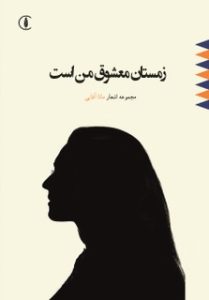
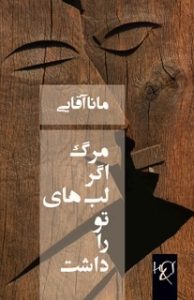
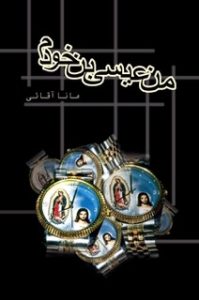
Three collections: Man ʿĪsā ibn-i khvudam [I am Jesus, son of myself] (Stockholm: Alfabet Maxima, 1386/2007); Marg agar lab′hā-yi tu rā dāsht [If death had your lips] (2nd ed., London, H&S Media, 2015); Zimistān maʿshūq-i man ast [Winter is my lover] (2nd ed., Stockholm: Cypress bokförlag, 1398/2019)
A Poet of Ideas
Āqāyī’s poetry is characterized by bold imagery and a voice that is subtle and wholly original. She uses shiʿr-i āzād (free verse) and follows the rhythm of natural, everyday speech, since she believes that the individuality of the poet is better expressed in free verse than in conventional forms. Her poetry is metrically irregular and unrhymed but subject to various guiding principles and elements of form, such as the evocative values of words and the repetition of given rhythmic features determined by accent or stress. Each poem also corresponds to an inner unity of emotion and frequently embodies the complete artistic development of an idea. She favors precision of imagery, directness of presentation, and clear, vivid language. The poetic style is condensed, momentary, and suggestive, mirroring the intelligence, sincerity, and clarity of her vision. The tone is usually informal, calm, and gentle with unexpected shifts aimed at creating tension or depth in meaning. Āqāyī has not been involved in any literary movement, and it is not easy to fit her lyric compositions into a specific literary category. Her poetry belongs to global literary modernism in the sense that she emphasizes her own personal imagination, emotions, desires, and memories.4For a discussion on modernist poetry, see Peter Howarth, The Cambridge introduction to modernist poetry (Cambridge: Cambridge University Press, 2012), 1–32. On global literary modernism, see Jahan Ramazani, A Transnational Poetics (Chicago: The University of Chicago Press, 2009), 1–50. She believes that concentration is the very essence of poetry and tends to focus on concrete details that are further expounded upon with the use of figuration to represent complex ideas. Her style includes introspective narratives, and like many other modernists, she embraces fragmentation and ambiguity, leaving gaps and unresolved tensions within the poem.5Rajab Bazrafshān, “Darbārah-ʾi man harf mī′zanand. Nigāhī bih majmūʿah-ʾi shiʿr-i ‘Man yik rūz-i tābistān bih dunyā āmadam’, asar-i Mānā Āqāyī” [They talk about me. A review of the poetry collection ‘I was born on a hot summer day’ by Mānā Āqāyī], Majallah-ʾi adabī-i piyādih′raw (Āzar 19, 1392/December 10, 2013). Her early poetry has some affinities with the Finnish modernist poet Edith Södergran in her willingness to engage with difficult emotions and her search for meaning in a rapidly changing world. Like Södergran she focuses on the theme of selfhood and emphasizes precision and fluidity of expression over more symbolic and mystical tendencies in poetry. She shares with modernism a commitment to self-conscious experimentation and a desire to always find new ways of expressing the complexities of human life.
Āqāyī can be defined as an existential poet in the general sense, as she confronts the fundamental questions of human existence and meditates on the complexities of life. Because of her ability to craft thought-provoking and evocative poems about the human condition, she can be considered a “poet of ideas”. It is not the variety of tone or complexity of structure that makes each of her individual poems an organically unified text, but the creative concord of thought, feelings, and images. She seeks to express the meaning of subjective thoughts and emotional experiences, but her poetry is typically situated in an outer world, sometimes clearly defined in time or geography. Many of her concise, image-focused short poems in Zimistān maʿshūq-i man ast are characterized by a growing connection to nature and have some important affinities with the later work of the modernist poet Suhrāb Sipihrī, who is credited with introducing the haiku genre in Iran. The haiku is characterized by a simple form, a focus on nature, and the profoundness of single thoughts. Like Sipihrī, her depictions of the natural world are influenced by Japanese haiku poets and the Buddhist concept of the emptiness of ultimate reality. Captivated by its absolute directness and inner vision, she uses exacting momentary images and generally favors simplicity, clarity of expression, and precision. To both Sipihrī and Āqāyī, poetry is not only a form of writing, but more importantly, an ontological condition of human existence. She experiences poetry as a kind of innate drive that seizes her and makes her its instrument. Relying on intuition and expressing herself as a wielder of creative power, she pierces through the veil of appearances and depicts reality through figurative language. Like Sipihrī, her poetry is characterized by concrete imagery, elusive concepts, and the expression of complex thoughts in a simple and highly economical form. But in contrast to Sipihrī’s personal form of modern mysticism, her poetry delves more into subjective experiences and embodies an entirely social and humanistic approach. Her invariably personal poems address the complexities of the human condition in ways that resonate universally and transcend cultures and political borders.
A characteristic of Āqāyī’s poetry is the common use of the first-person narrator, which creates a sense of intimacy, drawing the reader into the personal experiences of the speaker. Even if her confessional style gives profound access to her emotional life and predicaments, it would be naïve to immediately identify the person who speaks in the poem with the author’s self. Her use of the first-person form defies any personal limitations and cannot be considered autobiographical as such. Instead, the poetic self is projected into the narratives and participates ambiguously in the poems. She tends to proceed from a personal incident or personal emotion, but the subject matter is imaginatively transformed and developed as the poem takes a distinct form. Āqāyī is conscious of her own existential subjectivity and of herself as a thinking and feeling subject. Her self-consciousness as a poet is observable in the fact that her poems display awareness of their own creation and of themselves as poetry. In some poems the first-person speaker even identifies herself as a poet and her utterances as poetry. For instance, she depicts the creative act of writing poetry as throwing down “the thin rope of imagination” into “the well of oblivion” and then “very easily” pulling up the moon reflected therein.6Mānā Āqāyī, Zimistān maʿshūq-i man ast [Winter is my lover] (2nd ed., Stockholm: Cypress bokförlag, 2019), 44. In Persian literature the presence of the moon symbolizes immortality, beauty, and unspoken words between lovers. Being aware of poetry as a subjective composition, self-consciousness becomes the centre of her imaginative life as a poet. In the rather surrealistic poem “Bū-yi pīrāhanat” (The scent of your shirt), she portrays life’s journey as a short break, a transient moment beneath the open window to her lover’s bedroom. In the final lines, she turns to her beloved, confessing that she is performing the poem for its own sake and that she is content with not seeing him and only possessing the scent of his shirt:
And this poem I repeat for its own sake
The very thing that I have travelled a long way to meet you
But is content with bringing with me the scent of your shirt7Mānā Āqāyī, Marg agar lab′hā-yi tu rā dāsht [If death had your lips] (2nd ed., Stockholm: Cypress bokförlag, 2015), 51.
و این شعر را بهخاطر خودش تکرار میکنم
همینکه راه درازی را
برای ملاقاتت آمدهام
اما به بردن بوی پیراهنت قانعم
Alluding to the story of Joseph in the Qurʾan, the “scent of your shirt” is a metaphor for the relationship between the lover and the beloved and is used by the poet to evoke the presence of her lover in the absence of union. The message is that poetry has an intrinsic value, separate from any ulterior motives and mightier than any external influences or pursuits, such as love.

Photo of Mānā Āqāyī (Courtesy of Mānā Āqāyī, taken in 2017 in Paris)
Multiple and Interwoven Themes
Āqāyī’s poetry mirrors the evolution of her outlook and style from a young defiant woman’s longing for fulfilment, preoccupation with the future, and search for meaning in a transient world, to bolder images, interest in exploring the complexities of life, and compassion for the current predicament of humanity. Among the most important themes in her work are belonging, love, intimacy, and the enduring power of the human spirit in the face of adversity. Frequently, she delves into the central topics of loss, memory, the circle of life, fate, pain, and the will to survive. A prominent feature of her verses is the combination of various principal and subsidiary themes in one and the same poem. In addition to her penchant for polysemic language and ambiguous imagery, this is a structural technique that she has in common with the lyrical poet Hāfiz of Shiraz, even if the latter worked within a very different literary form and context, aiming at renewing the classical ghazal.8Ehsan Yarshater, “Hafez i. An overview”, Encyclopaedia Iranica, Volume XI, Fascicle 5 (New York: Bibliotheca Persica Press, 2003), 461–62. Āqāyī gives a special aesthetic value to each individual sentence in her free verse poems, and the principal and subsidiary themes are intimately interwoven and often appear within the same narrative. The subsidiary themes are sometimes derived from the principal theme, which provides the beginning and climax, and often closes the poem. The interwoven character of her poetry is perhaps nowhere more apparent than in those poems that describe the poet’s condition and the creative activity of lyrical composition. In these poems individual themes and motifs are effectively combined in unexpected ways and closely connected to the aesthetic, ethical and transcendent. In the poem “Bidūn-i nām” (Without name) she vividly describes her birth as a poet and the process of writing as a delivery or childbearing, interweaving the principal theme of the poet’s calling with the subsidiary themes of memory, socio-political criticism and a young girl’s emotions. Invoking the reign of terror during the 1357/1979 revolution and the war years, she instructs her child to be aware of the oppression in society (“the redness of the spilled blood will show you the way”). In the final lines, she touches upon the purpose of poetry, suggesting that the poet should be either a heroic and forceful voice against injustice or a source of comfort (“a lullaby”) for her compatriots who are collectively suffering from insomnia due to widespread oppression:
I gave birth to you in the year of fear
In the time of the shamefacedness of the moon
When the names of all the alleys were Shush!
And no one except Death rang on one’s door
I found refuge behind a blank sheet of paper
And upon hearing the boots approaching
I cut your navel string with the sharp blade of the word
Farewell, my child!
I don’t bestow a name upon you
So that our parting won’t be even more arduous
So that the redness of the spilled blood
Will show you the way
My conscience says: Poetry must be a roar
Amid darkness
And my heart says: It must be a lullaby
In the land of insomnias9Mānā Āqāyī, Man ʿĪsā ibn-i khvudam [I am Jesus, son of myself] (2nd ed., Stockholm: Cypress bokförlag, 2025), 21.
تو را در سال ترس به دنیا آوردم
در زمانهی روسیاهی مهتاب
وقتی که نام تمام کوچهها هیس بود
و جز مرگ کسی زنگ خانه را نمیزد
پشت کاغذی سفید پناه گرفتم
و گوش به صدای چکمهها
که نزدیک میشدند،
بند نافت را با چاقوی تیز کلمه بریدم
بدرود فرزندم!
نامی بر تو نمیگذارم
تا جدایی از این دشوارتر نشود
تا سرخی خونی که ریخته
راه را نشانت دهد
وجدانم میگوید: شعر باید نعرهای باشد
در دل تاریکی
و قلبم میگوید: باید لالایی باشد
در سرزمین بیخوابیها
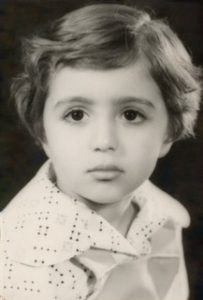
Photo of Mānā Āqāyī (Courtesy of Mānā Āqāyī, taken in 1977 in Bushehr).
Identity and Belonging
The themes of belonging and identity appear frequently in Āqāyī’s work and are often closely related to other leitmotifs, such as reminiscences of childhood, migration, displacement, and resilience. The personal background of these themes is her traumatic experiences of the Revolution and the Iran-Iraq War, and of being forced to leave her native land. Many of these poems resonate with the force and intensity of the personal and at the same time express universal human experiences of nostalgia, longing, and loss of innocence. In “Kūdakī [1]” (Childhood [1]), she vividly captures a child’s transition from a state of naivety to more complex conceptions of the human condition. The style is narrative, emphasizing introspection, emotional depth, and immediacy. The use of concentrated imagery enhances the narrative experience and transports the reader to the heart of the poem. The speaker is typically not the poet but a self-representation, partly autobiographical and partly fictional. She reflects on her happy and cheerful early years, but she is not depicting an idealized time or place. By adopting a precise and evocative language, rich in imagery and connotation, she creates a sense of realism and effectively captures the essence of conflicting feelings, such as joy and melancholy, comfort and distress, safety and vulnerability. The mood reflects the speaker’s emotional state, but the poem can also be seen as a broader commentary on the process of becoming an adult and on human yearning for the lost paradise of childhood. The verbalization of the personal has an unmistakable universal value that transcends the writer’s immediate historical and geographical context. The ambience of her childhood days in the port city of Bushehr is lost to her temporarily, and it is also physically distant. Yet, by recalling the simple joys and early anxieties of her youth, she creates an enduring legacy:
I was born on a hot summer day
The year when the shadow of the palm tree burned the soil
And the sea was a huge blister on the forehead of the port
My mother brought me up on a handwoven jute rug
With the eye’s tear and the heart’s sigh
Like all children my body wore a dress of clouds
And under my head was the soft pillow of dreams
My father I had never seen except in sleep
They said he had gone for a long journey
Later we received his ragged shoes
Those days the war had not yet come to our street
I chattered with the doves
The walls were short
And the hand of the kite touched the ceiling of the sky
In the mornings I went to school shoulder to shoulder with the sun
In the afternoons I returned home with happy pinwheels
I sat by the window
And listened to the words of the rain
It was behind those cold iron grilles
That I became familiar with poverty
It was through those thin, pink curtains
That I fell in love for the first time
According to the mirror I was fourteen
My fingers smelled of fear and ink
And inside all my books
I placed red rose petals10Āqāyī, Marg agar lab′hā-yi tu rā dāsht, 7–8.
من یک روز داغ تابستان به دنیا آمدم
سالى که سایهی نخل زمین را میسوزاند
و دریا تاولى درشت بر پیشانى بندر بود
مادرم مرا با اشک چشم و آه دل
بر فرشى از حصیر دستباف بزرگ کرد
مثل تمام بچهها پیراهنى از ابر به تن داشتم
و بالش نرم رؤیا زیر سرم بود
پدرم را هیچوقت جز در خواب ندیدم
میگفتند به سفر دورى رفته است
کفشهاى پارهاش بعدها به دستمان رسید
آن روزها هنوز جنگ به کوچهی ما نیامده بود
من با کبوترها حرف میزدم
دیوارها کوتاه بودند و
دست بادبادک به سقف آسمان میرسید
صبحها دوش به دوش آفتاب به مدرسه میرفتم
عصرها با فرفرهاى شاد به خانه برمىگشتم
کنار پنجره مینشستم
و به حرفهای باران فکر میکردم
از پشت همان میلههاى سرد آهنى بود
که فقر را شناختم
از لاى همان پردهی نازک صورتى بود
که اولین بار عاشق شدم
به روایت آینه چهارده ساله بودم
انگشتهایم بوى ترس و مرکّب میداد
و لاى تمام کتابهایم
برگهاى سرخ گل میگذاشتم
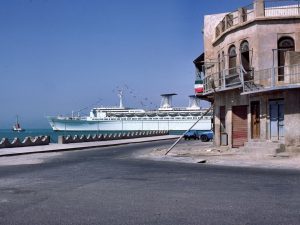
S/S Raffaello in Bushehr, 1977 (unknown author, Wikimedia Commons)
Several poems in Āqāyī’s first collection Marg agar lab′hā-yi tu rā dāsht focus on the loss of childhood and the pains of exile, and are concerned with the themes of alienation, loneliness, and distance from the homeland. By returning to the innocence of her childhood, the poet escapes the ugliness of adulthood and forgets the tragic, lonely moments of exile. The vivid imagery that she uses in these poems not only reflects her alienation or psychological distance from the world around her but also illustrates her profound disillusionment and fragmentation in the face of political upheaval and rapid social change. Her existential feeling of non-belonging represents the dispossessed personality’s search for identity and meaning. This form of alienation is a recurrent motif in modernist literature and arises out of the ontological insecurity and self-estrangement of the modern subject. By recalling the authentic moments of her youth, the poet enters the nostalgic space of return and virtually cancels the logic of time. It is as if this early period in her life embodies a timeless, infinite space parallel to and more authentic than that of her present situation. With the collapse of time, the poet is imaginatively present in the eternal beginning when the world was first created and becomes coexistent with the golden days of humanity when all people lived in peace, prosperity, and happiness:
Let us return together to the first days of rain
Let us run, let us close our eyes
Let us speak to each other anew11Āqāyī, Marg agar lab′hā-yi tu rā dāsht, 46.
بیایید با هم به روزهاى اوّل باران برگردیم
بدویم، چشم ببندیم
همدیگر را از نو صدا کنیم
In her childhood poems, Āqāyī creates a nostalgic modality and deliberately connects to the notion of the mythical utopia or the idea of humanity’s lost golden age. The golden age is imagined as a lost perfection prior to the earthly exile of man. By installing the space of nostalgic return, her free verse is invested as a space of revival for her readers. As one critic has put it, through her poetry, she preserves the paradisiacal vision of primordial man and restores the days of our eternal beginning:
By revisiting the first age of humanity, Āqāyī makes the vision of primordial man tangible to us. Primordial man or mythical man believed that in the beginning, Heaven and Earth were intimately joined together. Man could reach the sky from any height, either from the top of a tree or from a mountaintop and speak to the gods. Because of the advent of evil that befell the righteous, Heaven and Earth, which are our mythical parents, became separated from each other and the paradisiacal state was no longer accessible to man. However, the poet has preserved this primordial vision to this day and, by reversing time, she restores the days of our eternal beginning.12Muhammad Yaʿqūb Yasnā, “Dilvāpasī barāyi zamān az dast raftah dar shiʿr-i Mānā Āqāyī” [Nostalgia for lost time in the poetry of Mānā Āqāyī], Khurāsān Zamīn (Day 13, 1388/ January 3, 2010).
Self-consciousness and introspection are unavoidable dimensions of Āqāyī’s portrayal of her acute sense of displacement and alienation in her early exile. In the poem “Āvārah-ʾi shab” (Vagabond of the night), she delves into the enduring losses and pains she experiences as an Iranian exile in Sweden. In the opening lines, she portrays herself as a vagabond in the night of separation, a homeless migrant who carries the exile within herself. In Persian poetic tradition, the night is a symbol of the absence of the bright face of the beloved, entailing mourning and despair. Alluding to this symbolism, the poet compares her existential condition to the dark night of the soul, experiencing separation from her native land. She has chosen to be exiled to the most remote location in the world (“on the world’s highest rooftop”), a faraway place where nature is in a bitter and unfriendly mood (“low skies”). The poet refers to herself as a shahīd-i zindah (living martyr) for the suffering she is enduring and calls upon the stars to fall from the sky as a sign of her internal turmoil. She summons Heaven to shed its thick tears of ink on her blood to give witness to her personal sacrifices. The poem uses an overtly religious vocabulary. The word shahīd literally means “witness” and in the Abrahamic religions a living martyr is a person who gives witness to the truth. In the Bible stars falling from the sky is a sign of the final apocalypse, and according to an Islamic tradition, the ink of the pen is more sacred than the blood of the martyr. The darkness of exile is semantically connected to the blackness of the ink that the poet makes use of to give testimony to the bloodshed. Despite the markedly pessimistic tone that permeates the poem, Āqāyī refuses to embrace nihilism or to fall into a self-destructive conception of the world. In the final lines, she expresses a rejuvenating hope for the future and has taken on the role of being a guide for her readers. She has come to consider suffering as inseparable from life itself and has accepted her destiny as an exile. The poem reads in full:
I don’t know if I am the vagabond of the nigh
Or if it is the night
That is wandering in me
Talking
Mourning
Stars, fall, fall down!
Wash the corpse of this living martyr
With your dense tears
Let your ink
drip on her blood
Let the blackness give testimony to the redness
When I
Was choosing to settle on the world’s highest rooftop
I never feared of falling
The low skies of exile know
I was a lost woman
But made my heart your compass13Āqāyī, Marg agar lab′hā-yi tu rā dāsht, 27.
نمىدانم منم که آوارهی شبم
یا این شب است
که در من راه مىرود
حرف مىزند
گریه مىکند
بریزید ستارهها، بریزید
نعش جوان این شهید زنده را
با اشک غلیظ خود غسل دهید
بگذارید جوهرتان
بر خون او چکّه چکّه کند
و سیاه بر قرمز گواه شود
وقتى که من
بر مرتفعترین بام جهان خانه گزیدم
هیچگاه از انگیزهی سقوط نترسیدم
آسمانهاى کوچک تبعید مىدانند
زنى گمراه بودم
اما قلبم را قطبنماى شما کردم
Death and Adversity
The complex and often daunting theme of death permeates Āqāyī’s early poetry. She explores the subject with notable sensitivity and awareness of the transience of human life. Her interest in her own mortality reflects her strong conviction that poets die young and her personal experience of losing close family members in her adolescence. The theme of death is ubiquitous in Marg agar lab′hā-yi tu rā dāsht, where the general tone and mood are more afflicted and melancholic than in her later work. In several poems she engages with different aspects of death, often depicting it as inescapable, mysterious, and intensely fearful. In one poem she meditates on her own sudden demise and in another she imagines her own burial, focusing on sensory experiences as she leaves this world for the unknown. The anticipation of an imminent death is reflected in the poem “Hizār va yik shab” (One thousand and one nights). The poet presents herself as a storyteller, mentions the legendary Scheherazade, and rhetorically asks why her own death is being postponed every night.14Āqāyī, Marg agar lab′hā-yi tu rā dāsht, 13. Cf. Āqāyī, Zimistān maʿshūq-i man ast, 33. In the culmination of the title poem, “Marg agar lab′hā-yi tu rā dāsht” (If death had your lips), she confesses that if death had her lover’s lips, it would long ago have perforated her jugular veins with a kiss.15Āqāyī, Marg agar lab′hā-yi tu rā dāsht, 10. The existential perspective in her subsequent collections is fairly influenced by her personal studies in modern psychology, Zen philosophy, and the spiritual teachings of Jiddu Krishnamurti. She feels life to be meaningful, emphasizes continuity in nature, and accepts death as the natural outcome of the life process. There are even vaguely positive associations of an afterlife as she imagines herself posthumously as a wind that escapes the cemetery, wandering around town like a homeless vagrant.16Āqāyī, Zimistān maʿshūq-i man ast, 34.
Narrative style is a salient feature of Āqāyī’s lyrical poetry. She regularly weaves storytelling into her work and narrative techniques are essential tools for her to convey complex personal emotions, ideas, and experiences. In “Man ʿĪsā ibn-i khvudam” (I am Jesus, son of myself), she relies on a religious event as a basis for the poem’s larger metaphoric structure. With biblical accounts of the path that Jesus took on the way to his crucifixion at Calvary as background, she depicts her own personal struggle and existential crisis over questions about self-identity and the meaning of life. The poet skilfully captures the open-endedness of the event, conveying the idea that life is a continual becoming and that the quest for individual self-realization is universal. The message is that adversity reveals true character, fostering resilience and deeper understanding about the human condition, and that the power of perseverance determines a person’s destiny. The Via Dolorosa or “Sorrowful Way” of the poet culminates not with crucifixion at Calvary Hill but with her victorious ascension at the Hill of Poetry, which symbolizes her artistic triumph and fulfilment as a poet:
In the beginning was the “A”
And thirty-one other letters
That burdened my heart
And a city that burned
Desertlike under the zenith of the sun
The “B” reminded me of my Judas brothers
The “F” was the father who forsake me
And the “T” was the narrow triangle of family
That I had to escape from
The “C” I was indifferent to
To following the crowd
That saluted me with ridicule
On that lengthy Friday
I set foot on a path of no return
And the “L” of loneliness
Shone on my head like a crown of thorns
I wrote “P”
And a wide stony path appeared in front of me
I wrote “S”
And passed through the narrow streets of the alphabet
I wrote “H” and carried the cross with me
And pantingly
Ascended the Hill of Poetry17Āqāyī, Man ʿĪsā ibn-i khvudam, 8. The last sentence in the original has the letter sad (ص) as in salīb (cross) but to avoid repetition “C” has not been used in the translation.
در آغاز «الف» بود
و سی و یک حرف دیگر
که بر دلم سنگینی میکرد
و شهری که بیابانوار
زیر ستیغ آفتاب میسوخت
«ب» مرا به یاد برادران یهودایم میانداخت
«پ» پدری که ترکم کرده بود
و «ث»، مثلث تنگ خانواده
که باید از آن بیرون میزدم
به «ج» بیاعتنا بودم
به جماعت همرنگی
که با ریشخند بدرقهام میکردند
در آن جمعهی طولانی
من پا در راهی بیبازگشت گذاشته بودم
و «ت» ی تنهایی
چون تاجی از خار بر سرم میدرخشید
نوشتم «س»
و روبرویم سنگلاخی گسترده شد
نوشتم «ک»
و از کوچههای باریک
و تودرتوی الفبا گذشتم
نوشتم «ص»
و صلیب را با خود کشاندم
و نفس نفس زنان
از تپهی شعر بالا رفتم
With the title “I am Jesus, son of myself”, Āqāyī expresses the idea of her own self-generation as a poet. The letters are signs that represent entities, objects, sentiments, or ideas rather than sounds. For instance, the letter “A” (alif or aleph) has the archetypal value of the whole alphabet and represents the infinite eternal light and the initial state of existence. By passing through various immanent manifestations of the alphabet, starting with the alif, she has become her own savior and the self-generating source of her own inspiration. Through her poetry, which is the result of a continuous creative process of self-generation, she has become the Word.
Love and Gender
Throughout her oeuvre Āqāyī delves into the themes of love, gender relations, and the sexual experience of love. Her love poetry is characterized by concrete language and figures of speech, modern subject matter, and avoidance of romantic or mystical themes. Breaking away from the flowery, idealized imagery of late classical Persian poetry, she uses vivid, everyday language to convey powerful images that highlight the ambiguity and depth of the subject. Emphasizing the imperfect and multifaceted nature of love, she portrays the complexity, insecurity and trials of human relationships. Her overtly erotic poems stand out for their combination of realism and symbolism and reflect her profound preoccupation with the theme of intimacy. Āqāyī often projects herself personally into the verses, expressing individual experiences and challenging male-centred perspectives in literature and culture. In her poem “Gāv-āhan” (The plough), she depicts the physicality and sensuality of an intimate relationship, exploring her own desires and pleasures. Embracing symbolism, she adopts the imagery of ploughing and harvesting to capture the transitory moments and transformative power of the erotic encounter. She is the farmland, and her lover is a plough who passionately loosens and turns her before sowing his seeds. The poem focuses on body sensations and is intensely personal, but the corporeal intimacy of the occasion ultimately transcends understanding. In the culmination of the poem, she elegantly exploits the ambiguous possibilities inherent in language. When saying that she carries her lover’s name like a yoke around her neck, she is alluding to the lexical ambiguity of the verb bar gardan giriftan (to shoulder), which has the figurative meaning to take on a burden. The poet is making a confession, stating that she willingly takes on the burden of her lover’s sin, the sin of unfettered love:
You are the wild lover of the wheat field
A civilized plow
Who invades my bedroom
Threshes the ripe harvest
You stick a pitchfork in my hair
And the grain is winnowed by the wind
You kiss my lips
And the cracked soil is watered
I want to be a stalk, tall
And get stuck between your teeth
Open your mouth!
You are the leather of that whip
That drives forward the wagon of the seasons
I shoulder your name like a yoke
My heart is not drunk to satiety of you
In the drought year of words
And the dryness of cries18 Āqāyī, Man ʿĪsā ibn-i khvudam, 23.
تو معشوق وحشی گندمزاری
یک گاوآهن متمدّن
که به اتاق خواب من یورش میآوری
و محصول رسیده را
لگدکوب میکنی
چنگال در موهایم فرو میبری
و خرمنی بر باد می رود
بوسه بر لبانم میزنی
و خاک ترک خورده آبیاری میشود
میخواهم ساقهای باشم بلند
و لای دندانهایت گیر کنم
دهان باز کن!
تو چرمِ آن تازیانهای
که گاری فصلها را جلو میبرد
نامت را چون یوغی به گردن گرفتهام
قلبم از تو سیراب نمیشود
در قحطسال کلمه
و خشکی فریادها
Āqāyī’s poetry reflects a feminist perspective in the sense that she explores gender roles in ways that defy patriarchal structures and challenge conventional restrictions on women in Iranian society. By describing romantic emotions, sexual desire, and instincts from a woman’s perspective, she asserts a distinctively female subjectivity. In “Āgahī-i hamsarʹyābī” (Personal ad [seeking husband]), the speaker is a young woman searching for a spouse, and the poem is consciously presented to the reader as more or less autobiographical. The speaker describes herself, her personality, her daily habits, and the kind of person she is looking for to her readers. She questions stereotypical male notions of femininity and challenges the authenticity of romantic notions of love. Suggesting a more realistic understanding of gender that considers individual dispositions, the poet is undoubtedly voicing her own personal sentiments in many lines of the poem. For instance, one of the two conditions that she has set for her future husband is that “he should obey only his shoes”. Shoes are a recurring motif in Āqāyī’s poetry and often symbolize personal growth, transition, and a longing for exploration. She effectively adopts humor as a literary device to comment on the subject, indirectly criticizing cultural norms and expectations about female virginity, chastity, and marriage proposals. Given the subject matter, the language is straightforward and unadorned, reflecting an emphasis on simplicity, immediacy, and authenticity. The tone is resolute and determined, mirroring the poet’s unwavering spirit and call for equality and intimacy in uncertain times of social and cultural change. Compared to her other work, the poem is less experimental in form and stands out for its humorous tone, yet it retains her signature style:
I am a twenty-eight-year-old woman
with strange habits
Mistakes as large as myself
I brush my teeth every morning
I sit at my desk at work
And I drown my sorrows by reading the classifieds
I have survived many storms
I respect the rights of all animals, even humans
and I favor suffering to achieve a goal
to the short-lived pleasures of life
I have boycotted the cinema
Tight skirts and high heels
Rob me of my ability to think freely
My God is merciful
He has created hell to make me feel guilty
and Viagra for the survival of my offspring
I have accepted being human with all its perils
In a world where in its every corner a chemical bomb leaks
One would be foolish to wish to become an angel
To sew wings to the wounds on one’s shoulder
The man I am looking for
Must share my beliefs
Must not have his nose buried in books
Must not turn the other cheek to every superpower
I have two conditions for him:
First, he should never tire of moving
Second, he should obey only his shoes19Āqāyī, Man ʿĪsā ibn-i khvudam, 10.
زنی هستم بیست و هشت ساله
با عادتهایی غریب
و اشتباهاتی همقد خودم
که صبح تا صبح دندانهایم را مسواک میزنم
پشت میز اداره مینشینم
و غصّههایم را با خواندن «نیازمندیها»ی روزنامه فراموش میکنم
من از توفانهای بسیاری گذشتهام
من به حقوق همهی حیوانات – حتّی بشر- احترام میگذارم
و زجر کشیدن در راه هدف را
به لذّتهای زودگذر ترجیح میدهم
سینما را تحریم کردهام
دامنهای تنگ و پاشنههای بلند
حق آزادانه فکر کردن را از آدم میگیرند
خدای من مهربان است
او جهنّم را برای عذاب وجدانم
و وایاگرا را برای بقای نسلم آفریده
من آدم بودن را با همهی مضرّاتش پذیرفتهام
در دنیایی که از هر گوشهی سقفش
بمب شیمیایی چکّه میکند
آدم باید احمق باشد که آرزوی فرشته شدن کند
و به زخم شانههایش بال بدوزد
مردی که دنبالش میگردم
باید شریک اعتقاداتم باشد
او نباید در کتابها زندگی کند
و صورتش را برای هر ابرقدرتی جلو بیاورد
برایش دو شرط گذاشتهام:
اوّل اینکه هیچوقت از رفتن خسته نشود
دوّم اینکه فقط از کفشهایش اطاعت کند
Āqāyī’s reimagination of femininity is evident in her transformation of deeply rooted gender categories of language. For instance, in a short poem, she compares the body of her lover to a physical map of the world (atlas) that she explores, continent by continent. In contrast to those women who conquer the male body straightaway without paying attention to physical details, she discovers it gradually, limb by limb. By portraying women as explorers and conquerors of the male body, the poet effectively reverses the patriarchal norm of sexual satisfaction according to which men are invaders and conquerors of the female body and rulers of what they have conquered. For the poet the male body is not a personification of conquered lands, but instead it embodies territories in the process of being explored. This poem contains a fine polysemic wordplay, since the Persian word atlas has the dual meaning “map collection” and “satin”. The poet exploits the lexical ambiguity to create an effective metaphor, equating her lover’s skin to the glossy, smooth, and lustrous material:
Your body is the soft atlas of geography
Everybody conquers it
I discovered it continent by continent20Āqāyī, Zimistān maʿshūq-i man ast, 47.
تنت اطلسِ نرمِ جغرافیاست
همه فتحاش میکنند
من قارّه به قارّه کشفش کردم
Nature and the Four Seasons
Āqāyī considers the natural world with more complexity than the celebratory odes of the Persian late classical tradition. She contemplates nature as an individual experience and frequently adopts natural imagery to evoke a range of conflicting ideas and emotions. The restless wind blowing across borders is a symbol of freedom, but also of death as it penetrates the heart of the night without returning according to its circuits.21Āqāyī, Marg agar lab′hā-yi tu rā dāsht, 34. Exploring the transformative qualities of nature, she likens the climbing morning glory to the courting lover, and uses the image of the trembling yellow leaf to evoke a sense of anxiety.22Āqāyī, Zimistān maʿshūq-i man ast, 48, 53. Mighty symbols, such as the palm tree, the sun, or the high blue sky, become recurrent motifs of endurance and hopefulness in the torments of exile in contrast to transient and momentary motifs, such as clouds, rain, or snow. Self-reflection within nature allows the poet to connect with the natural world on a deeper level and to obtain silent knowledge about her own inner states and dispositions. Her haiku poems are preoccupied with the affinity between man and nature and utterly avoid delving into human sentiments in the context of society. According to the worldview of the Japanese haiku and the teachings of Zen Buddhism, nature is ultimately a mirror of the enlightened self.23Kenneth Yasuda, “‘Approach to haiku’ and ‘Basic principles’”, in Japanese aesthetics and culture. A reader, ed. Nancy G. Hume (New York: State University of New York Press, 1995), 132, 145. The genre is essentially concerned with the objects of the natural world and traditionally requires the poet to include a clear reference to one of the four seasons. In contrast to classical haiku writers, who aimed at the depersonalization of sensation through the portrayal of nature, Āqāyī occasionally engages in expressions of individual thoughts and her fundamental orientation is self-conscious and typically modern. She does not follow the formal rules of the classical haiku, but experiments with diverse syllable counts and formats to achieve a minimalist style that allows for greater flexibility and creativity in language and imagery:
My old shoes
with the raging river
to places not traveled.24Āqāyī, Zimistān maʿshūq-i man ast, 56.
کفشهای کهنهام
با رودخانهی خروشان،
به راههای نرفته
Āqāyī’s haikus are not immersed in single emotions, but they are receptive and pensive experiences. It is as if the objects in the world speak to her, inviting her contemplation, whereby she becomes absorbed into an aesthetic experience:
The scent of wild jasmine,
returns to the bedroom
with closed eyes25Āqāyī, Zimistān maʿshūq-i man ast, 55.
عطر یاس وحشی،
چشم بسته برمیگردد
به اتاق خواب
In an interview she has explained that her meditative outlook emerged from personal experiences during a period of solitude when she abandoned the mechanical routines of life and engaged in everyday observation of the natural world. She started to observe without evaluating and discovered “the true nature of things”, for instance, in the sound of a “falling leaf”.26Sipīdih Judayrī, “Musāhibah bā Mānā Āqāyī: nigāh kardan bidūn-i radd yā qabūl” [Interview with Mānā Āqāyī: Observing without rejecting or accepting], Shahrgān (Ābān 5, 1391/October 26, 2012). Haiku poetics is based on Zen Buddhistic teachings about the essence of being and an aesthetic attitude of disinterested contemplation, reflecting a profound engagement that transcends superficial appreciation of existence. “The haiku moment”, a term coined by Kenneth Yasuda, can be described as a Japanese literary equivalent to James Joyce’s notion of the “epiphany”, a moment of illumination or insight into beauty: “The nature of a haiku moment is anti-temporal and its quality is eternal, for in this state man and his environment are one unified whole, in which there is no sense of time.”27Yasuda, “‘Approach to haiku’ and ‘Basic principles,’” 146. Haiku is ultimately a state of being, an aesthetic moment in which the words which created the experience and the experience itself become one:
I bend over
in a spring pound
a wounded deer.28Āqāyī, Zimistān maʿshūq-i man ast, 58.
خم میشوم
در برکهی بهاری،
گوزنی زخمی
The integration of haiku sensibility into Āqāyī’s poetics is evident in numerous poems in the collection Winter is my lover, which is characterized by its minimalist, image-driven, and suggestive style. The poet seeks out new and revealing perspectives on the human condition, reconnecting with the immediate physical world around her, and focuses on vivid imagery to evoke emotions. For instance, the poem “Rāhnamā-yi fasl′hā” (Season’s guide) shuns human-centred emotions and has some important affinities with the allusive, condensed, and concrete qualities of the haiku. The mode of experience is suggestive rather than descriptive. The avoidance of intellectual or moral reasoning, as well as the ensuing sense of unity with the rhythm of the seasons, is in harmony with Zen philosophy. Āqāyī’s portrayal of the seasons is characterized by economy of language and contrasting elements. The final line contains an element of surprise attributable to the polysemy of language, which is difficult, if not impossible, to convey in translation. Given that the person is riding a car, the ambiguous use of the word تصادفی, having the double meaning “by accident” (tasādufī) and “an accident” (tasādufī), leaves the process of understanding up to the reader:
The road of summer traverses the midst of the sun
But to find autumn
You must walk on fallen yellow leaves
When you’ve reached the end of that season
Next to a lonely bench
A white car is waiting for you
Get on it
And ride through winter without delay
Be careful
There is a slippery and dangerous slope ahead of you
Which as of today
Only the wind has survived
Remember
If spring comes
It won’t come by accident29Āqāyī, Zimistān maʿshūq-i man ast, 9–10.
جادهی تابستان از وسط آفتاب میگذرد
اما برای یافتن پاییز
باید روی برگهای زرد ریخته راه بروی
به انتهای آن فصل که رسیدی
کنار نیمکتی تنها
ماشین سفیدرنگی منتظر توست
سوارش شو
و بیدرنگ از میان زمستان بگذر
احتیاط کن
سر راهت سراشیبی لیز و خطرناکیست
که تا امروز
فقط باد از آن جان سالم به در برده
یادت باشد
بهار اگر بیاید،
تصادفی نمیآید
Āqāyī’s nature poems are not representational in the sense that they reveal the sameness of processes in nature, but the emphasis is on presenting and offering a precise and suggestive arrangement of ideas. In some poems she anthropomorphizes nature as a literary technique to emphasize the interconnected relationship between human subjects and the objects of the natural world. The poet attributes human characteristics, emotions, and intentions, to non-human entities, like plants, or to inanimate objects, like stars. For instance, the poem “Dirakht [1]” (The tree [1]) is about a tree that displays human traits, such as language, and is capable of human sentiments and behaviors. The perennial plant is used as a metaphor to explore the complexities of human experience through the lens of the natural world. The technique of anthropomorphism allows the poet to make abstract concepts, such as loneliness, wisdom, and longevity, more tangible and to create a sense of familiarity or empathy with the tree as a non-human character. By emphasizing the interconnectedness of living organisms, she bridges the gap between the human and the natural worlds and indirectly challenges the Abrahamic notion of man’s dominance and priority over nature. The tree communicates with the reader and teaches us stability and resilience in the face of the trials of time:
Go
Run after the winds
Crush my shadow
I am used to the cycle of the seasons
To this earth that trembles beneath my feet
To the clouds that are going to rain somewhere else
To the loneliness I know is making me withered
I will stay right here, under this sky
Because of the children who encircled me
Because of the laughter heard from afar
Because of the stone that grasped my silence
Because of the names
You carved on my body as a memorial30Āqāyī, Marg agar lab′hā-yi tu rā dāsht, 29–30.
بروید
دنبال بادها بدوید
سایهام را له کنید
من به گردش فصلها عادت دارم
به این زمین که زیر پایم میلرزد
به ابرها که میروند جای دیگری ببارند
و به تنهایی که میدانم زردم میکند
همینجا میمانم، زیر همین آسمان
بهخاطر کودکانی که دورم چرخیدند
بهخاطر خندههایی که از دور شنیده شدند
بهخاطر سنگی که سکوت مرا فهمید
و بهخاطر نامهایی
که بر تنم به یادگار نوشتید
Conclusion
Āqāyī has contributed to Persian modernist poetry with a unique voice that has shown itself capable of shaping and transforming the reader’s experience. Her free verse is a continuation of modern Persian literary traditions and a vivid example of individual innovation, bearing witness to the enduring vigor of this art in the Iranian diaspora. Her poetry also belongs to global literary modernism in the sense that she is committed to self-conscious experimentation and emphasizes her own personal imagination, emotions, and memories. Like many other modernists she embraces fragmentation and ambiguity, leaving gaps and unresolved tensions within the poem. Āqāyī can be considered as a “poet of ideas” because of her ability to craft thought-provoking and evocative poems about the complexities of the human condition. The most important themes in her work are belonging, love, intimacy, and the enduring power of the human spirit in the face of adversity. Frequently, she explores the central topics of loss, memory, pain, the circle of life, and the will to survive. By delving into these universal themes, she imparts meaning to an unstable and turbulent world that in her view has lost its foregone innocence and order. She regularly weaves storytelling into her poetry and narrative techniques are essential tools for her to convey complex personal emotions, ideas, and experiences. Her short poems, particularly her haikus, are characterized by a growing connection to the natural world and the cycles of the seasons. She contemplates nature as an individual experience and employs natural imagery to evoke a wide range of ideas and emotions. By adopting an overtly minimalist, image-driven, and suggestive style, she seeks out new and revealing perspectives on the human condition. Overall, her multifaceted literary work is marked by powerful imagery, lyrical quality, and intellectual depth, testifying to a profound poetic imagination and vision.
Cite this article

Mānā Āqāyī has contributed to Persian modernist poetry with a unique voice that has shown itself capable of shaping and transforming the reader’s experience. Important themes in her free verse are belonging, love, intimacy, and the enduring power of the human spirit in the face of adversity. Her short poems, specifically her haikus, are characterized by a growing connection to the natural world and the cycles of the seasons. Āqāyī can be considered as a “poet of ideas” because of her ability to craft thought-provoking and evocative poems about the complexities of the human condition. Overall, her multifaceted literary work is marked by powerful imagery, lyrical quality, and intellectual depth, testifying to a profound poetic imagination and vision.